
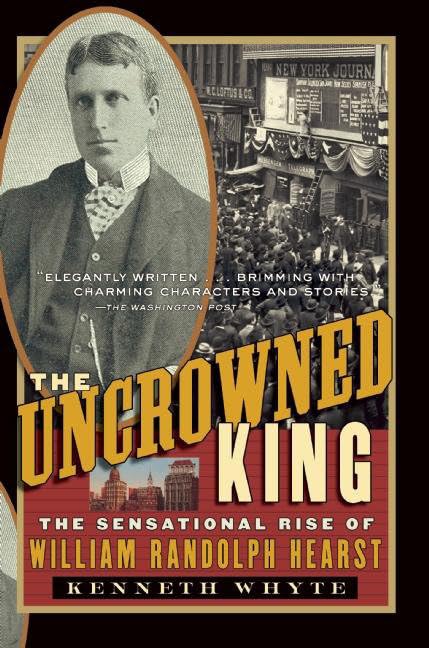
The Uncrowned King: The Sensational Rise of William Randolph Hearst
by Kenneth Whyte
Counterpoint (8 December 2009)
What’s it about?: Kenneth Whyte‘s biography of William Randolph Hearst, focusing on the years of his takeover of New York magazine. It attempts to challenge the popular image of Hearst as a ruthless mogul and media tycoon, to present the man behind it all.
My opinion: One might wonder why the world needs so many biographies of William Randolph Hearst. And there really are many; the man’s life and times have been exhaustively documented, with a whole wave of books on him during the 2000s. Then again, there is a lot of ground to cover with him; the man who fought his business rivals to establish a media empire the likes of which nobody had seen before. One can also have different perspectives of a complex man whose private life goes beyond the public image of a ruthless businessman.
The Uncrowned King is definitely worth the time, and for good reason. While the popular image of Hearst is one of power, recklessness, ruthlessness, and egomania, Whyte is attempting to portray him as a far more complex man, far more than just a greedy tycoon. He may have been that tycoon, yes, what with his highly publicised battles with Joseph Pulitzer, Orson Welles, and others. But he was also someone who gave a voice to the voiceless — farmers, immigrants, the working class, and got them reading more. David Nasaw attempted something similar with The Chief, another biography that challenged the entire Hearst mythos. Take your pick as to which text does it for you.
I should point out that The Uncrowned King is not a comprehensive biography of Hearst, but focuses mainly on two key events: the 1896 presidential election, and the Spanish-American War. For all the criticisms of Hearst as a ruthless tycoon, he identified strongly with William Jennings Bryan‘s opposition to the anti-labour lobbyists that supported William McKinley. Was there any conflict of interest, given the Heart’s family’s interests in silver mining at the time? Was it also good for business to have the Examiner and the Journal uniquely supporting Bryan? Probably yes and yes, but Whyte asserts it’s a mistake to assume it was all about silver.
One of the biggest misconceptions people have of Hearst comes from the Spanish-American War. For the longest time, it was believed that he supported the war only for the sake of his papers’ circulation. James Creelman’s infamous “I’ll furnish the war” quote, for instance, which was taken as gospel for a time. There was just one small problem: it was made up. What many historians refuse or forget to acknowledge was that Hearst wanted the Spanish out of Cuba, as he saw their forces as leading only to further bloodshed (and they would have exterminated the Cuban people if allowed).
His papers were tabloids, and he may have pandered to the working class for personal gain first and foremost. But is that really the worst thing? Given how things were in the 1890s through the early twentieth century, I look at Hearst and kind of think he’s the villain I’d want on my side. What were the alternatives? Pulitzer? And given how things are now, I kind of want to hear what Hearst might say about the cost of living, opioid crisis, and the endless funnelling of U.S. taxpayer money into Ukraine and Israel.
In short, he wasn’t Charles Foster Kane… not entirely, anyway.
If you’re looking for a new perspective on this particular breed of capitalist, one that challenges some of the assumptions historians have taken for granted over the years, The Uncrowned King certainly does not disappoint.
 Lawrence Deveney