
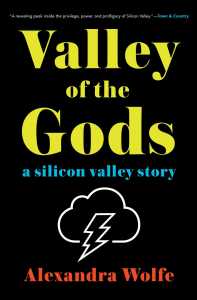
Valley of the Gods: A Silicon Valley Story
by Alexandra Wolfe
Simon & Schuster (10 January 2017)
What’s it about?: A history of the youth who come to Silicon Valley in Northern California to change the world and make billions of dollars. An expository work of sorts, on the men and women – migrating from cities, states, and continents – who make up the Valley’s elite class.
My opinion: This could have and should have been an awesome book. Unfortunately, it misses. It really drew me in at first, because I find Peter Thiel fascinating, and needed a bird’s eye view of the microcosm of the Valley, and the “eternal freshmen herds” who make up the Thiel Fellowship. This fellowship offers students aged 22 and under USD $100,000 for two years to skip mainstream education and pursue alternative forms of work or research. Whether these people are placed in startups, secure funding for their own companies, or do cutting-edge research, they aspire to move beyond a sense of self prescribed by traditional institutions (i.e. Ivy League universities) and make the world a better place while they do it.
On one hand, Valley of the Gods shines a light on the everyday happenings of this world. A glimpse of what really goes on in terms of finding ideas and testing them, financing companies, et cetera. It gives you a sense of what motivates these freshmen herds, beyond simply making billions. You almost get the feeling that it’s building up to something more.
Unfortunately, it’s all over the place; essentially a series of one-note observations thrown together, and very little ties them together. This is possibly due to the general tone of the book going in – casual and in-jokey. The observations come and go, before circling back to the main focus, which is the throngs of Thiel Fellows. Yes, it is amusing to hear about the loose-fitting t-shirts and jeans, peanut-butter-and-jelly sushi rolls, the bizarre training regimens, the parties, and the dating scene in every corner of the Valley. However, it would have been nice to have a more consistent focus on Thiel himself, given that he’s the one presiding over this whole thing.
The book concludes that not every Thiel fellow hits that Facebook-like home run. In fact, the ones who even come close are exceedingly rare. Most end up returning to mainstream education and work. On this, Wolfe writes, “The Thiel fellowship was a microcosm of the millennial generation. It said, ‘If you’re so good, let’s take the best and brightest among you and see if you can prove it’–and maybe the fact that they didn’t start billion-dollar companies didn’t matter.” Perhaps the experience alone made it all worthwhile. After all, applying for the Thiel Fellowship is a whole different game from your standard educational scholarship.
While the culture surrounding Silicon Valley is certainly fertile ground for observation and humour, Valley of the Gods struggles to get beyond its string of nerd culture anecdotes and cliches, making for a fragmented reading experience.
 Lawrence Deveney