
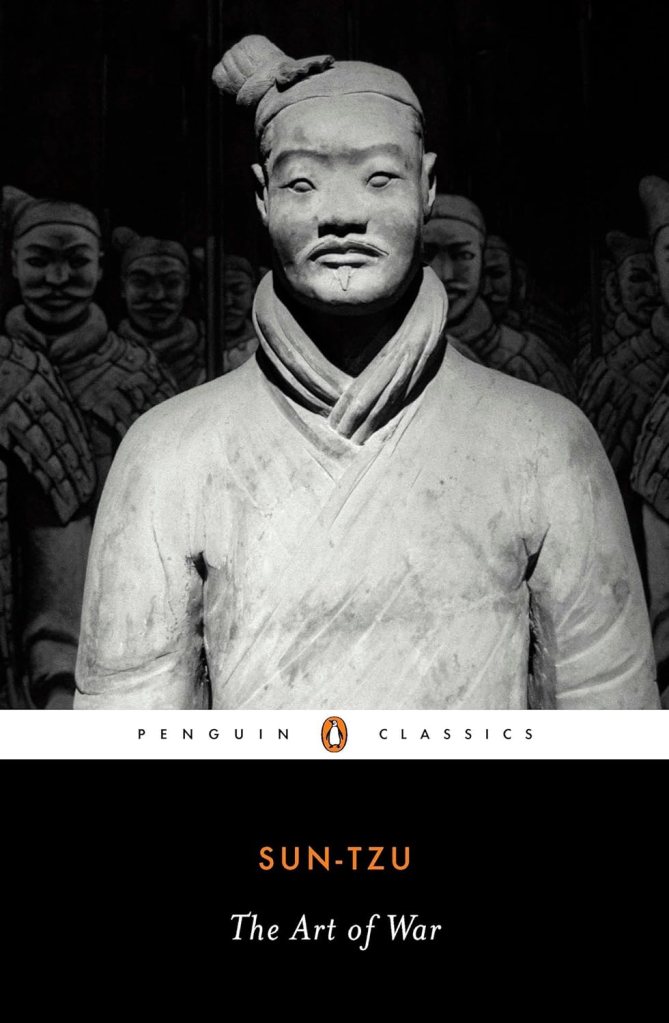
The Art of War: The Essential Translation of the Classic Book of Life
by Sun-Tzu (translated by John Minford)
Penguin Classics (14 July 2009)
What’s It About?: Sun-Tzu’s classic treatise on military strategy, studied and widely applied by military, financial, business, and political leaders around the world.
My opinion: This book is a classic for a reason. There is something I love about these texts being essential reading not only for war and war strategy, but for work, relationships, and everything in between. Which seems funny at first, because I don’t exactly think of my life in militaristic terms. But then I realise that war doesn’t exist in a vacuum. It is the human condition in many ways, and you can see how these things work in everyday interactions.
There are many things you can take from The Art of War, but I want to focus on just one:
“All warfare is based on deception. Hence when able to attack we must seem unable. When using our forces we must seem inactive. When we are near we make the enemy believe we are far away. When far away we must make the enemy believe we are near.”
“Appear weak when you are strong, and strong when you are weak,” Sun-Tzu goes on to say. It’s one of those passages that manages to be overrated and underrated at the same time. Overrated because people almost deliberately miss the point, focusing on a particular definition of deception and hypertrophying it. Underrated because that makes us miss the important message.
There is a negative connotation with the word “deception,” especially when viewed from a Western sense of self. That is, the Judeo-Christian worldview of good and evil. This might be why The Art of War has a reputation as being a guidebook for conniving and deceiving your way to the top, much like Robert Greene’s The 48 Laws of Power (both books are regularly seen in “top books for entrepreneurs” lists). However, from an Eastern cultural perspective, life isn’t that simple. Things are not black-and-white, there are many gradients, and feints and disguises may be a necessary part of strategy. Transcending the selfish ego, and all that.
I would interpret it as reality being different from appearance. And, if conflict is a construct of the human mind prior to any physical conflict taking place, then it makes sense to control one’s perceptions instead of trying to always control situations by force. Otherwise, you’re putting the battle armour on before you go about your work, and that’s the last thing I want to do. It doesn’t necessarily have to be about conflict, either. It could just be competition and comparison in life and work, individuals scrambling to make their mark in whatever field they’re in.
Teaching, for example. When I started my placements years ago, I felt like I was in a constant rush to tick all the boxes and do all the right things. And yes, it is good to meet targets and be good at your job. I won’t argue that. However, over time, my priorities had less to do with my class English having the highest study score and more to do with teaching with a focus on advocating for continuous learning. Process-oriented practice, rather than goal-oriented. You can pause and steady yourself, while others are running at full pace.
Now I’m going off topic.
Understanding the difference between appearance and reality, between perception and observation, and using these distinctions to inform your decision-making process. That is how I interpret warfare being based on deception.
And that is why I love The Art of War. There are, of course, other observations, some more valuable than what I’ve cited. They might work for you, they might not. Every time I re-read this text, I always see something that I hadn’t noticed during previous readings.
Minford’s translation has been my go-to for years, but if there’s a better one out there, drop me a line.
 Lawrence Deveney