
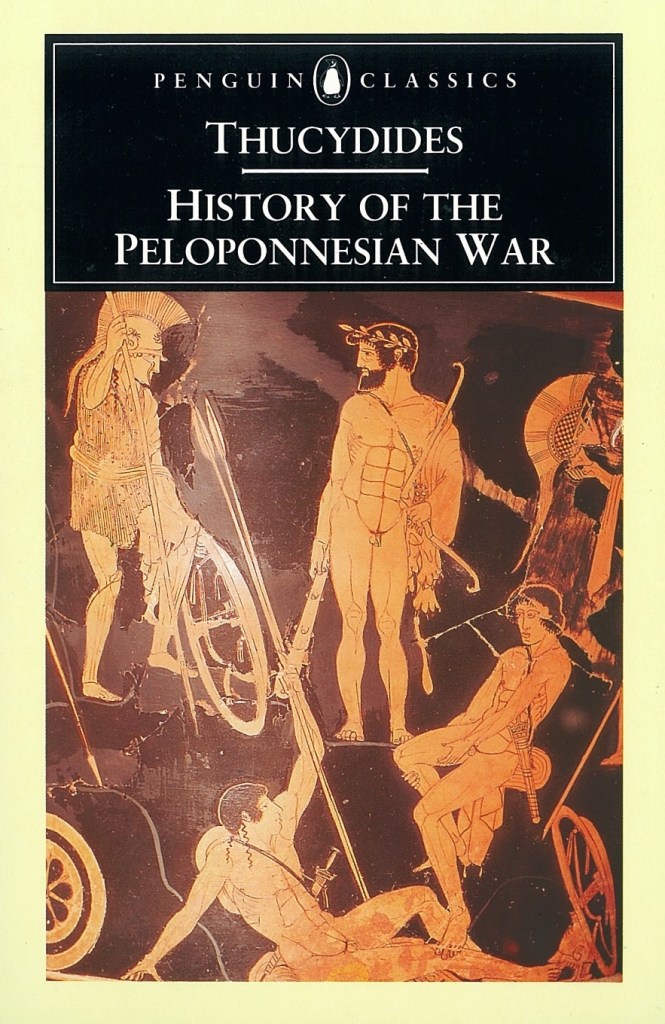
History of the Peloponnesian War
by Thucydides (translated by Rex Warner)
Penguin (31 December 1963)
What It’s About?: Thucydides‘ historical account of the Peloponnesian War (431-404 BCE), fought between the Peloponnesian League (led by Sparta) and the Delian League (led by Athens). The author served as an Athenian general during the war, a long and bloody process that ultimately ended with Sparta’s victory. Translated by English classicist Rex Warner.
My opinion: Awesome. History of the Peloponnesian War seems like a really dense text, and it can be a lot to digest. But there is a reason why countless people — military, economic, and political leaders, and ordinary people alike — have read it over the last two-thousand years, in order to better understand war, military strategy, politics, and life. Just look at the impact it has had on the modern Western world. It’s required reading in military academies at West Point and Annapolis. People in the U.S. State Department have read it to get a better grasp on the rising military threat presented by an increasingly powerful and ascendant China. For an ancient text to have such broad practical application today is very, very incredible. A truly timeless work.
There is just so much to this text. The Melian Dialogue, the defeat of the Athenian fleet at Syracuse, the betrayal of Athens by Alcibiades, and much more. But if not for anything else, read it for “Pericles’ Funeral Oration,” an eminent Athenian statesman’s speech, delivered at the end of the first year of the war. Thucydides was there for it, and that’s partly why this book is so incredible. Differing from the traditional method of Athenian funeral speech, Pericles eulogises Athens itself, as well as those who fought while also glorifying their accomplishments, to inspire the people in a time of conflict. The man practically invented Western-style public speaking. John F. Kennedy’s “Ask not what your country can do for you,” Martin Luther King’s “I have a dream,” Barack Obama’s “Yes we can!” and just about every famous speech from history’s movers and shakers are all rooted in this rich tradition.
People might disagree with me on this, but you almost have to learn Thucydides in a classroom setting, simply because there is so much historical context that goes into reading him. Years ago, I had the luxury of learning the text from Victoria Fritze, who taught Classics at the Centre for Adult Education in Melbourne. She brought it to life in a way I have not experienced since. We read it as part of a syllabus that included Homer’s Iliad, and the plays of Aeschylus, Euripides, and Sophocles. Thucydides came in around the end of that year. The heroic code, civics and governance, the cultures of Athens and Sparta, democracy and freedom were themes that could be discussed at length for days. I cannot emphasise enough how incredible this learning experience was.
So, I highly suggest reading Thucydides’ History of the Peloponnesian War. Read it, learn from it, and apply the lessons learned to the situations you face today. That’s what you want in a historical text — a way of understanding the present through historical example(s).
It’s a lot to digest, but it’s worth reading for any citizen of a democracy looking to learn about how civil society can completely break down.
A fascinating read, and probably one of my favourite non-fiction books ever.
 Lawrence Deveney