
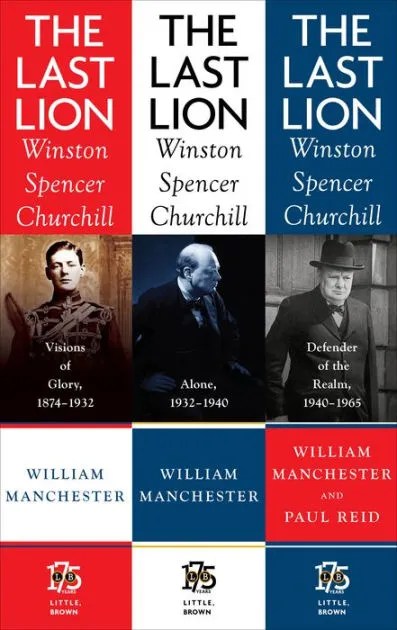
The Last Lion: Winston Spencer Churchill, 1874-1965
William Manchester and Paul Reid
Little, Brown and Company (6 November 2012)
What’s it about?: A trilogy of biographies covering the life of Winston Churchill, British statesman, solider, and writer. The first two volumes were published in the 1980s. Author William Manchester passed away while working on the final volume. Paul Reid was selected to complete it.
My opinion: What an epic set! Very well researched, it could easily be the definitive biography of Winston Churchill. The life and times of a complex political figure, with plenty of historical context woven in to really help you understand not only the man himself, but the United Kingdom and how it figured in the world at the time. The peerage system and its history, the Victorian era, the British empire and colonialism, war, international relations, morality, and Churchill’s childhood and education are all explored in depth in this trilogy.
Each of these volumes are excellent. The first, Visions of Glory, is all about Churchill’s early life and military career. Growing up with abusive parents, peers, and educators (his temper tantrums in adulthood start to make more sense). And then, his time spent in India, Afghanistan, and South Africa, before his journey into politics. Do not be deterred by the lengthy prologue on the Victorian era, because once you get past that, the text starts to pick up in a big way. The second volume, Alone, is where it really starts to get interesting. Taking place during Churchill’s so-called “wilderness years” out of government, he spent a good deal of time writing and reflecting, prior to his leading position in calling for British re-armament to counter the threat of militarism in Nazi Germany. And Churchill’s election as prime minister and his involvement in the Allied war effort against the Axis Powers makes up the third volume, Defender of the Realm. After that, only a small portion of this volume covers the remaining years of his life, post-WWII.
For all his flaws (which were many), Churchill’s return to politics and leadership against a more heavily armed and ascendant Nazi Germany is nothing short of mind-blowing. His objections to some of the Allied invasions don’t exactly stand up to scrutiny (e.g. Operation Torch), and Manchester makes this very clear. And this is what a such a biography should be. Not simply history summarised in textbooks, but history as seen through the lens of somebody who lived through those times. Someone who was more than just a mythologised, cigar-chomping icon of the twentieth-century, but a human. And while this trilogy is not Churchill’s words exactly, Manchester’s third-person account gives the reader valuable insight into these times nonetheless.
It might not be the first choice for academic historians, but for the WWII- and Churchill-obsessed, or people who just want awesome books, The Last Lion is essential reading. The depth of Manchester’s research and his account of Churchill’s life, with so much history interwoven, make this trilogy something really special. He was not able to finish the third volume, but Reid does nicely in picking up the pace. Not a bad effort at all. I can see why he was chosen to finish it; his writing style is a solid match, albeit with less of the commentary and critical analysis that made Manchester such an awesome biographer.
I try to use the word “epic” sparingly, but I can’t think of any other word to describe The Last Lion. It is a marathon, spanning three-thousand pages across three volumes, and well worth the effort. Once you get started, the text just flows. Highly recommended.
It was also my introduction to William Manchester as an author, and with that, I would also recommend his biography of Douglas MacArthur, American Caesar.
Clementine: The Life of Mrs. Winston Churchill by Sonia Purnell also makes for an excellent contrasting piece.
Happy reading.
 Lawrence Deveney