
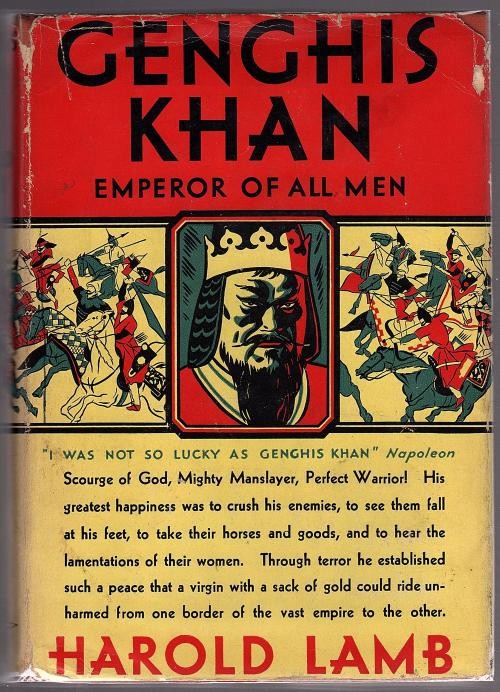
Genghis Khan: Emperor of All Men
by Harold Lamb
Amereon Press (12 October 1927)
What’s it about?: Harold Lamb‘s biography of Genghis Khan, founder and first khan of the Mongol Empire. It details the leader’s life and conquests, and analyses his legacy.
My opinion: A strange text. It excels in some areas, yet falls flat in others. It’s well-written, an engaging text on one of history’s most notorious leaders. If you were to ask me where to start on the history of Genghis Khan, I would recommend it first, since it flows and doesn’t demand much of the reader. But overall historiography is where the text starts to have problems.
In Genghis Khan: Emperor of All Men, Lamb paints the Mongol leader not simply as the warrior who conquered half the known world (though he certainly did that), but as a human. Someone who was not born a killer, but someone who grew up in harsh conditions and responded to his environment. Lamb has an extraordinary ability to bring historical characters to life, and this is simultaneously a strength and a weakness. While the text is well-sourced in some parts, Lamb also imagines what life would have been like for his subjects in others. One might see this as replacing facts with fiction, and you may be right in saying that. Apparently this was common with many historians of that era, with many historical texts becoming works of narrative nonfiction, or historical novels. Which isn’t the worst thing in a book, but if you’re looking for a more comprehensive discussion of sources, this text comes up lacking.
This could be due to Harold Lamb’s background as a novelist. He wrote novels and short stories for years before writing his first work of historical nonfiction, Genghis Khan: Emperor of All Men. His interest in Asia and the Middle East drew him to the Mongol leader (fun fact: the novel The Three Palladins tells of a young Khan, told from the perspective of a childhood friend).
One strength I found in the text is the way Lamb makes references to World War I. Having first hand knowledge of what went on during that time, he’s able to discuss aspects such as genocide, and all manner of war crimes and atrocities, and how all of this contrasts with Mongolian military history. His research on Mongolian law and governance is also impressive. Lamb’s account of Khan’s early life is well-rounded in terms of both research and overall storytelling ability, which gave me a much better understanding of the man. It’s just that elsewhere in the text, this depth of research is inconsistent. That being said, the basic timeline of events more or less holds up, and I found it interesting enough to hold my attention from start to finish.
Whether you’re horrified by the destruction left in Khan’s wake, or amazed by the Mongol horde’s organisation and its legacy throughout subsequent generations, Genghis Khan: Emperor of All Men is a decent starting point.
But for something more academic and comprehensive, look elsewhere.
 Lawrence Deveney