
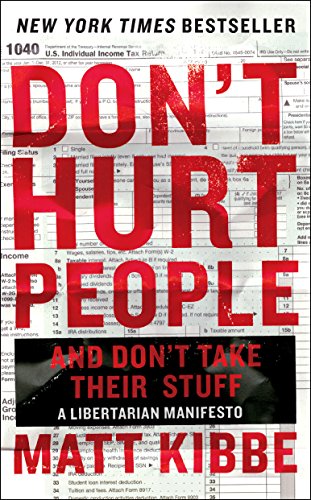
Don’t Hurt People and Don’t Take Their Stuff: A Libertarian Manifesto
by Matt Kibbe
Harper Collins (24 March 2014)
What’s it about?: The unofficial official manifesto of the new libertarian movement, by American community organiser Matt Kibbe. It makes the case for small government, freer individuals, voluntary cooperation, and solving problems from the bottom up as opposed to social engineering from the top down. Kibbe’s basic rules for libertarianism are:
1. Don’t hurt people. Free people just want to be left alone, unfettered by the designs and agendas of others.
2. Don’t take their stuff. Property rights are serious business; America’s founding fathers fought for the individual’s right to enjoy the fruits of their labour.
3. Take responsibility. Responsibility is the better part of freedom; don’t wait for somebody to come along and solve your problems.
4. Work for it. Hard work brings success; cause and effect.
5. Mind your own business. Live and let live, provided what you’re doing does not infringe on the liberty of others.
6. Fight the power. Stand against corrupt, overreaching authority.
These rules are consistent with Murray Rothbard‘s non-aggression principle, that “the fundamental axiom of libertarian theory is that no one may threaten or commit violence (‘aggress’) against another man’s person or property.” From this principle comes the conclusion that the state must be limited in size and scope. A federal government exists for two reasons: One, maintaining a stable currency, and two, a charter of human rights. Beyond that, the state has no business interfering in the lives and affairs of individuals.
My opinion: For starters, the title was enough to draw me in. Sure, you have the theories of Friedrich Hayek and Ludwig von Mises, and the whole Austrian school of economics provides a theoretical framework for classical liberalism and has produced some works. However since there’s no official, definitive treatise on new libertarianism to rally around, it’s good to have Kibbe’s work to refer to. Definitely written for the layperson more than the academic, but that’s totally appropriate in this case. The basic tenet of the text can be summed up with this quote:
“Government should be limited, and it should never choose sides based on the colour of your skin, who your parents are, how much money you make, or what you do for a living. And it should never, ever choose favourites, because those favourites will inevitably be the vested, the powerful, and the ones who know somebody in Washington, D.C.”
To paraphrase P. J. O’Rourke, I’ve always seen the United States of America as being this sort of drunk uncle figure to Australia. Both countries are wrought with political division, and extreme partisanship. Whether it’s the outrage and sanctimony-driven shaming of the left, or the law of the gang that defines the new right, you have an environment where people are easily riled up, and if you’re not with them, you’re against them. And then there’s libertarianism, which may well be just another faction banging their pots and pans in the mix. They all have their creeds and manifestos, and Don’t Hurt People and Don’t Take Their Stuff makes for a concise introduction to libertarianism.
And I want to be perfectly clear about this: Kibbe is not pushing for some dystopian Bitcoin gambling anarchy where we all use cryptocurrencies to buy as many guns, drugs and hookers as humanly possible (although, in theory, a libertarian would neither support nor oppose such an endeavour). Rather, the text concerns itself with the argument that concentrating too much power in one place (i.e. large, federal government at the expense of smaller, regional governments) is antithetical to the libertarian idea of individual liberty above all else. It makes for a highly fragile system and is prone to abuse, while decentralising power and empowering local and regional governments is better for everyone (more or less). Other libertarians have a more hardline stance, advocating for the complete abolition of income tax and social services, policies which even the most staunch Republicans would consider to be fringe at best. But that’s not what Kibbe is aiming for here.
Some government departments and programs are money pits, I’ll grant Kibbe that. Maybe even most. Still, I wonder: What about the disadvantaged? For example, what is the libertarian position on indigenous rights and sovereignty? Would a freer country increase economic and social mobility for Aboriginal Australians, or Native Americans? This is where that whole notion of personal responsibility can become a thought-terminating cliche for opponents of libertarianism, especially those who are more left-leaning. And it’s not hard to see why. Telling people to “just pull yourself up by the bootstraps” doesn’t always cut it. To that, Kibbe asks, “Can you mandate compassion? Can you outsource charity by insisting that the political process expropriate the wealth of someone you don’t know to solve someone else’s need?” And maybe you can’t. But that’s libertarianism, where you either believe in individual liberty or you don’t. This theory purportedly “defends ‘the minority,’ the opportunity to work for it, the ‘underclass’ with absolutely no political pull, the unconnected, and the rights of every single individual to make it. Liberty is colour-blind. Liberty is a merit-based system, and blindly measures all of us based on the content of our character.”
All of this is more of a what than a how; then there’s the whole meritocracy debate. You could argue about that until the sun comes up, but I tend to think that if one should pull themselves up by the bootstraps, then the bootstraps should be reasonably priced. But that’s just me.
I’m not diametrically opposed to Kibbe’s political philosophy, and he’s no dummy. He talks a good game, and a system of limited government sounds great in theory, but then, everything sounds great in theory. What a libertarian government would look like in practice is anyone’s guess, in terms of what it entails and the philosophy being employed. Kind of like those socialists on university campuses whose untested, unfalsifiable model of socialism is somehow the key to our salvation. That, and the assumption that people will just do the right thing on principle alone. Argentina and El Salvador have been forming new governments with strong libertarian leanings, but we’ll have to wait and see how that all works in the long term. They could end in complete disaster (or they could turn out great). And, if the collapse of FTX and Monsanto’s domination of the U.S. food supply chain are anything to go by, then maybe you can start to see why some regulations are necessary.
Where I would argue in favour of a small government is on social issues, rather than economic, or things that people are quick to deem “right” or “wrong.” Do you oppose same sex marriage? Fine, don’t marry a gay person then. I don’t smoke cannabis; never really have and I don’t quite see the point. Sometimes, I wonder if the reasons given for legalisation/decriminalisation have strayed from the principles of responsible, medicinal use. However, does this mean I want people thrown in prison for carrying a dimebag in their pocket? No, not at all. Let them do their thing, and have the authorities focus on real crimes for a change. I will not actively support or oppose anyone lighting up, and I cannot justify taking any deliberate action against them.
Or, consider the military and defence spending. To quote the philosopher Nassim Taleb, a government’s defence budget should be for “when you defend your country at, or near, your borders. Not when you fight people several time zones away.” This also comes back to the non-aggression principle, where action should only be taken when individual freedoms are threatened.
I can see where Kibbe is coming from. He survived a long and excruciating battle with cancer — and the U.S.’s convoluted healthcare system and regulations — earlier in life, an experience that influenced his libertarian beliefs. That, and his love or Objectivist prog-rockers Rush would have been a key influence when he was younger (particularly the 2112 album). Nothing in this text can really be called extreme, at least not when compared to actual fringe groups that exist today. In fact, I agree with the basic tenet of this new libertarianism. Don’t hurt people, and, don’t take their stuff. Pretty simple. This is why I consider myself to be libertarian at heart. It’s only when I start to dwell on the specifics that I find myself with more questions than answers.
All that being said, I can think of far more dangerous ideologies, and I recommend Don’t Hurt People and Don’t Take Their Stuff to anyone looking for a concise introduction to libertarianism.
 Lawrence Deveney