
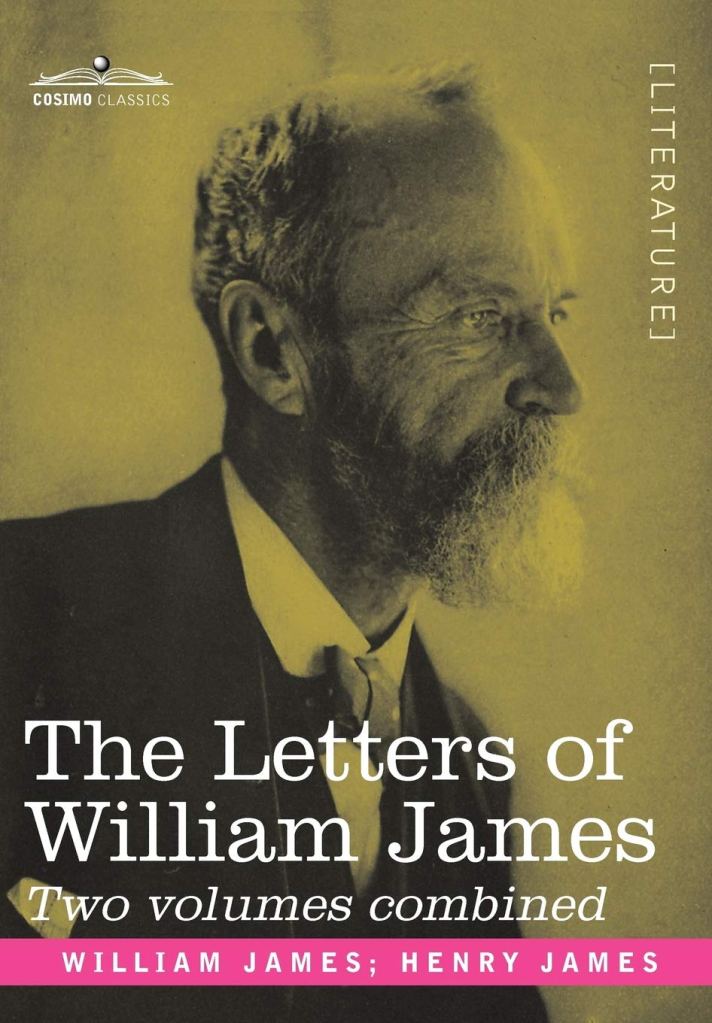
The Letters of William James: Two Volumes Combined
by William James and Henry James
Cosimo Classics (31 October 2008)
What’s it about?: The correspondence of American psychologist and philosopher William James, who offered the first psychology course in the United States. He published many works, most notably The Principles of Psychology and The Varieties of Religious Experiences. He was also the brother of novelist Henry James. His son (also named Henry) edited these letters. Originally published in two volumes, these letters span William’s life and career, written to friends and family, and the likes of Hugo Münsterberg, George Santayana, H. G. Wells, John Jay Chapman, Henri Bergson, and John Dewey, just to name a few.
My opinion: I already knew of the elder Henry James going in, since I read Washington Square in one of my undergraduate subjects. William James would get a mention now and then, and the relationship between the two brothers became something of interest. That, and I like collections of letters, so The Letters of William James seemed like a natural addition to the collection. What I found was a man who truly loves life, his family, and his friends. His relationships with his colleagues and contemporaries are fascinating to explore, and his perspectives on science, metaphysics, philosophy, theology, and all manner of subjects are invaluable. Letters written during his travels — across Europe and South America — chronicle his intellectual growth and development. It’s easy to start at the beginning and read through these letters as a whole text. They don’t need much in the way of notation or editorialising. There are some introductions that provide some context, of course, but that’s fine.
William James is known for his concepts of stream-of-consciousness, pragmatism, empiricism, and other schools of thought, and I was blown away to learn that he was hugely influential on fields that I’ve taken for granted throughout my studies and career as a teacher. “My system is Tychistic, pluralistic,” he explains. “A philosophy of pure experience.”
One really cool quote, that can be found in his 1895 letter to E. L. Godkin:
“We are all ready to be savage in some cause. The difference between a good man and a bad one is the choice of the cause.”
This can be applied to just about anything in recent history, like when Peter Thiel secretly funded Hulk Hogan’s lawsuit against Gawker Media. Or, his support of Donald Trump’s 2016 United States presidential election campaign, which he would later regret to some degree. Another example would be when Silk Road founder Ross Ulbricht took his own libertarian-inspired stand for liberty by disrupting the ways individuals could purchase illegal drugs for personal use with an online marketplace. From his apartment, with only his laptop, Ulbricht took his stand, ultimately ending up in a federal prison cell. Whether you admire or condemn what he did, you can’t deny he was all in, whatever the consequences. There are those who believe he should be freed, or at the very least, given a reduced sentence. It could also apply to all those free speech guys putting up alternative platforms, which always seem to crash and burn spectacularly. For them, I might recommend considering J. D. Salinger purportedly quoting Wilhelm Stekel as well: “The mark of the immature man is that he wants to die nobly for a cause, while the mark of the mature man is that he wants to live humbly for one.”
Were Thiel, Ulbricht, and all those free speech guys really in the business of helping others with their endeavours, or were they all about themselves? I can’t say for sure, but one could draw some parallels with James’s position on savagery for the cause. It’s definitely fertile ground for discussion.
The very last letter makes for one incredible ending. To Theodore Flournoy in 1910, William James laments, “I can write no more, my very dear old friend, but only ask you to think of me as ever lovingly yours.” And those were the last words, of the last letter he wrote, a little over a month before his death in August of that year. This is something you rarely see anymore, if ever. You sure as hell don’t see this kind of emotion on Reddit or in comment sections. The emotionally-crafted, handwritten letter is truly a lost art, and this collection does not disappoint.
Highly recommended for anyone wanting to learn more about William James. Particularly, how he grew and developed in his thoughts and perspectives, his views on human emotions, and his relationships. Awesome!
 Lawrence Deveney