
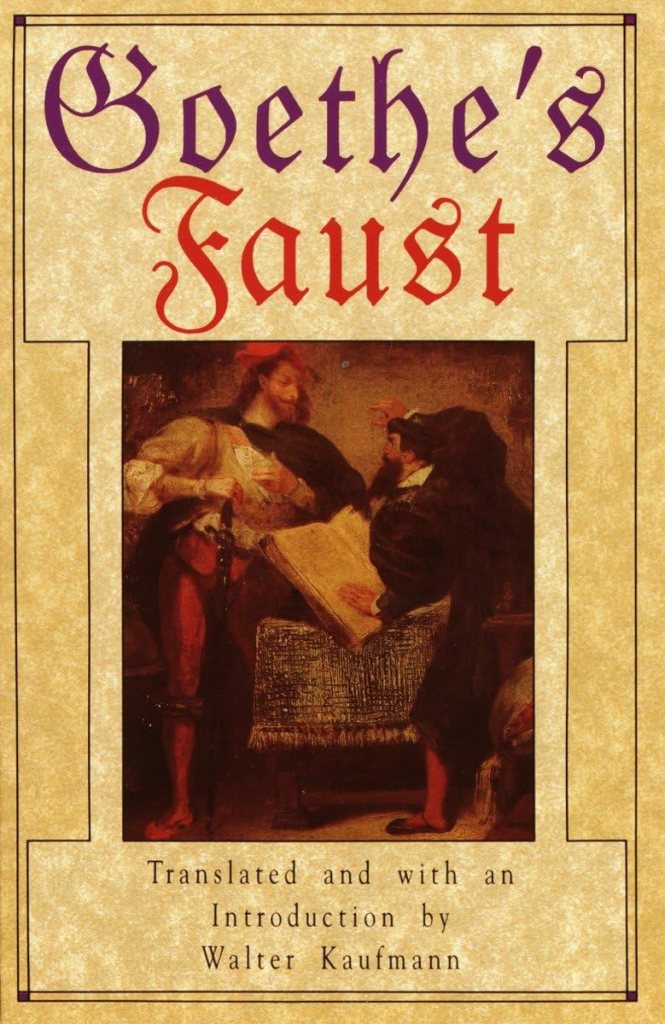
Faust
by Johann Wolfgang Von Goethe (translated by Walter Kaufmann)
KNOPF US (31 March 1999)
What’s it about?: Goethe‘s tragic play, Faust, in a volume providing the original German text, with philosopher Walter Kaufmann‘s English translation on the facing pages. Based on a traditional theme of making a deal with the devil, Mephistopheles, and the tragedy of Gretchen. And then, ultimately, a resolution. It is considered to be a significant influence on German thought and literature. Kaufmann’s translation is considered to be one of the best English translations available, while this edition itself includes Part I, and selections from Part II.
My opinion: Faust follows the tendency of many works of German classicism in that the protagonist, story and themes are presented in a highly complex manner. Friedrich von Schiller and Goethe being two of the leading figures in the eighteenth- and nineteenth-centuries. Themes of ethics and spirituality serve as a springboard, raising question after question. In the case of Faust, the reader is left to draw their own conclusions on the humanity of the protagonist Heinrich Faust and his salvation.
What’s interesting about this edition is that we get the first part of the text, while the second part is abridged to the point where it’s essentially an appendix. This is probably due to the problems translators have had with this part. The story is all over the place, scenes change so frequently, and characters come and go in a way that would make Rian Johnson blush… or so I’m told. It took a lifetime to finish and was published posthumously, so it’s safe to say a lot went into it. I’d like to unpack Goethe’s exploration of classical themes and his meditations on the good life, because his Classicism and exploration of human relation to God(s) as a contrast to the Romanticism of his era is a rabbit hole I could easily get lost in. However, I can understand translators being reluctant to approach it. “To let Goethe speak English is one thing,” Kaufmann said of his decision. “To transpose into English his attempt to imitate Greek poetry in German is another.” I’m not going to argue. Such a thing could be the most beautiful thing in all of literature if done well, and a complete dumpster fire if done poorly.
My German is non-existent, so I can’t say how well Kaufmann’s translation compares to the original text, but as a reader, I found it flowed beautifully. Seeing the original text on the opposite pages is cool. I don’t know why, but I like having the text that way. Goethe scholars seem to think it’s great, so there’s that too.
Faust is still a great read. I wish I could have more of Goethe’s meditations on psychology, history, politics, and ethics, but I am still very happy with this volume
 Lawrence Deveney