
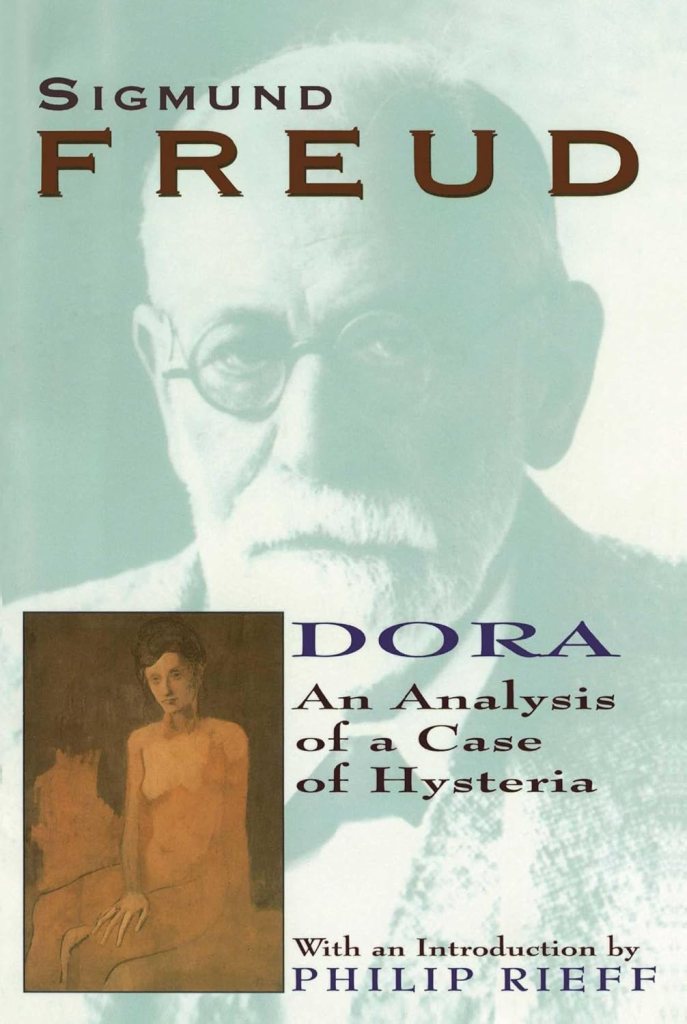
Dora: An Analysis of a Case of Hysteria
by Sigmund Freud
Touchstone Books (1 November 1997)
What’s it about?: Sigmund Freud’s case study of a teenaged girl diagnosed with “hysteria.” Her real name was Ida Bauer, but she was referred to as “Dora” throughout the text. This study is (in)famous for Freud’s exploration of Dora’s personal life, the people in it, and the factors that he believed contributed to her mental condition. Her father, her mother, her father’s lover, and an older man who pursues her sexually.
My opinion: Pretty much what I expected. I first encountered Freud when I studied Philosophy and Psychology years ago. He was referenced in literary criticism many times. I read a few extracts of his works, so when I got started in Dora, I knew his language would be loaded with patriarchal and bourgeois nonsense. I suppose we can forgive him that, being a product of his time. Attitudes towards sex and gender back then were… different, so it’s probably best if we try and approach him with this in mind.
Freudian theory is not necessarily wrong or bad, but a lot of it depends on how you read him. His contributions to psychology include the study of the subconscious and various mental defence mechanisms, which are still discussed today in various contexts. He was fond of explaining things by way of analogy. Elements of personality such as the id, ego, and superego make for an interesting metaphor, at least. You have the Promethean fervour that influenced Joseph Campbell so profoundly when he laid out his character archetypes in The Hero with a Thousand Faces, which in turn inspired the likes of George Lucas, and generations of writers to follow. And, broadly speaking, just generally picking apart the Enlightenment-era notion that humans are rational animals taking pride of place at the centre of all things, so credit where it’s due.
I tried to keep an open mind when reading Dora. It was hard, and looking at how he approached his subject, you can see why. I try not to do that thing where we condemn yesterday’s thinkers by today’s morality, but Freud’s theories and methods are something else. Things like the Oedipus complex, or penis envy are more truthful than they are factual, which doesn’t count for much in psychology now. For example, his assertion that Dora’s “no” meant “yes,” like she was the problem. Which may very well be reflective of society’s attitudes towards women at the time, and you can see just how far we’ve come since then, hopefully. Actually, for all his merits, the more I dwell on examples like this, the happier I am that he’s been relegated to the English and Philosophy curriculums, along with other social scientists. Happy, in the same way I’m happy ethics committees exist today, or that my family doctor never prescribed cupping as a treatment when I had pneumonia as a kid. Might seem like a good idea that’s rooted in tradition; does next to nothing to make you better.
Dora does not read like a clinical report on the interactions between a psychologist and their patient, but like a poorly-conceived fanfic made up of connections between disparate details. Freud studied Dora’s situation, then created a narrative to explain it all: That she wanted sexual relations with the older man, her father, and her father’s lover. Fascinating, except it was completely made up. Like if I said that if one has a strong, pronounced dislike of Wonder Bread, then they secretly want to fuck a loaf of Wonder Bread. Float that theory all you want, it’s still not science. Despite Freud disclosing that he altered “nothing of importance,” it still feels suspect. It’s no wonder Dora wasn’t buying any of it. It’s one of many reasons why Freud is considered pseudoscience in the Popper sense of the word.
Now, does this mean Freudian psychoanalysis is completely worthless and that we should just throw his theories out the window? No. Freud’s theories are conceptually interesting as a literary device, definitely, but nothing one would consider science proper, same with Adler’s individual psychology, or Marx’s dialectical materialism. The fields that now make up the humanities are great, and definitely have value. We just shouldn’t call them science, because they’re not.
[Aside: If you think I’m full of shit, this piece explains why Freud has effectively been debunked. Mark Manson’s piece on parenting techniques and personality is also worth a read for the non-scientist.]
One can’t help but feel for Dora. For all its flaws, this case study does provide some valuable insights into what a tumultuous environment can do to a young mind. Whether Freud intended for that to be a key takeaway or not is anyone’s guess. Problems forming and maintaining social relationships, risky behaviour–all of it starts at a young age.
It’s an interesting text, to say the least, depending on how you approach Freud and his work.
 Lawrence Deveney