
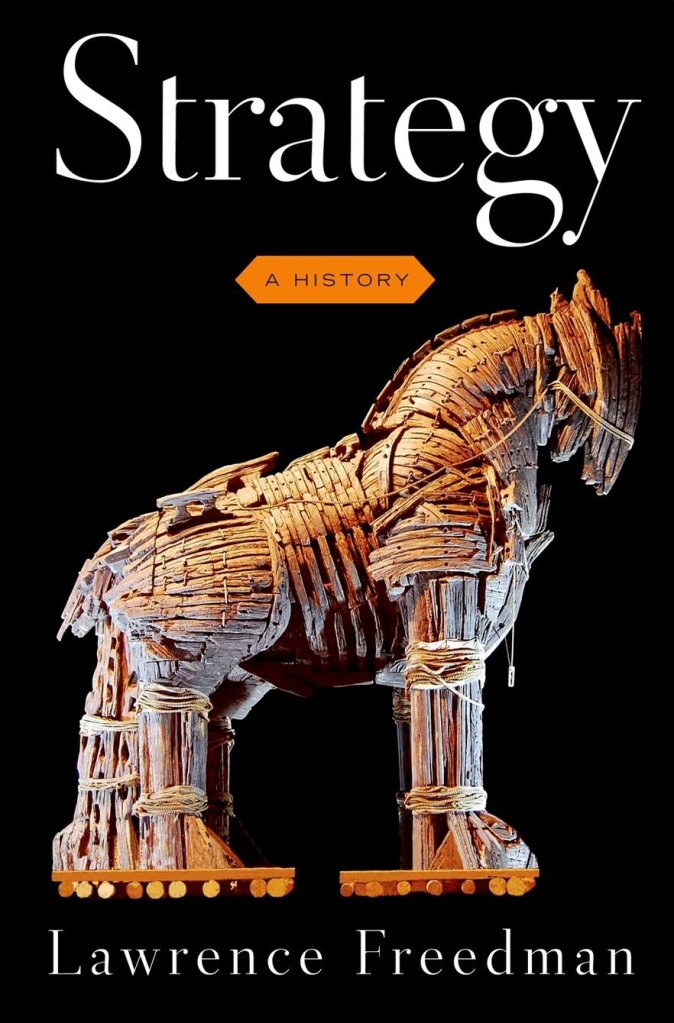
What’s it about?: The history of the concept of strategic thinking, ranging from primate warfare, to classical myths and legends of Greece and Rome, to the works of Sun-Tzu, Machiavelli, and Clausewitz, to Marx and Che Guevara, to big names in the corporate world like Henry Ford and Peter Drucker.
My opinion: If I had to recommend one book as a hub for dozens of sources on strategic thinking throughout history, it would be this. The author, Lawrence Freedman, is Emeritus Professor of War Studies at King’s College London, so it’s more than safe to say he knows his stuff. And it shows. Strategy is thick and dense, really showing how complex and convoluted history is. It can be overwhelming, especially if you are going through the text from start to finish, which is appropriate for something like this. However, one can also revisit parts and dip into it casually. However you’d like to approach it, the book accommodates.
My favourite quote, one that I find to be true in many things:
“Combining with others often constitutes the most strategic move.”
In almost any pursuit, or any line of work, one needs allies to achieve a common goal. This depends on having the right people around you, of course. When it works, creativity flows and great things happen. Everyone walks away better for it.
Strategy is not a history of military strategy in a practical sense, but of strategy in every aspect of our lives, to the point where it can feel more like an encyclopaedia than a work with one or two central ideas, signposted with examples. Freedman stresses that all environments are inherently unpredictable, which can serve as a theme, but even that’s huge. The scope of the text is vast, to the point where one can get lost in the reading of it. That being said, Freedman manages to strike a balance with it all. This is the product of two decades of writing and research, after all. And no matter where one is on the political spectrum, Freedman treats his subjects and their methods fairly, with little biographies for every person that comes up. I thought this was a cool touch. Given its scale and scope, most people would think it’s not a book for casual reading, but I’m not so sure. Maybe I’m weird, but I think it’s because of its density that one is better off dipping into it here and there.
Depending on your expectations and how you read history, Strategy: A History could either be a wonder to consume, or an author throwing everything he has at the wall and seeing what sticks. Either way, it’s one for the strategy-obsessed.
 Lawrence Deveney