
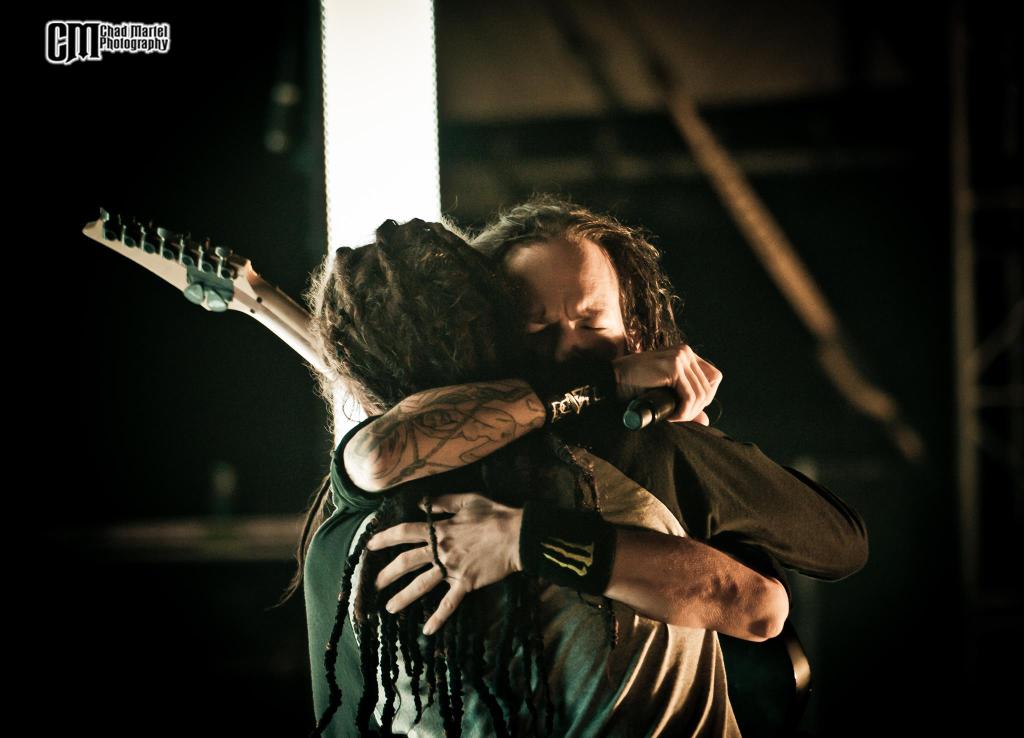
The first Korn album I listened to was Follow the Leader. I had just turned twelve, and the band were at the height of their popularity, thanks to the success of hit singles “Got the Life” and “Freak on a Leash.” But as great as that album is, it’s not my all-time favourite. That would be Untouchables.
To this day, when I tell people this, I’ll get some raised eyebrows. It is an unusual preference, I’ll grant you that. Released in June of 2002, Untouchables came out when Korn and the nu-metal sub-genre were declining in popularity. Its first single, “Here to Stay,” got some decent airtime. The album itself debuted at number two on the Billboard chart with 434,000 copies sold in its first week, coming second only to hip-hop legend Eminem, and his seminal third record, The Eminem Show. Things looked rosy for the first month or so, though soon after, the singles “Thoughtless” and “Alone I Break” didn’t have the same impact. By the end of the year, the album slid down the charts, only selling a few thousand copies per week.
But for me, Untouchables was and is the peak and pinnacle of all things Korn. The first album to be recorded in 24-bit sound with a 96kHz sampling rate, it had retained the band’s signature downtuned atmosphere, but with a level of polish and flare one would never have expected from the Bakersfield boys, possibly influenced by vocalist Jonathan Davis’s work on the Queen of the Damned soundtrack with Richard Gibbs. “Here to Stay” even won a Grammy for Best Metal Performance!
This is the hill I am going to die on. Although, I must acknowledge the album that started it all: Korn’s self-titled. The band’s founding musicians — James “Munky” Shaffer (guitar), Brian “Head” Welch (guitar), Fieldy (bass), and David Silveria (drums) — and Davis formed a hybrid sound that combined heavy metal with elements of hip-hop, funk, industrial, and grunge. This was not some forced attempt at fusion. It was the result of the band members’ natural chemistry, and would later be called “nu-metal” by the music press.
It was just what I’d been looking for. Something heavy and down-tuned, but not something that fell victim to the cliches and tropes of traditional metal. Something with a pop structure that’s melodic, but very densely layered. And, of course, from there I was introduced to the likes of Deftones, Limp Bizkit, Linkin Park, Papa Roach, Disturbed, Staind, Evanescence, Breaking Benjamin, and dozens more soundalike bands that made up the nu-metal scene. And from there, those who influenced my favourites, such as Nirvana, Alice in Chains, Led Zeppelin, Nine Inch Nails, Pink Floyd, Tool, Stone Temple Pilots… the list goes on.
For a time, nu-metal became one the most popular genres of music on radio, and one of the most reviled. It was a movement that seemingly no artist wanted to belong to. It wasn’t sophisticated enough for many a music critic, and really had a way of pissing off the metalheads, who saw the fusion of distorted guitars and hip-hop beats to be an abomination. The image was another thing. Short hair was as common as long, and the denim and leather of old gave way to Dickies and Tribal Gear. Deftones and Linkin Park had more female fans than most, a significant departure from what you’d find in conventional metal scenes.
It might sound weird, but Korn and nu-metal helped put me on the path to where I am today. There are several prongs to this.
Throughout Korn’s works, Davis sings about alienation, frustration, depression, and anxiety. Part of this comes from childhood sexual abuse. Some of it comes from being bullied in high school. A little bit comes from his tenure working at the county coroner’s office as a teen. “It just opened my eyes to what life’s all about,” he said. “Shit can happen at any moment, bam, you’re dead.”
“Memento Mori” is the daily practice of reflecting on our own mortality. It is not limited to any single art form, by the way. In fact, it’s an artistic symbol as old as humanity itself. Entire schools of philosophy have been built on it, with roots in Greco-Roman and early Christian philosophy, according to Wikipedia. Rene Ostberg, associate editor of Encyclopedia Britannica, says, “Rather than being a morbid directive, the statement espouses mastering one’s fear of death by recognising the body’s mortal reality and pursuing knowledge, which nurtures the immortal soul.”
“You could leave life right now,” Marcus Aurelius famously said. “Let that determine what you do and say and think.”
“Keep death and exile before your eyes each day, along with everything that seems terrible,” the philosopher Epictetus would often tell his students. “By doing so, you’ll never have a base thought nor will you have excessive desire.”
Stoics get all the credit, but others have been meditating on it for even longer. The Buddhist practice of Maranasati (mindfulness of death), for example. I’m hesitant to present any philosophy as a universal, totalising theory, but there’s something to this. Ever see those paintings with the tulip, the skull, and the hourglass? There are several variations, but the most famous one is Still Life with a Skull, by Philippe de Champagne. The tulip represents life, the skull death, and the hourglass time. These are the three essentials of life, according to this work. None of it means that life is pointless. Rather, Memento Mori is simply a tool in the process of creating a sense of urgency and meaning for ourselves. Davis used his experience at the coroner’s office to set a direction for himself, and not waste any time in the process. I don’t know if he had ancient philosophy in mind when Korn started out, but it is a very Stoic thing nonetheless. I think that’s pretty cool.
It’s easy to see nu-metal as being ruggedly individualistic, lyric-wise. And in many ways, you would be correct in thinking so. The cartoonish machismo of Fred Durst hasn’t really helped dispel this notion. But a lot of nu-metal singers have spoken from the perspective of being victims. Victims of abuse, of injustice, or of circumstances. And then, how one goes beyond being a victim, that there is a light at the end of that tunnel. They have helped listeners understand that they do have options, that nobody deserves injustice or abuse, and that we are all deserving of at least some bare minimum level of respect and dignity.
It goes far deeper than being angry at your parents for making you clean your room and do your homework, that’s for fucking sure.
I remember reading a book called Rapcore: The Nu-Metal Rap Fusion, by Dick Porter, which provides a clear and concise history of the genre. In the chapter on Korn, he explains how Munky and Head were introduced to the seven-string guitar. It might be commonplace now, but when Korn first started, the seven-string was confined to the domain of jazz guitarists, and ridiculously awesome virtuosos like Steve Vai. It was he who designed the Universe solid body electric with Ibanez, and Munky was a huge fan. The Korn guitarists took the unusual step of tuning this model down a full octave, with the bottom string at “A.”
And how did they figure this instrument in Korn’s sound? “None of us in Korn have the technique that Steve [Vai] has,” Munky explained. “But that doesn’t prevent us from expressing ourselves in an interesting way. Instead of soloing in a traditional manner, we’ve learned to communicate by creating really raw and emotional sounds using new combinations of textures. I use a lot of different effects — uni-vibes, phasers and wahs, as well as fuzz boxes — but it’s a matter of using the right sounds in the right context and the right part of the song.”
Steve Vai couldn’t help but be impressed with Munky and Head’s use of the seven-string. “I was driving down the street, and I heard this incredible heavy music on the radio, and I knew it was a seven-string,” he recalled in an interview with Ultimate Guitar. “I pulled the car over, and I listened, and it was what I was expecting, in a way. The band that was playing was Korn, and it was brilliant.”
I won’t say that listening to Korn made me want to be a teacher, but their ability to tap into the collective mood of young people played a part in making me want to pursue a career working with kids. A part of the community, basically. School isn’t just about memorising facts, after all. If Davis could speak to kids in my generation, then maybe, just maybe, I could connect with someone else and help inspire and empower them to realise their potential.
And the band’s music videos! Who didn’t love seeing David and Munky blow up a Ferrari in “Got the Life”? The wandering bullet and Todd MacFarlane’s artwork in “Freak on a Leash”? Or seeing the band members portrayed by some of the biggest hip-hop artists of the day — Lil Jon, Snoop Dogg, Xzibit, and David Banner — in the laugh-fest that was “Twisted Transistor“?
To date, Korn have released fourteen studio albums, and have sold more than forty-million records worldwide. The best part of all this: When they released their self-titled album in October of 1994, they did so with practically no fanfare or media interest. Korn earned their fanbase through relentless touring and word of mouth, at a time when the internet was mostly just porn sites, unmoderated chatrooms full of spam, and homepages for people’s pets. There were no social media networks or streaming services, and to see the band navigate the music industry through all its ups and downs has been simply astonishing.
And this weekend, to mark the thirtieth anniversary of their eponymous debut, the band are playing a once-in-a-lifetime concert at BMO Stadium in Los Angeles.
“Reflecting on thirty years of Korn fills me with such immense gratitude for our journey, the growth we’ve experienced, and the incredible bond we share with our fans,” Davis says. “It’s humbling to see how our music has touched so many lives across the globe. From our small club beginnings to now headlining stadiums, it’s been an unforgettable ride, and we owe it all to our amazing, undying, loyal community that’s made it possible. I’m really looking forward to this incredible night to celebrate together.”
Special guests include Evanescence, Gojira, Daron Malakian and Scars on Broadway, Spiritbox, and Vended. More than just a concert, this is a celebration of a band that paved the way for generations of heavy acts to follow.
Again, Korn and the nu-metal sound were just what I was looking for in music. Like a good book or film, it’s a kind of nourishment for the heart and mind, and Davis has served as an inspiration for how I’ve approached my work and studies at various points in my life. What kind of example am I setting? What do kids think about when they see the adult in the room? What am I even doing if I’m not challenging myself? How can one not constantly be improving, revealing new ideas and skills in their craft? I look at how he’s evolved and pushed himself over the years, and it’s humbling. Truly, it is.
To a good chunk of my friends and peers, my taste for Korn and nu-metal has always been a kind of weird enigma. “What is this garbage? Why listen to this at all?” they must think. Which is fine. I’m not casting a shadow on that. But as I’ve listened to Korn over the years — every new album and side project — it’s helped keep me focused and opened my mind to new things. Munky and Head even inspired me to pick up the guitar. Of course, my guitar-playing has never been more than a glorified hobby, and I still have yet to find my way past the fifth fret, but it is a lot of fun.
Years later, my musical tastes have evolved as I’ve uncovered more artists, genres and styles. Things are a bit more relaxed, and I don’t need every band to be like every band. That’s to be expected, but Korn have always been the sonic blueprint, the baseline for what’s followed. And, even today, I can listen to Untouchables from start to finish and it still sounds valid. That’s awesome.
It might not be for everyone, and that’s perfectly okay. It’s only rock and roll.
 Lawrence Deveney