
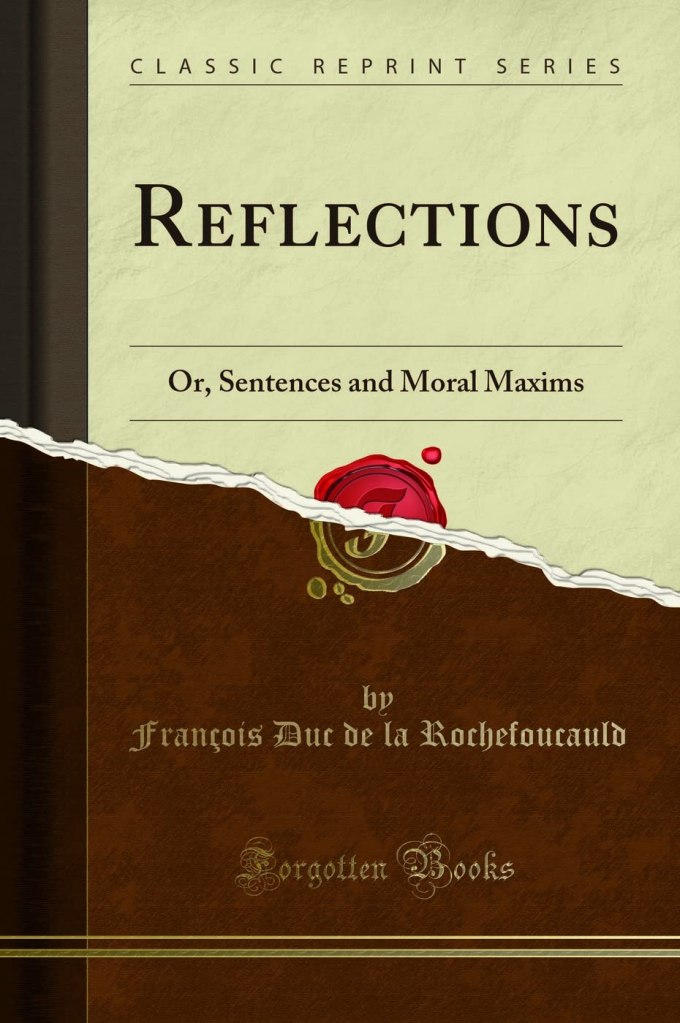
Reflections: Or, Sentences and Moral Maxims
by François de La Rochefoucauld
Forgotten Books (19 April 2018)
What’s it about?: A collection of epigrammatic reflections by François de La Rochefoucauld. The author is considered a pioneer of the maxime, a French literary form of the epigram, a brief statement that expresses some truth about human nature.
My opinion: Awesome. La Rochefoucauld isn’t associated with any particular school of philosophy, but one can draw parallels between this text and the Stoics and Epicureans, or those of Montaigne and Pascal. I think it sits nicely with Martial’s Epigrams, or Nassim Taleb’s The Bed of Procrustes. Involved in the Fronde, he was concerned with morality and self-interest. But rather than simply rail against the virtue-signalling of times, he would lament that it was impossible to find a pure form of virtue. This wasn’t so much cynicism as much as it might have been just a realistic appraisal of France at the time.
Reflections has quotes for days; a few examples:
“No persons are more frequently wrong, than those who will not admit they are wrong.”
“If we had no faults we should not take so much pleasure in noting those of others.”
“We are so accustomed to disguise ourselves to others, that in the end, we become disguised to ourselves.”
“True love is like ghosts, which everybody talks about and few have seen.”
I’m sure the Romantics would come out with more than a little pushback, but I think he’s great. I can open this book to any page and find something that makes me nod and go, “Yep.” Or, at the very least, something that gives me a bit of a prod and questions some of the beliefs or assumptions I might take for granted. Whatever I see in Reflections on any given day, it all has the singular effect of making me think that the author would have been an all round pretty cool guy. To me, at least. I’d love to have a conversation with him in the present, just to see what he thinks of the world today. Legacy media, social media, materialism, and all the grifters and charlatans festering in our timelines like a sickness.
That’s kind of what these classic texts are — conversations with these artists, philosophers, and personalities — and a reminder of just how great writing can be.
 Lawrence Deveney