
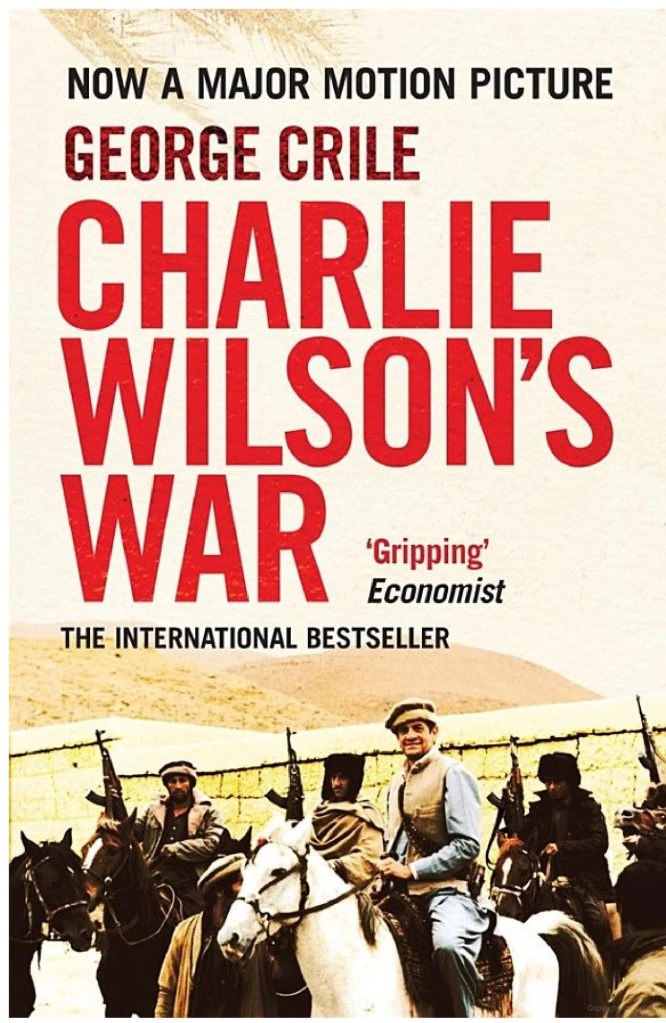
Charlie Wilson’s War: The Extraordinary Story of How the Wildest Man in Congress and a Rogue CIA Agent Changed the History of Our Times
by George Crile
Grove Press (6 November 2007)
What’s it about?: How US congressman Charlie Wilson, CIA agent Gust Avrakotos, and a host of characters manipulated global politics to turn the Soviet-Afghan War into the shitty sequel to Vietnam, by empowering the rebel Mujahideen, mostly by funnelling billions of dollars worth of military equipment. It was adapted into a film, with Tom Hanks portraying Wilson and Philip Seymour Hoffman portraying Avrakotos.
My opinion: If you’ve ever wondered why Afghanistan and Iraq are so completely and irreparably fucked up, this book makes for an excellent primer. The CIA trained these Afghani rebel fighters (which included Osama bin Laden), who then pushed back and wreaked all kinds of chaos on the Soviet forces. The very tools and strategies that gave the US power in this conflict also made the rebel forces one of the most powerful political and militant groups in the region today. The problem with involving themselves in the Soviet-Afghan War — and the problem with much of America’s foreign policy and proxy wars — is that the CIA had no exit strategy. The power once wielded in favour of American interests in the region ended up being used against them. The rest is history, but very recent history, with consequences impacting nations and ethnic groups today.
Imagine if 9/11 ended up being worse than it actually was, by death toll or damage to infrastructure. Or if Australia or some other US ally was targeted. What would the response have looked like then? It’s frightening to think about. Fast-forward to 2021, and the U.S. leaves Afghanistan. Weapons and equipment are left behind to be snatched up by the Taliban, and the common people are at their mercy. We all saw the footage of planes taking off with people hanging onto them. I still can’t wrap my head around it; this kind of foul-up. No end in mind at all.
A slight aside: There’s a good reason Afghanistan has been called the “graveyard of empires” in the West. Alexander the Great wasn’t kidding when he described the land as being “easy to march into but hard to march out of.” He couldn’t hold it, the British Empire couldn’t hold it, the Soviets couldn’t hold it, and the Americans couldn’t either.
Books in a similar vein include The 33 Strategies of War by Robert Greene, and Brave New War: The Next Stage of Terrorism and the End of Globalization by John Robb.
Charlie Wilson’s War is a fascinating read, not only as a piece of twentieth-century history, but also as an example of the dangers of American interventionism abroad.
 Lawrence Deveney