
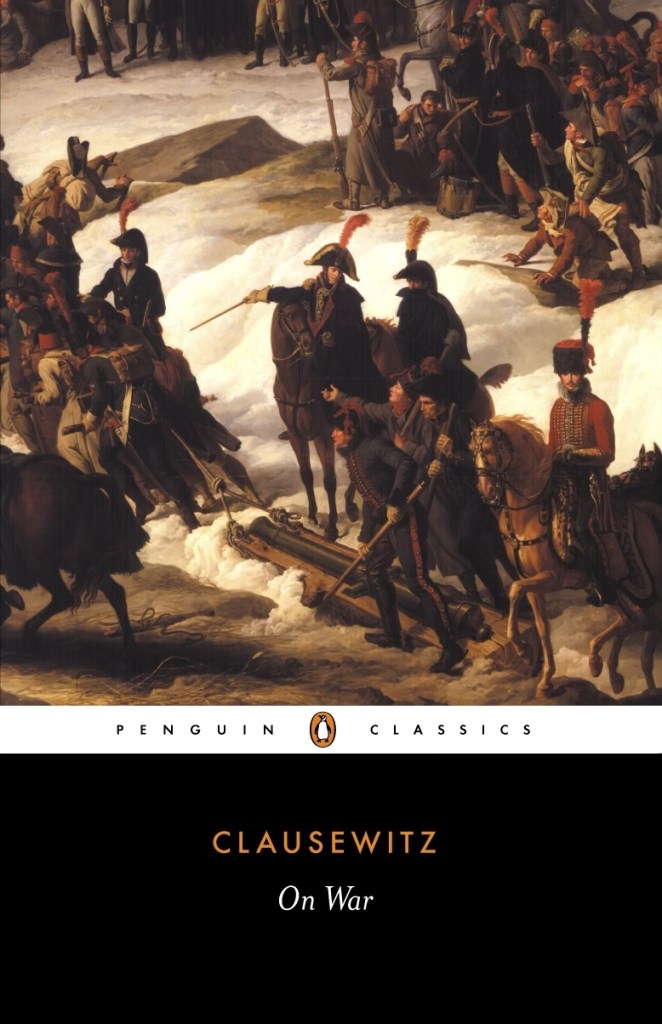
What’s it about?: Prussian general Carl von Clausewitz‘s classic treatise on war and military strategy. Written after the Napoleonic Wars, it is an incomplete work, with Clausewitz passing away before he could finish his task. It is considered to be one of the most important and controversial texts on military strategic thinking.
My opinion: Another one for my desert island list. Like The Art of War by Sun Tzu, The Prince by Machiavelli, or The 33 Strategies of War by Robert Greene, this text will be viewed as low-hanging fruit in the eyes of many history buffs and purists. Whatever. I’m still recommending it, and while I try to do the whole listing-of-takeaways thing sparingly, one quote has stayed with me more than anything else:
“Our knowledge of circumstances has increased, but our uncertainty, instead of having diminished, has only increased. The reason of this is, we do not gain all our experience at once, but by degrees; thus our determinations continue to be assailed incessantly by fresh experience; and the mind, if we may use the expression, must always be ‘under arms.'”
I had to pull this one, because I firmly believe that we must always be checking our assumptions, about the world and ourselves. Yes, it is good to form a coherent worldview, and I think we all form one in adulthood. But your views will always be challenged, and to be flexible, monitor how one learns and receives information, check how vulnerable you can be to your own biases… one must constantly learn and grow. It’s certainly not something that’s exclusive to the world of war and military strategy.
And warfare is something that has changed constantly over the course of history. It’s hard to imagine the conflicts of the Napoleonic Wars being fought today. Strategies and tactics differ wildly, as weapons and technology advance. Look at warfare after Clausewitz: World War I was mostly trench warfare; World War II was defined mostly by tanks, aircraft and strategic bombing. America’s involvement in the Middle East has been a series of proxy wars and drone strikes.
Throughout this year’s United States presidential election, there has been all sorts of alarmist rhetoric from some people, a good chunk of it having to do with the possibility of another civil war (or worse, World War III). Many wonder what such a conflict would look like. Some say that it wouldn’t be like the old days or armies marching against armies in the fields; it would be more like the asymmetric warfare of Northern Ireland in the twentieth century, with armed groups controlling this or that section of town. Anyone can make predictions, but we really won’t know until we see it. We could talk about this all day, being armchair generals and whathaveyou.
I am no soldier, but I can’t ignore the lessons here on flexibility, and the ability to learn and adapt with the times. That, and it’s another great nonfiction book to have in your library.
 Lawrence Deveney