
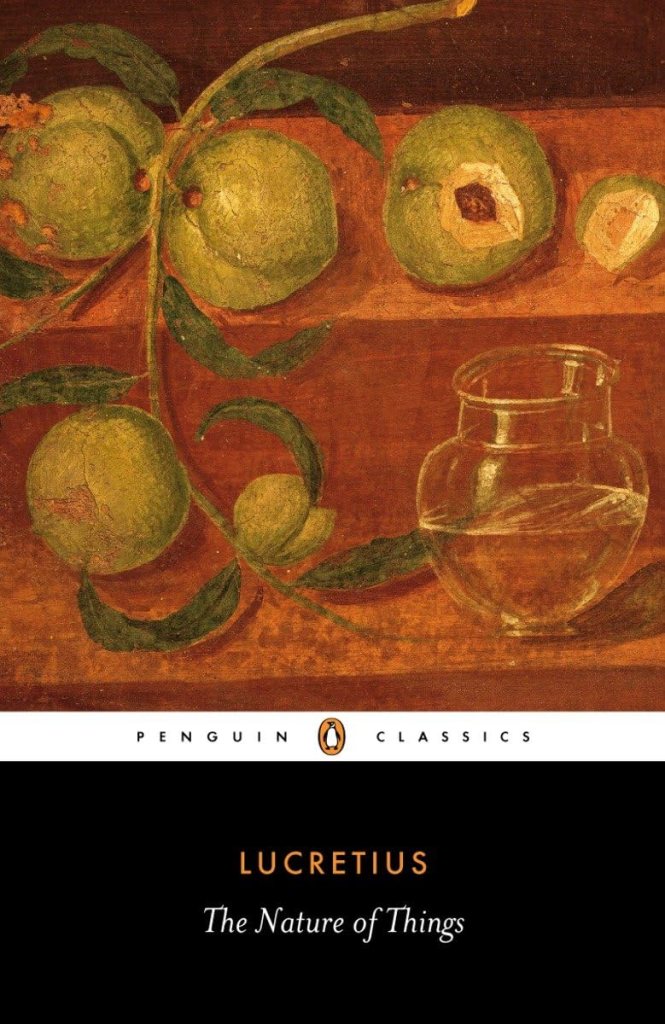
The Nature of Things
by Lucretius (translated by Alicia Stallings)
Penguin (13 September 2007)
What’s it about?: A scientific and philosophical treatise, written in the form of a didactic poem. The Nature of Things (De rerum natura) is Roman poet and philosopher Lucretius‘s (99-59 BCE) explanation of Epicureanism to a Roman audience. This edition was translated by Alicia Stallings, with an introduction by Richard Jenkyns.
My opinion: An incredible text in a convenient paperback format. I haven’t read a lot of didactic poetry, so I wasn’t really sure what to expect going in, but I enjoyed reading this. The topics explored in Lucretius’s didactic poem are vast and interesting — sensation, sex, cosmology, meteorology, geology, and man’s place in the world are all explored. My Latin is non-existent, so I’m no authority on these texts in their native language or the author’s intent. I have not read any other translations, but I found Alicia Stallings’ to flow steadily, keeping me hooked as I progressed through the text. One day I’ll get around to another version, Ronald Melville or William Ellery Leonard perhaps, just for comparison.
For all the diverse subject matter, there was one thing that really jumped out at me: Lucretius’s insistence on the earth being flat. Despite the fact that round-earth theory had been well and truly established in his time, Lucretius was a fierce advocate for a flat-earth. The section on weather and earthquakes made me laugh a little, as his advice reminded me a lot of the “duck and cover” bit from South Park. His views on sex and gender are very much of his time; one should know this going in. I wasn’t quite sure what to do with some of this, but I will give Lucretius some credit for being so forthright in his views… I suppose.
But at the heart of this work is the Epicurean belief that death is not to be feared, since the soul is mortal, and all things are temporary. That it is not the gods that govern the earth, but the laws of nature. For the Epicureans, to remind ourselves of this is the key to happiness and peace of mind. It was these sections (mainly book three) on mortality that I found most interesting.
I came into this text familiar with Epicurean philosophy, but I was not prepared for the form, that of the didactic poem. It is unlike anything I’ve read before, vastly different from the epics of Homer or Virgil, but it really hit the spot.
There are many quotes and passages one can pull, but I want to share just one:
“Life is one long struggle in the dark.”
This crystallises how I’ve always felt. One step forward, one step back. Progress and momentum are not always obvious; they’re not even necessarily tangible. But we continue on.
Again, I can’t say how this edition compares to other translations, but I enjoyed it thoroughly. Not bad at all, would recommend.
 Lawrence Deveney