
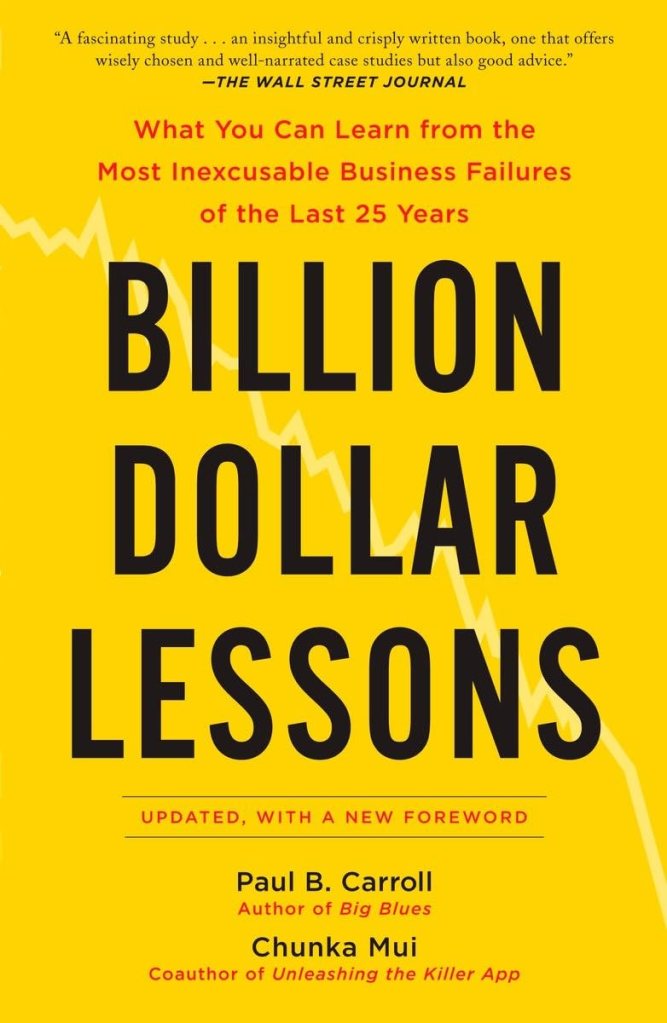
Billion Dollar Lessons: What You Can Learn from the Most Inexcusable Business Failures of the Last 25 Years
by Paul B. Carroll and Chunka Mui
Portfolio (25 August 2009)
What’s it about?: A different kind of business book. Chunka Mui and Paul B. Carroll drew on decades of case studies to give us some fundamental lessons about strategic errors in business.
My opinion: Better than Unleashing the Killer App, that’s for sure. We’ve all seen the many business books telling you how awesome the most successful companies and founders are. And there is value and inspiration to be found in some of them, sure. Hackers and Painters by Paul Graham (you can also read his essays here), The Hard Thing About Hard Things by Ben Horowitz, Zero to One by Peter Thiel, anything by Tim Ferriss or Seth Godin. You can find plenty of examples of what happens when things go right — people succeed and awesome companies are made. I personally love these books (the good ones, anyway). I’m not in business, but I have learned so much about how to lead, get the team onboard, set expectations, and just generally bring out the best in them.
But what about all the times it all went wrong? You don’t see those books getting as much press, and that is a crime. If we are to learn from the experience of others, then surely we could benefit from examples of failure. Mistakes that are not only avoidable, but seem to be repeated over and over. Not to gawk at the misfortune of others, but to stay humble and remind oneself that things can always go wrong. A great example is the story of Jim Paul, who enjoyed a swift rise from his modest beginnings in Kentucky to being the governor of the Chicago Mercantile Exchange. Unfortunately, hubris was his undoing, and he lost it all — job, reputation, fortune, everything. And he knew it. In fact, Paul went on to write What I Learned Losing a Million Dollars, which is also a great read.
I have heard many times that experience is the only reliable teacher. In part, I can see where they’re coming from. Experience is crucial, and the overwhelming majority of business books are worse than useless (Good to Great made me want to headbutt myself in the face). But I have also found that without a solid theoretical framework, it can be hard to know where to start. Experience may be the best teacher, but it doesn’t just magically happen. It’s worth considering, at least.
Again, I’m not in business or entrepreneurship, but I think it’s safe to say that one can benefit from some simple observations about letting pride and arrogance getting to one’s head. And yes, learning from experience cannot be substituted, but I can’t make every mistake myself. If I can learn from the experience of others and skip a whole lot of trial and error, I’ll count that as a win.
Billion Dollar Lessons is a great read, with some valuable insights for those who think they have it all figured out.
 Lawrence Deveney