
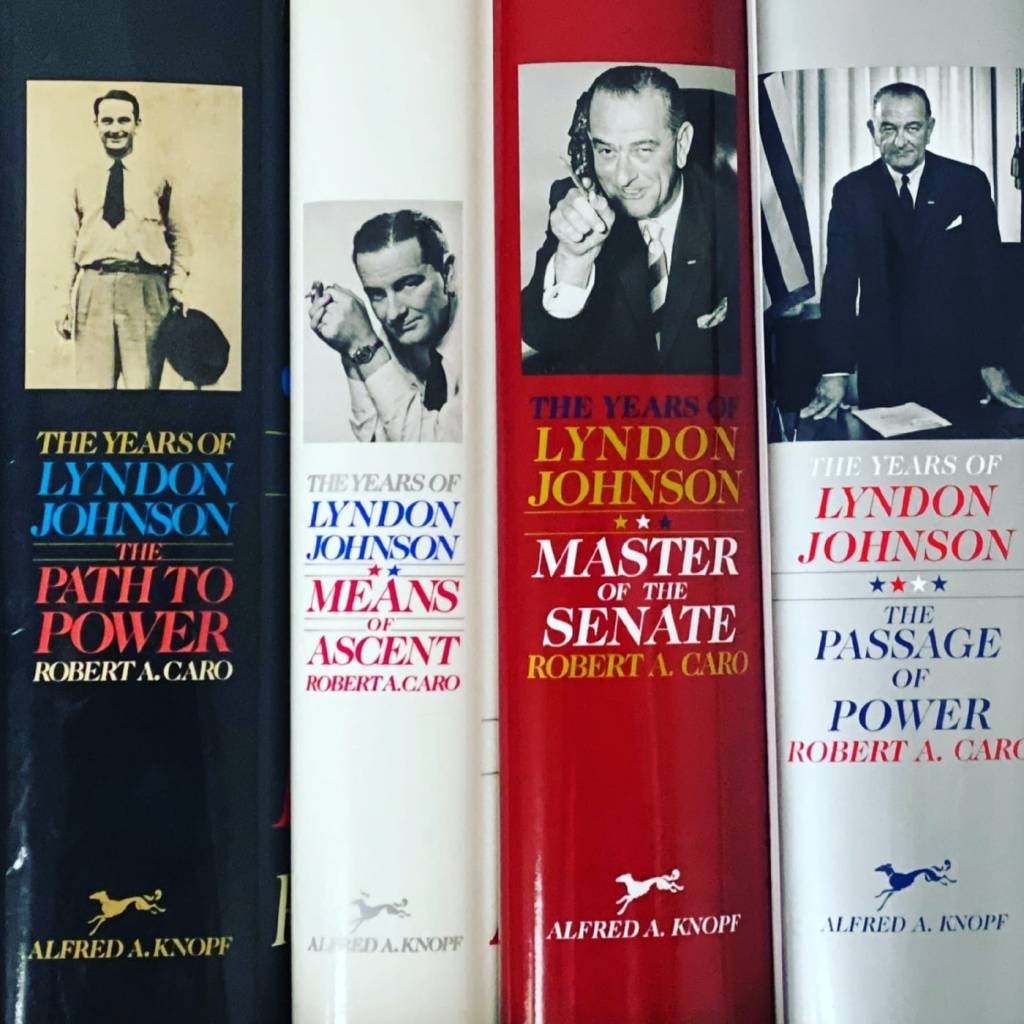
The Years of Lyndon Johnson: The Path to Power, Means of Ascent, Master of the Senate, The Passage of Power
by Robert A. Caro
Knopf Publishing Group (9 April 2013)
What’s it about?: Robert Caro‘s epic four-volume biography of 36th president of the United States, Lyndon B. Johnson. The Path to Power chronicles the beginnings of Johnson’s political ambitions, from his childhood in Texas, through the Great Depression, to his congressional debut in New Deal Washington. Means of Ascent is mostly about Johnson’s contested Democratic primary against Coke R. Stevenson. Volumes three and four get a lot busier. Master of the Senate covers Johnson’s ascent in United States Congress, his tenure as Senate majority leader, and his struggle to pass a landmark civil rights bill. The Passage of Power is concerned primarily with the challenges Johnson faced when assuming the presidency in the aftermath of John F. Kennedy’s death.
My opinion: Epic series. Getting through just one volume feels like an accomplishment. Caro is an incredible biographer, and his investigation into the life and career of Johnson is hugely impressive.
My favourite volume out of these is the first. In addition to the story of Johnson himself, The Path to Power provides a rich history of South Texas. If you want to learn about the lives and times of people living and struggling to get by in twentieth-century rural America (especially Texas), then this text makes for a good primer. The lives of Johnson’s ancestors, and his childhood of extreme poverty gave birth to his political ambitions. Political ambition, and by extension, opportunism.
There are many lessons to be learned throughout this series, but one really stands above all the others: “Power doesn’t corrupt, it reveals.” This is essentially Caro’s response to that old Lord Acton quote, “Power tends to corrupt and absolute power corrupts absolutely.” I get what Acton means, but is he being too simplistic? I don’t believe it is all-corrupting, all at once. Like a cancer, the disease does not cause itself, and things are rarely cut and dried. It’s easy to look at politics in the U.S. and Australia and see crooks and phonies everywhere. And you’d probably be right. But then, people and systems have always been complicated. The so-called “good old days” weren’t really good. They were the present, for the people who lived through them. Not to dismiss how anyone feels about today’s events, but it is what it is.
It may seem like a labour to read, but The Years of Lyndon Johnson makes for a fascinating case study of not only the man himself, but power, ambition, people, and justice. Each chapter could be a book in itself, each book separated into its own series, they’re that good.
 Lawrence Deveney