
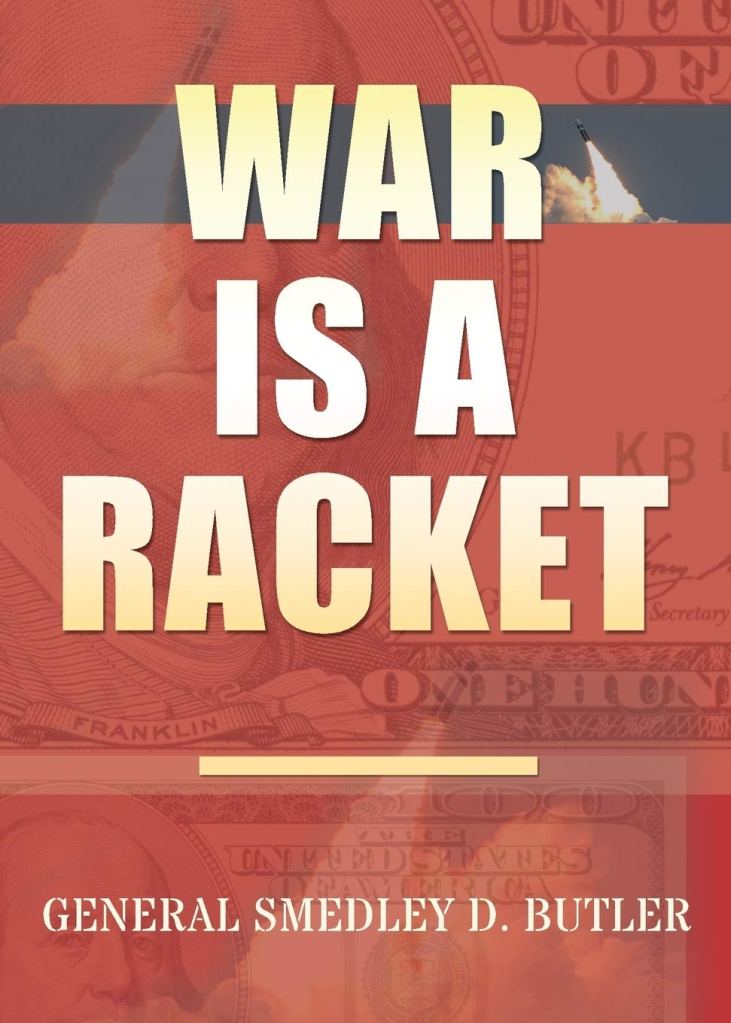
What’s it about?: The famous speech and short book published in 1935 by United States Marine Corps major general Smedley D. Butler (1881-1940), on why wars are conducted. Butler describes the commercial relationship we call the military-industrial complex. He defines a racket as “something that is not what it seems to the majority of the people. Only a small ‘inside’ group knows what it is about. It is conducted for the benefit of the very few, at the expense of the very many. Out of war a few people make huge fortunes.”
My opinion: A must for any student of military history, or those looking to work themselves into a frenzy over the ills of capitalism and American interventionism. Well worth reading on its own, but the text truly shines when you read it in the context of its era, and the parallels found in today’s world.
Butler served in the American Occupation of Haiti, during the Banana Wars. This period of history might not be as well remembered as World Wars I or II, but it was a series of U.S. military interventions in Latin America and the Caribbean, from 1898 to 1934. These interventions were carried out by the Marine Corps. Butler was deployed to various countries to enforce American commercial interests and maintain stability, with an emphasis on protecting U.S. corporations in countries where American investments were being threatened. Two U.S. corporations with the biggest stakes in this were United Fruit Company and Standard Fruit Company (now known as Chiquita and Dole plc, respectively).
Examples of Butler’s service include Honduras, the Dominican Republic, and Nicaragua, but perhaps most infamously, perhaps, was Haiti. From 1915 to 1934, Butler led the Marine forces against a local rebel militia known as the Cacos, and secured control of Haiti’s government and economy, effectively making it a U.S.-controlled protectorate. The Marines took over USD $500,000 in gold from the country’s reserves, at the behest of what is now known as Citibank (that amount of gold would be around USD $14 million in today’s money).
Butler did his duty, aggressively and effectively putting down the counter-insurgencies in these countries. However, he would later reflect and strongly criticise his involvement and methods, referring to himself as a “racketeer for capitalism.” He realised that the purpose of such military intervention was to protect American commercial interests, as opposed to just national security. I have to say, I agree. When you think of national security and defence, you tend to think of defending your country at or near your borders, rather than across the sea. They ought to find a new name for such a thing.
So, when Butler defined “racket,” he knew what he was talking about, and that’s what makes this text such a brilliant artefact.
People tend to invoke different historical periods when talking about current events. Some go with the Roman Empire and its fall, others the American Revolutionary War, Civil War, World War II. More recently, I’m seeing a lot of dudes bringing up Bolshevism and the Spanish Civil War. Well, mine is the Banana Wars, and if you look at American commercial interests in Ukraine, or Libya, Iraq, and Afghanistan, then maybe you can see why.
Read War Is a Racket, and follow it up with The Fish That Ate the Whale: The Life and Times of America’s Banana King by Rich Cohen. You won’t be sorry.
 Lawrence Deveney