
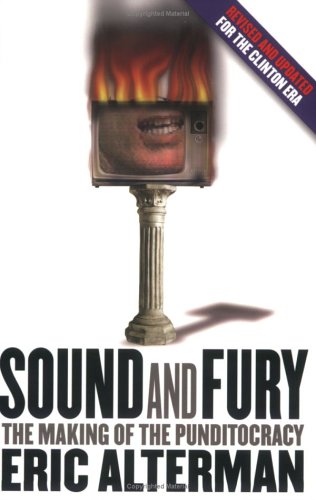
Sound and Fury: The Making of the Punditocracy
Cornell University Press (1 January 2000)
In Sound and Fury, Eric Alterman discusses the decline of political discourse in the United States. Everything he says can be applied to Australia, or the U.K., or any place where news has become entertainment. He attributes this decline in quality of reporting to the rise of the “pundit class,” the talking heads and gurus seen on news and current affairs shows so frequently, and how they became such a big deal.
The title is drawn from Shakespeare’s Macbeth, from the titular character’s famous soliloquy in Act V, Scene V.
Out, out, brief candle!
Life’s but a walking shadow, a poor player,
That struts and frets his hour upon the stage,
And then is heard no more. It is a tale
Told by an idiot, full of sound and fury
Signifying nothing.
Which summarises things well enough.
Why does this matter? Because the media is a crucial element of how public opinion is formed, and Sound and Fury really gets into how opinion and commentary get passed off as news. An upper-primary student can see the problem here. The purpose of journalism is to inform and contextualise. But with the pundit class, we’re not getting that.
Alterman goes after conservative pundits almost exclusively, and if you think he’s biased, it might be due to his background as a pundit, or because conservative pundits seemed to everywhere, or the fact that this book was written just as the United States was coming down from the Reagan and Bush, Sr. administrations. Maybe this isn’t so much a negative as it is an example of how social and political context can really inform writing. Personally, I could almost give these talking heads a pass if they lived the same lifestyle they wanted others to follow. Some probably do, and in the pre-internet era, you might have assumed they all did. Nice, upstanding conservative Christian values and whathaveyou. Now, post-social media, I can’t help but see them as complete dorks, regurgitating the same talking points with no coherent political or religious worldview.
Look at the legions of commentators currently glutting the market on YouTube and Twitch. Piers Morgan, Ben Shapiro of The Daily Wire, Cenk Ugyur of The Young Turks, Steven “Destiny” Bonnell, Nick Fuentes, and many others. Talented rhetoricians, these guys are the pundit class of today, and people watch their content not so much for the news itself, but for the personalities.
Morgan, especially. The darling of Fox and Sky News, he is perhaps best known for hosting Piers Morgan Uncensored. Every time he conducts an interview, it’s basically a hit piece on the guest, deservedly or not. In a simple conversation, people know what you’re saying, more or less. Pundits like Morgan know that they could present what you’re saying in good faith and argue against it accordingly, but he doesn’t do that. Instead, he aggressively twists his subject’s words, assumes a premise that isn’t even there, and forces them to defend a position they did not take and did not mean. His “Do you condemn Hamas?” catch phrase, directed at Medhi Hasan, being a perfect example. I feel like there’s enough going on in the world, and enough to argue about, without some talking head aggressively twisting his guest’s words, and bullying them into giving a binary response that can be used as a soundbite.
And it’s not just these big names doing this; it’s half the internet (i.e. the average Redditor). This creates a corrosive element that only leads to less understanding of news and current affairs. I have to get off this subject, I could write a ten thousand words on it right now.
Back to Sound and Fury. All of this — the economics of online media and the rise of the e-celeb — is why I consider the text relevant today. Originally published in 1993, it was revised and updated to include the O. J. Simpson trial, the rise of MSNBC, and the absolute media shitstorm that was the Bill Clinton/Monica Lewinsky scandal (related: Lewinsky’s TED Talk opened my eyes, and I highly recommend watching it).
Another must for any student of the history of media.
 Lawrence Deveney