
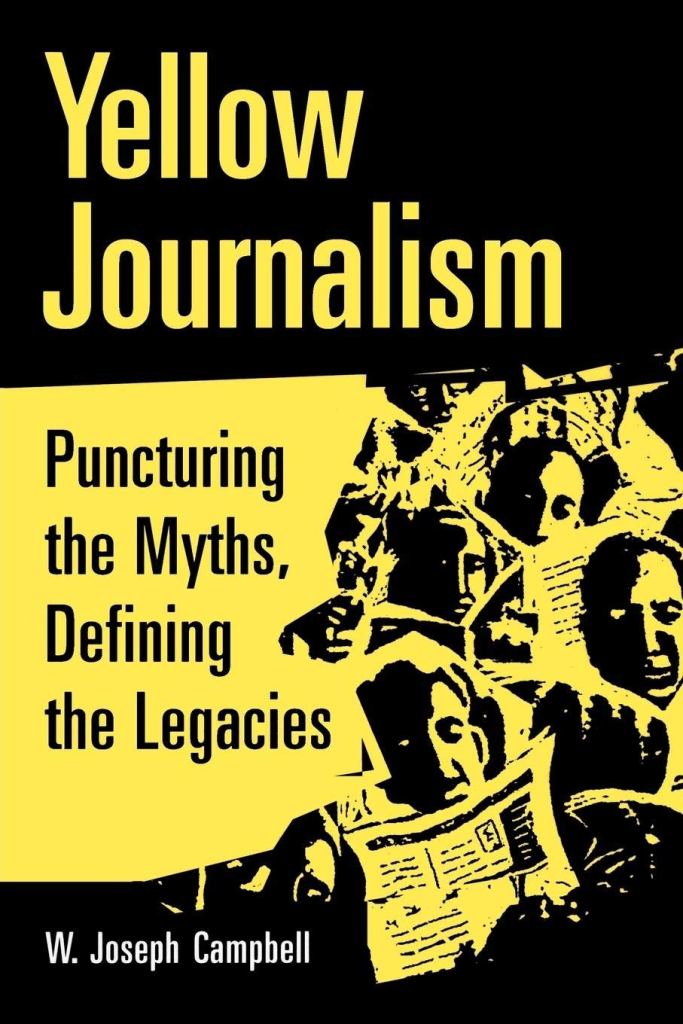
Yellow Journalism: Puncturing the Myths, Defining the Legacies
Bloomsbury (1 March 2003)
Yellow Journalism is a concise introduction to what this model of journalism is, and of some of the most common myths and misconceptions surrounding it.
The term “yellow journalism” was originally an American colloquialism, used to describe the battle for dominance between William Randolph Hearst’s New York Journal and Joseph Pulitzer’s New York World. The “yellow” part comes from a character used in the works of cartoonist R.F. Outcault, who was poached from the World to work for the Journal.
Yellow journalism is characterised by the following:
- Multi-column front page articles about ultimately unimportant news.
- Bold layouts and lavish use of pictures with little relevance.
- Imposters, frauds and fake interviews.
- Use of unnamed sources.
- Blatant self-promotion.
- Prominent coverage of high society and events, sports and scandal.
If any of the above characteristics sound familiar to you, that’s because they pertain to the media just as much today, amplified many times over with the internet.
There is a famous anecdote about the role of yellow journalism in the Spanish-American War. There is the famous anecdote where Frederic Remington telegrammed Hearst that the situation in Cuba was more or less okay and that “there will be no war.” He then claimed that Hearst urged him to remain in Cuba, “Please remain. You furnish the pictures and I’ll furnish the war.” Which sounds like a textbook example of how the media can be used to manipulate people and situations, except it didn’t happen. Many historians have conceded that there is no evidence to support that such an exchange took place, which is a testament as to how shallow anecdotal evidence can be. “I know a guy who…” et cetera.
I can see where Campbell is coming from. Myths like these are easy to believe. Yellow journalism was (and is) an entire cottage industry where owners and editors obsess over headlines, everyone was very particular about how things were worded, and an endless cycle where every paper and writer was trying to be heard over every other paper and writer. A cursory glance at Google News and you can see the same thing happening. Gawker and the Huffington Post built entire brands out of this in the 2000s and 2010s, which not only killed the subscription model as we knew it, but created a news cycle so fast that even a basic factcheck was a burden no journalist could shoulder.
Overall, I would recommend Yellow Journalism for those just looking for an angle on the subject of fake news. Check it out.
 Lawrence Deveney