
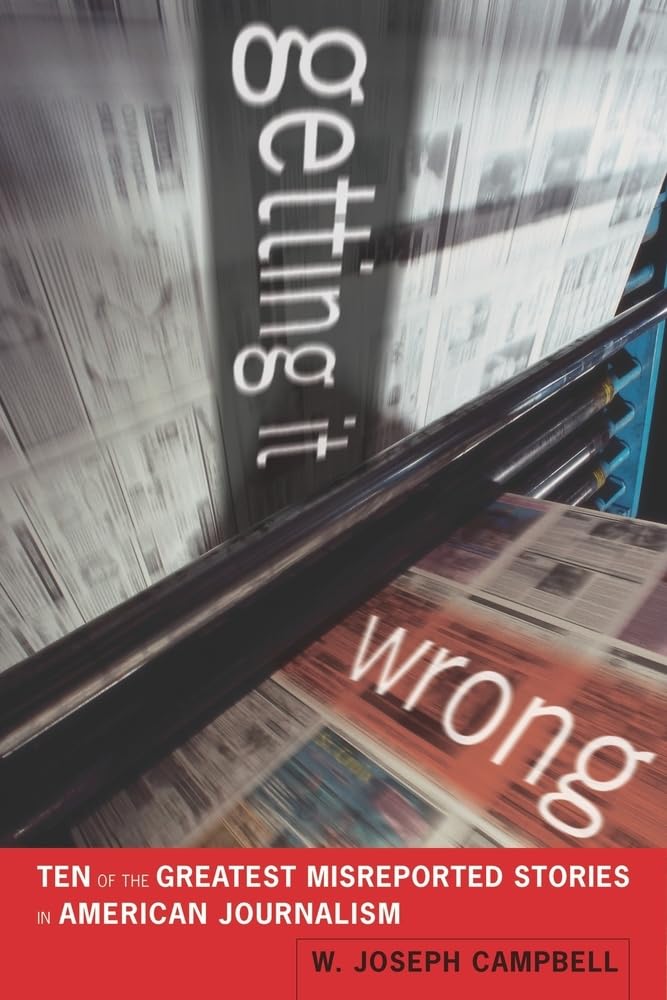
Getting It Wrong: Ten of the Greatest Misreported Stories in American Journalism
University of California Press (15 July 2010)
Getting It Wrong is a deep dive into some of the most exaggerated and outright fake stories in the history of American journalism.
In my last piece, I mentioned William Randolph Heart’s “you furnish the pictures, I’ll furnish the war” quote that he probably never actually said. This is just one of many examples of fake news, of the media fighting all forms of misinformation besides the variety they peddle. I like to think of it every time I see some “democracy depends on you subscribing or donating to our paper” popup every time I click on an article. It assumes that the media are gatekeepers, arbiters of truth when often they are the opposite.
Hearst and Cuba, Morrow and McCarthy, New York Times and the Bay of Pigs, and LBJ’s infamous “We lost Cronkite, we lost Middle America.” Apparently, Cronkite’s coverage of the Vietnam War did little to sway public opinion. The media purportedly plays such a significant role in getting the truth out there, but what does it say when so much of what’s put out there is complete garbage?
If this doesn’t worry readers, then it should. We live in a society run by public opinion, and public opinion is informed by the media. What does it say when so much of the news that finds us is exaggerated or completely false? Is it not important to dismantle the false narratives that have become so deeply embedded in our society and culture? Remember WMDs in Iraq? Seemingly every newspaper on the planet pushed that narrative, despite there being no actual evidence. Democracy dies without the news, you say? Well, by the looks of things the corpse of democracy was looted by the media a long time ago. It’s done.
Campbell approaches the problem of fake news with the kind of academic detachment you’d expect from an expert in the field. He can correct the record without shouting “fake news” like an imbecile, which in turn invites the reader to draw their own conclusions.
Sure, not everything that’s published is fake. There are reliable outlets to be found. But I do think that a text like Getting It Wrong is worth reading, and that it’s important to take the lessons learned to remember how things can and do go wrong with reporting. Yellow Journalism made for a concise history of one of the most controversial moments in twentieth-century media. Getting It Wrong is the perfect companion piece, a healthy dose of scepticism that’s very concise and even-handed.
 Lawrence Deveney