
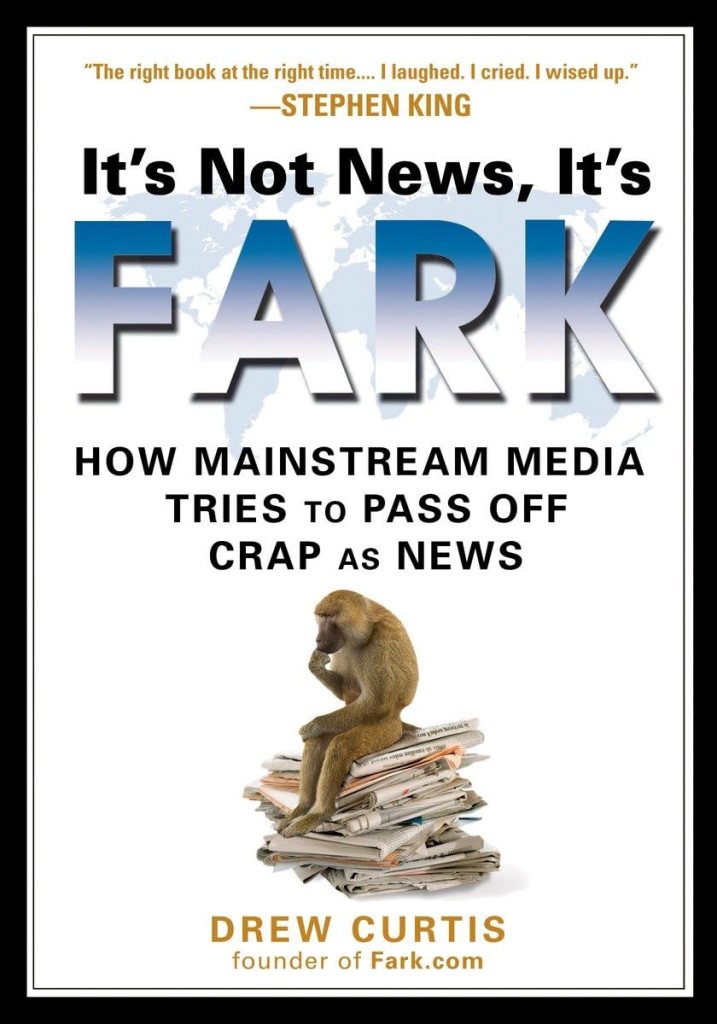
It’s Not News, It’s Fark: Now Mainstream Media Tries to Pass Off Crap as News
by Drew Curtis
Avery (29 May 2008)
I used to love Fark.com back in the day, and I’m glad it’s still around. One of the biggest news aggregators out there, it gave founder Drew Curtis enough material to write this book slamming the media for its tendency to run non-news stories. And from my experience, pretty much everyone who bought this book did so because they enjoyed Curtis’s work on Fark.
Fark received countless story submissions from users (Farkers), and of course comments, since its foundation in 1999. It certainly gave him a unique perspective on journalism as a profession, and it’s a real contrast to some of the more academic, analytical books on the subject. Not that I don’t value the serious, nerdy stuff that’s out there, but I do appreciate having a text like this on the shelf. There was potential for it right from the get-go, but it wasn’t until the mid-oughts that book publishers started taking bloggers and e-personalities seriously. This was back in the days when Rudius Media was this ascendant entity with all the potential in the world. Might seem trite now, but this was two decades ago, before the YouTube revolution when text was still dominant.
It’s Not News, It’s Fark is a valuable text that can help one identify fake news and protect oneself from its tropes and cliches. It gets off to a blistering start with one of the most cogent analyses of media dishonesty you can find. Without a doubt, it’s one of the best examples of how an author can be hilarious but also really informative at the same time. What news is actually important and needs to be out there, as opposed to the various articles that are pumped out for the sake of meeting quotas.
The best part of this text is that everything is backed up with examples and comments from the web, so as outrageous as it all seemed, it was all based on facts. He even has a go at the Farkers for enabling this news cycle of putting out complete garbage presented as “news,” which is also part of the appeal. To me, anyway.
One criticism I have of the text is that most of its content can be found on Fark for free. Then again, I say this as someone who devoured Fark for years before this book was published, plus it does end with one of the best Fark stories ever. Read it and you’ll see what I mean.
I suppose one does not need to be familiar with the site to appreciate this text after all. It’s instantly accessible, and I would recommend it to pretty much anyone.
 Lawrence Deveney