
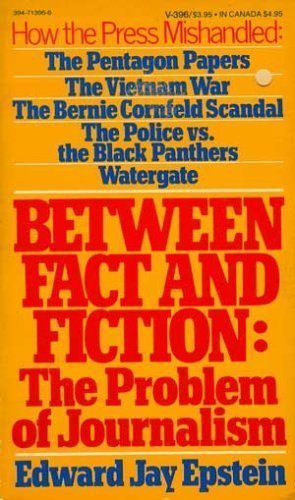
Between Fact and Fiction: The Problem of Journalism
Vintage (12 October 1975)
Edward J. Epstein always did an excellent job at explaining the business structure behind the news, and Between Fact and Fiction definitely lives up to this. The text focuses on the negative relationship between journalism and truth. Between fact and fiction, there is… journalism.
As was the case with News from Nowhere, the depth of analysis in Between Fact and Fiction is so thorough. The former went deep into the institutional constraints of journalism, and the role of television news in creating revenue for the parent companies of news programs. This text goes into this blurring of fact and fiction, where journalists dramatise events or reinforce existing misconceptions to appeal to the passions and prejudices of the public. The public are misled, all while these news sources maintain a front of objectivity and truth.
Examples include the belief that investigative journalism is what led to the Watergate scandal, or the 1969 police raid on the Black Panthers that resulted in the deaths of Fred Hampton and Mark Clark. The latter in particular, Epstein gets into how journalists relied on police reports over any other source, leading to biased reporting that missed a large part of the story and vastly overlooked some of the basic facts. Or, the relationship between the CIA and the press, where agents and journalists often collaborate, raising questions about the very notion on journalistic integrity.
Key to all of Epstein’s works are the economic factors that drive the media. News organisations are businesses first and foremost, and their survival depends on a healthy flow of audience numbers and advertising revenue. These economic incentives dictate editorial decisions, which is why so much of the “news” that’s out there can be reduced to rumour, gossip, and sensationalism.
I cannot emphasise this enough: like all of Epstein’s works, Between Fact and Fiction is a masterful critique of modern journalism. I say “modern,” because despite being published in 1975, the observations can easily be applied to today’s clickbait news. Our understanding of events is filtered by severely flawed institutional and commercial processes.
There’s a reason Epstein is so highly respected — he knew how to pull the curtain back, and this text goes well with News from Nowhere and The Big Picture.
 Lawrence Deveney