
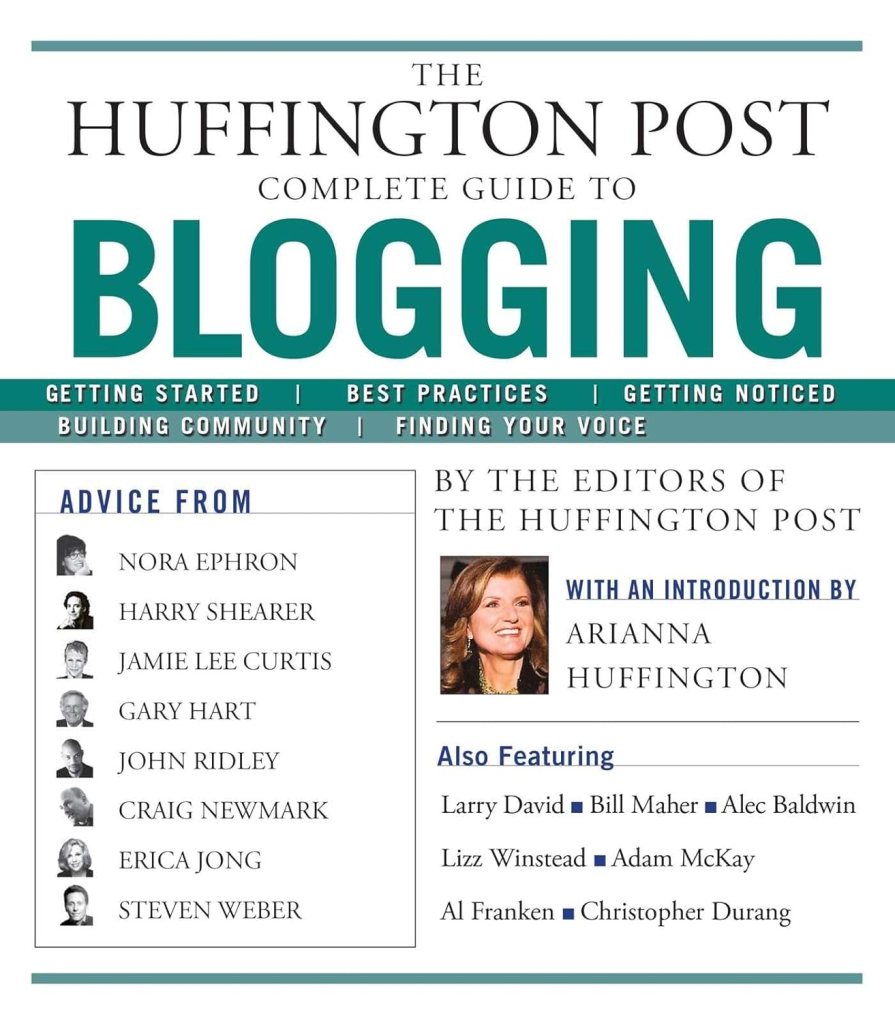
The Huffington Post Complete Guide to Blogging
by the Huffington Post
Simon & Schuster (2 December 2008)
Published in 2008 and edited by co-founder Arianna Huffington, The Huffington Post Guide to Blogging was published before Twitter and Instagram took off, and blogging was still the main social publishing tool. If you remember the 2000s, you probably remember the optimism surrounding Web 2.0, and the prospect of online voices rivalling traditional media.
Originally offered as an alternative to more conservative news aggregators like the Drudge Report, the HuffPost gave a voice to progressive writers, containing material by paid journalists and unpaid bloggers. This book serves as a practical guide for people interested in starting or improving their blogs, and reflects the ethos of the HuffPost during the mid-2000s. Again, this was a time when blogging was the main form of online expression and journalism.
It opens with Arianna Huffington advocating for blogging as a democratising force in media, presenting the medium as a tool for social engagement, personal branding, and social progress. By going past the gatekeepers of traditional media, anyone with an internet connection could potentially influence public discourse.
For those looking to get started, there are sections on choosing topics and themes, finding one’s voice, setting up your blog on various platforms, or even contributing to the Huffington Post. Various dos and don’ts include being authentic and transparent, posting frequently, jumping on big topics, and engaging with readers in the comments section, avoiding inflammatory of misleading commentary for clicks, among other things.
What really sets this book apart from others is the wealth of experience from various contributors, from celebrity guests to HuffPost writers. Celebs include Barack Obama, Hillary Clinton, Welsey Clark, Ari Emanuel, Nora Ephron, Mia Farrow, Al Franken, Gary Hart, Edward Kennedy, John Kerry, Bill Maher, Nancy Pelosi, John Ridley, Margaret Cho, Harry Shearer, Alec Baldwin, and others, as they share their insights into why they blog, and how blogging has shaped or reinforced their careers.
All of this was meant to signify how blogging and citizen journalism would shift how the media worked, from a rigid hierarchy to more of a superstructure. It may be dated by today’s standards, when you consider how blogging has merged with other forms of online media, or how so-called citizen journalism attracts conspiracy theorists and charlatans as much as those trying in earnest to inform and contextualise.
But the true value in this text today lies in the insights into writing with purpose, developing an authentic voice, and engagement with one’s audience. It makes for a concise beginner’s guide as to what goes into a blog, to share your views and experiences, and have it all written in a format that makes people want to come to you. In that light, it’s definitely worth reading.
 Lawrence Deveney