
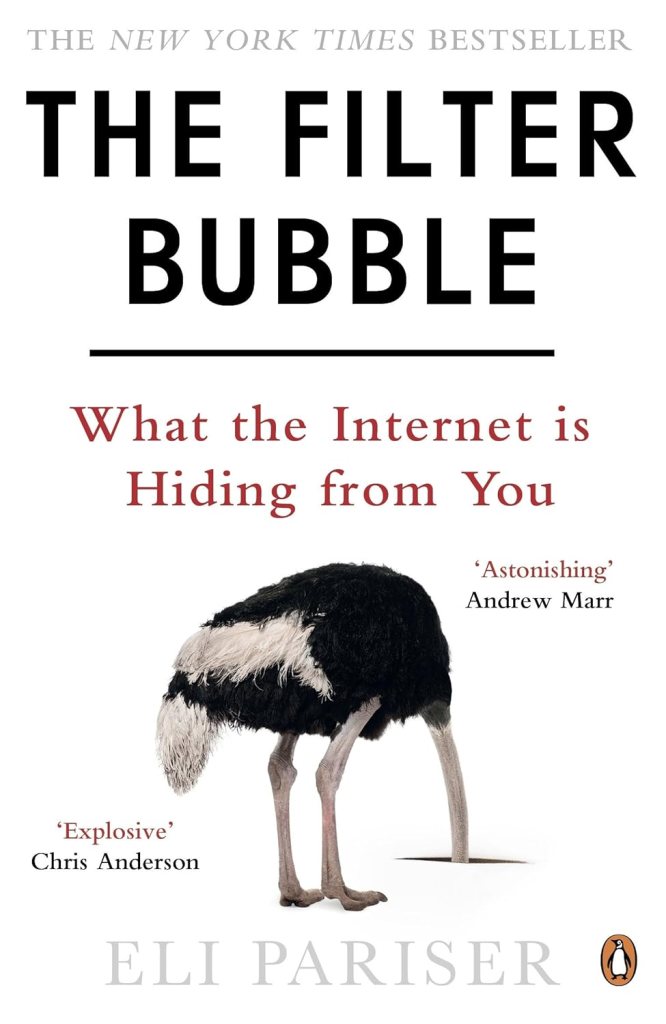
The Filter Bubble: What the Internet Is Hiding from You
by Eli Pariser
Penguin (16 April 2012)
The Filter Bubble explores how personalisation algorithms shape what information we see online. All the major tech companies do this — Google, Facebook, Amazon. Author Eli Pariser argues that while personalisation can make user experiences more convenient, they can narrow our exposure to diverse perspectives, creating “filter bubbles.”
In the text, Pariser warns of the dangers of living in bubbles of personalisation that reinforce our worldview. On a long enough timeline, algorithms tailor search results, news feeds, and recommendations, based on past behaviours, interests, and demographics. Each person ends up in their own filter bubble, reducing exposure to ideas, viewpoints, and information that might challenge their beliefs.
The internet isn’t like the front pages of established newspapers. Whereas newspapers are edited at least somewhat openly, online filtering happens behind the scenes. Clicks, search history, likes, and follows determine what platforms show you. Two people searching the same keywords might get vastly different results, depending on their bubbles. This leaves users at risk of intellectual isolation, loss of serendipity, higher risk of manipulation, and just generally an unhealthy impact on democracy.
When it was first published, what really made The Filter Bubble stand out for me was that it made for such a stark contrast with the “information age” ideal, and the optimism surrounding Web 2.0 in the 2000s. We keenly anticipated a new age where everyone would have access to a vast world of information. Instead, our horizons have narrowed. One can’t help but wonder, was it always going to end up like this, or did we simply let a bunch of finance bros come in and ruin everything? Editing and expertise have been replaced by the algorithms, with no accountability. And this book was published before Brexit and Trump’s 2016 election win, so it was very prescient.
Despite the weight of his subject matter, Pariser still approaches in with a relaxed tone, which makes a change. What he proposes is for companies to be more transparent about how filtering works; for people to have more control over how they adjust their personalisation settings, or opt out entirely; for platforms to balance exposure to more diverse perspectives; and higher digital literacy on the part of the users, which is what I try to reinforce in my students.
Pariser is a great thinker, and he has written extensively on fake news. One criticism I have of him and The Filter Bubble is that his creations — MoveOn and Upworthy — are largely responsible for creating their own versions of the problem. MoveOn was inherently partisan, and since the 1990s, seeking to cultivate an ideological community. Founded in 2012, Upworthy was known for its curiosity-terminating headlines like “You Won’t Believe What Happens Next…” It relied on algorithmic testing and engagement-optimisation to maximise clicks and shares on social media. Virality took precedence over diversity of perspectives.
The irony isn’t lost on Pariser. He has acknowledged the tension between his projects, and the message of The Filter Bubble. He considers his projects as having to operate within the system in order to pursue their goals. They did, however, worsen the patterns he wrote about.
“We try to combat that in two ways,” he said in an interview with The Verge. “First, by ensuring users see public-interest content — for example, climate change or economics — so such topics appear in feeds even when they might be competing with viral distractions. Second, by emphasising empathy and cross-partisan storytelling, including viewpoints from people unlike the reader, to help break down echo chambers.”
Credits to him for acknowledging the problem, and addressing the challenge of working around it.
Whether you see Pariser as insightful, a hypocrite, or some strange combination of the two, The Filter Bubble is a great text to have on the shelf if you want to learn more about the media nightmare we live in. And while the book may be dated, the subject is always current. It might not be new to some, but for those looking to for an eye-opener on how the internet works, it certainly delivers.
 Lawrence Deveney