
I’m not sure where to start on this, so I’m just going to make it up as I go along.
The image of Limp Bizkit and Fred Durst in their heyday didn’t really do the band or the man justice, that Durst was just some poser, or a dollar-fixated corporate shill. I would interpret him as an artist who can wear both the creative and business hats, in addition to his iconic red baseball cap. The band’s musicians — John Otto (drums), DJ Lethal, Wes Borland (guitar), and the late Sam Rivers (bass) — are one of the tightest units you will find in modern rock and metal. Borland in particular has earned a reputation as an extraordinarily talented force.
One memory that really stands out was when I was a kid, playing Chocolate Starfish and the Hot Dog Flavored Water (2000) at my dad’s. He is, unfortunately, no longer with us, but people who knew my father would say that he was a bit eccentric. Imagine Gandalf the Grey in a tank top, Yakka pants and boots. He worked as a tiler before moving to rural Victoria to live a quiet life away from the city, yuppies, weekend traffic, and insurance salesmen. He had no love for the corporate world and the idea of a normal nine-to-five job. He was the same with music. Whatever the big trend in music was, he tended to look the opposite way. It was like an instinct. He was really into blues and folk — Bob Dylan, Richard Thompson, Fairport Convention, the Incredible String Band, that sort of thing. He had this acoustic guitar, a Hummingbird knockoff made by some no-name brand. He was left-handed, and the guitar was a righty model. I have no idea where or when he acquired it, but he swapped out the nut, and it became a natural extension of his fingers. He wouldn’t go near an electric almost on principle, and he only played finger style, no picks.
Anyway, I put on the CD. He sat up and paid attention. For one, he really liked the tight rhythm work of Rivers and Otto. That was his benchmark for a band, the bassist and drummer. Everything else was negligible to his ears. Still, as far as leads went, he didn’t mind Lethal and Borland. Even Durst’s lyrics got a nod.
My dad would routinely write off Black Sabbath and Pink Floyd — bands that enjoy legendary status in the rock and pop worlds — as complete garbage. He thought Ozzy’s lyrics were “utter shit” and those of Pink Floyd as plagiarism. He absolutely loathed the “guitar wanking” of most heavy metal bands and shredders. He was kinder to Led Zeppelin, but only because of his fondness for the Yardbirds in his youth.
But for all the mainstream bands he’d written off, he gave Limp Bizkit a pass? Okay, not what I’d expected either, but he seemed to actually like them. Not enough to go out and buy their albums, or see them live, but they got the nod of approval, which didn’t happen often. Same with Korn, something about the focus on heavy rhythm seemed to resonate with my old dad in a way that other hard rock/heavy metal acts just didn’t.
It was around this time that I was learning the basics of guitar, and like an idiot, I just went straight to electric. It wasn’t that I disliked acoustic, nor did I think that the requisite scales and exercises had anything to offer (they do), I just wanted to do things my way (or the highway). The cool thing about my dad is that he never stopped me and said, “No, you have to play acoustic first!” Despite his distaste for anything non-acoustic, he saw that I liked the electric and did his best to teach me the basics I clearly needed to know. When it came to Borland’s heavy riffing, he’d go, “See, you’d do it like this,” and show me. He preferred played finger-style, and yet when he grabbed one of my picks to show me, he’d attack the instrument with it like it was nothing. As if to say, “Alright, it’s not exactly my thing, but you seem to like this style enough that I’m going to teach you, so here goes…”
I interpret this experience as being something I can always take with me. In my musical odyssey, in terms of both listening and playing. And, of course, my relationship with my dad.
The Rise
I was in my early teens, and had been listening to Korn, Kid Rock, the Bloodhound Gang, and Disturbed for about a year when Limp Bizkit showed up on my radar. I remember what the world was like back then. The tech boom was hitting its crescendo, and the NASDAQ was set to pass the 5,000 mark. Remember those days? Back then, Limp Bizkit were a multi-platinum success story with Three Dollar Bill, Y’All$ (1997) and Significant Other (1999), and hit singles like “Nookie” and “Break Stuff.” I knew they were a big deal, but nothing compelled me to look any deeper at that point.
That all changed one sunny afternoon on school holidays. I was hanging out with two friends, who were fans, and they put on Chocolate Starfish. I felt compelled to hear what they were hearing. Up until that point, I was familiar with the singles, “Take a Look Around,” “Rollin’,” “My Way,” and “My Generation.” But on this day, I got a proper introduction. “Full Nelson,” “Livin’ It Up,” “The One,” and Xzibit’s guest spot on “Getcha Groove On.” But two tracks really stood out to me: “It’ll Be OK,” and “Hold On,” the latter a duet between Durst and Scott Weiland of Stone Temple Pilots. It’s not a heavy track by any means. The guitars are all clean, drenched in delay and reverb. The lyrics seem to speak of a relationship that has fizzled. There was probably a lot of animosity when it went down, but as time passes, the narrator has let go of any anger or resentment, starting to empathise more with the other and wondering, was it really inevitable, how it all went so wrong, etc.
“The things you told me, to hear you speak
I’m burning slowly, I’m growing weak
You bring me closer to yesterday
Yesterday’s a million miles away
Why can’t you hear me? Why can’t I sleep?
And I don’t understand what keeps me breathingI’m waiting for you, I know you’re leaving
I’ll still adore you, you’ll never need me…”
The lyrics were great for sure, but it was the eclectic guitar sound of Borland that really drew me in.
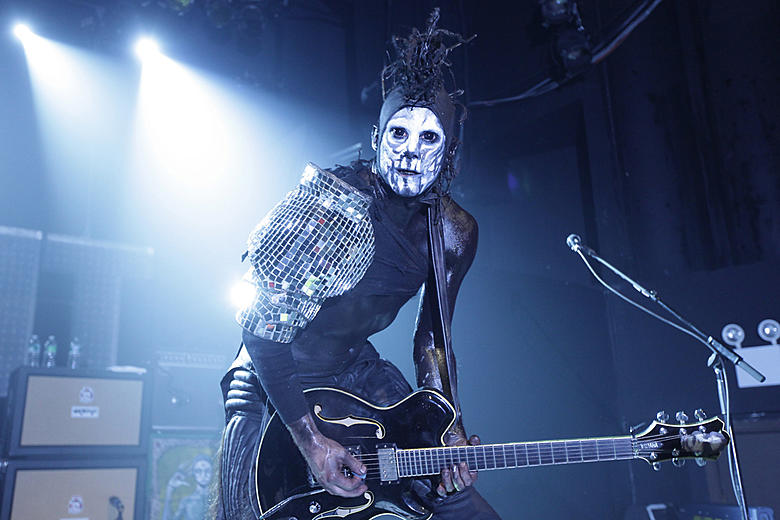
For many fans, Wes Borland was and is Limp Bizkit. His style of guitar playing is distinctive and highly creative, characterised by a mix of experimental techniques, heavy grooves, and unique sonic textures. He is known for playing in drop tunings and using various combinations of effects, in addition to the requisite heavy riffing.
If you will permit me the use of my nerd glasses, Borland recorded Three Dollar Bill with this beat up-looking Washburn. At least I think it’s a Washburn, judging by the headstock. The exact model isn’t known, but it was Borland’s second guitar. It had the neck pickup removed and who knows what other modifications. When it came time to tour, Borland started using seven-string guitars made by Ibanez, tuned to drop C#. On a six-string, this would be one-and-a-half steps below standard. But with that extra string, it went C# F# B E G# C# C#, which technically meant he was tuning up rather than down. The two high strings were used for a kind of droning effect on some tracks. Since Limp Bizkit were touring with Korn, Ibanez essentially gave him the guitars for free, and he would continue to use them throughout the Significant Other recording and touring cycles. Some of these guitars were custom-made, others were heavily modified RG, S, or AX models. He was also one of the few to endorse the RG7 CST, of which around twenty were made. It was around this time that he started using tenor guitars; he is one of the few hard rock/metal guitarists to do so. After using a modified Ibanez MC150 during live shows where the high strings were removed, he eventually had some custom tenor models made by luthier George Gorodnitski. These were tuned to a variation of drop F# — F# F# B E, for songs like “Nookie, “Full Nelson,” and “The One.”
The seven-string was popular in nu-metal, used by the likes of Dino Cazares of Fear Factory, Ryan Shuck of Orgy, and of course Munky and Head from Korn. Borland, however, found he wasn’t using it fully. Sometime during the Chocolate Starfish sessions, he switched to six-strings and was endorsed by Paul Reed Smith. He was often seen using a Standard 24 in a platinum metallic finish, a few Custom 24 models, and another custom-made four-string, during live shows around this time, up until his 2001 departure. He has used many other makes and models since, including Yamaha, Jackson, Fender, ESP, and Mayones.
Regardless of what make and model of guitar is in Borland’s hands, a key part of his sound is the Roland JC-120 Jazz Chorus, an amplifier that is rarely, if ever, used by jazz musicians. To this day, he uses it for clean tones, and it is a famous amp model for its lush clean sound, and being an excellent platform for effects pedals. For his high gain sound, Borland started out using Mesa Boogie Dual and Triple Rectifier heads and cabinets, as well as Diezel VH4 heads in the studio. In recent years, he has used different brands onstage, including Orange and EVH. For the latest Big Dumb Face record, he barely used any amplifiers at all, recording most of it with a Line 6 Helix modelling unit.
Borland’s pedalboard is where things start to get really freaky. While the exact selection of stompboxes has evolved over the years, he has always used multiple BOSS delay pedals, and some sort of reverb. For “My Way,” he ran an Ibanez CF7 Chorus/Flanger through a Selmer Zodiac amp for the track’s verses to get that buzzing, ring modulator-like sound. This particular pedal has long been discontinued, but supposedly, he will buy one if it happens to pop up on the used market. This is in addition to the plethora of distortion, modulation, pitch and filter effects that make up the other half of his board.
There are entire YouTube channels and videos dedicated to Borland and his guitar-playing. Whether it be people playing covers of Limp Bizkit and Black Light Burns songs, or people who have replicated his entire rig in the comfort of their living rooms, the quest for tone is vast and deep. Many guitarists — myself included — have become obsessed with the effects he uses and have gone to great lengths to replicate his tone. However, as the saying goes, it’s all in the fingers. Borland’s, not ours, fortunately and unfortunately.
That, and his stage presence is something else entirely. He is very animated onstage, and with the body paint and costumes he wore — skeleton, bunny, kung fu, weird alien suits — it is very hard to take one’s eyes off him.
And as Limp Bizkit’s popularity grew, Durst himself became this sort of monolithic entity, as opposed to just an entity. He helped Staind land a deal with Flip Records, and co-produced fellow Jacksonville band Cold‘s second album 13 Ways to Bleed on Stage. His eye for new talent paid off, as he became Senior Vice President of A&R at Interscope Records. He also founded Flawless Records, whose first acts included Big Dumb Face, Puddle of Mudd, and Kenna.
Fred Durst seemed to be on top of his newly-constituted world, with record sales surpassing their friends and unofficial mentors Korn. But, as with all things, after the peak comes the fall. Durst’s much-publicised feuds didn’t do the band any favours, but things really came to a head with the departure of Borland in October of 2001. He went on to form Eat the Day with his brother, Scott, while the remaining Bizkit members began 2002 with a string of open guitar auditions, the ill-fated “Put Your Guitar Where Your Mouth Is” tour.
The Fall
In September of 2003, Limp Bizkit released Results May Vary, their fourth studio album, and the first without Wes Borland. Guitar bros were somewhat curious to know what a Borland-less Bizkit would sound like. People in general not only wanted to know the album would sound, but how, and if, the band could transcend the floundering nu-metal scene and cement themselves as a timeless act.
Unfortunately, to many, Results May Vary missed the mark by a huge margin. It has long been derided by both hardcore fans and casual listeners alike.
I loved it; it has a special place in my heart to this day. Although it boasts some of the band’s heaviest numbers, it has a flavour that’s very different to the macho posturing of Significant Other and Chocolate Starfish, ignoring the obvious made-for-radio cover of the Who’s “Behind Blue Eyes,” which was little more than a Fred Durst solo track.
Rivers became a sort of de-facto band leader, playing guitar on several of the album’s tracks, in addition to his signature low-end. Mike Smith played guitar on seven of the album’s tracks and was recruited as a full-time member. He wasn’t a bad musician by any means — he was no Wes, but his tone was punchier and more mid-scooped, allowing for the band to get that little bit heavier. The Smith sessions made for the album’s best material, in my opinion.
The one track that really defined the album for me was the lead single, “Eat You Alive.”
Yeah, that’s right, the song where Durst sings about a girl he wants so bad he wants to… eat her alive.
“Hey you, Mrs. I don’t know what the fuck your name is
I’m drawn to you, something’s magnetic here
If I could approach you
Or even get close to the scent that you left behind
I’d be fine…”
Durst just lays out his baser instincts, on record. No fucks given. As Smith said, “It’s a great song with a great hook.”
Results May Vary didn’t reach the same heights as previous albums. But the lyrical subject matter and Durst getting older did make for a body of work that was more deeper and more introspective than its predecessors. “Underneath the Gun,” “Almost Over,” “Build a Bridge,” and “Drown” are examples of this. “Gimme the Mic” and “Head for the Barricade” hit hard and heavy, with some killer guitar work from Smith. “Lonely World” and “Creamer” maintain the band’s hip-hop influence, with further signs of maturity and focus. During much of the early 2000s, Durst was a household name. He was living the rockstar life — the house, the cars, his choice of women — a life that only the likes of Eminem and 50 Cent would have known. But none of it means anything; it’s all ephemeral. And it wouldn’t mean anything, even if it were multiplied by a thousand. You still have to look at yourself when you wake up and go to bed each day. Yes, tons of people would kill to have what Durst has and all that, but the fact is, rich or ordinary, no matter who you surround yourself with, all men are fundamentally alone. And one of Durst’s most redeeming qualities was that he knew this.
There is that famous line from Cicero, “Can anything be more certain than that on the theory of the school that counts pain as an evil, the Wise Man cannot be happy when he is being tortured on the rack?” I don’t know if I’m brave enough to try the torture rack, but I can see the basic point here: That if one’s happiness or contentment comes from these things that are temporary and can be taken at any time, then the fear of losing it will always be there, and we will never be content. And to understand this transient nature of things… could this be what Durst was thinking about when he penned his lyrics during these sessions? I don’t know, but it’s cool to think about.
In addition to Results May Vary itself, an unofficial companion-piece came about in the form of an album’s worth of outtakes and demos. They were never given an official release, but they circulated around MySpace for a time, and are referred to by fans as the Off the Record tracks. I count it as a good, proper Bizkit album in and of itself. My favourites: “Cowgirls from Hell,” “Masterbation,” and “Poison Ivy.”
Listening to Results May Vary, and watching MTV’s making-of documentary, you can see that Durst is going through it. Part of it was losing Borland, part of it was just this compounding thing of fame and juggling various projects and responsibilities. But what really gave fuel to the album was Durst’s relationship with Britney Spears. The two were reportedly working together in the studio for Spears’ then-upcoming album, and rumours of a relationship began to circulate in the tabloids. Spears denied any kind of romantic involvement, and Durst didn’t take kindly to this at all, “leaking” the diss track “Just Drop Dead.” As one spokesperson for Spears said, the whole thing was “very junior high.”
Not even a year after Results May Vary, Smith was out and Borland was back in Limp Bizkit. Reunited with producer Ross Robinson, the band recorded an EP, The Unquestionable Truth (Part 1). It’s a fantastic body of work in my opinion, and severely underrated. When it came out, nobody had heard of it. I didn’t even known about it until about three weeks after its release, when I was just casually browsing through JB Hi-Fi one evening. This is because Durst made a deliberate decision not to tour for or promote the album at all, a decision that confused everyone in the music industry, from critics to label executives.
My favourite track from this underrated gem? “The Channel.” I love the feel of it, but the lyrics especially. People who know me will tell you that I am obsessed with the economics of the media, and I love what Durst is saying here.
“Who gives a fuck about what I like
Who gives a fuck about who listens
As long as I’m here
As long as you know you can keep me here
For whenever you get lost
Or you need an excuse to cover up your intentionsYou hate that I express how I’m feeling
You hate that you relate to this shit
You hate that I’m a tick, a motherfucking tick
You’re finding hard to forget…”
Durst is not here to make friends. He is not here to make music that is palatable, to dance like a minstrel for the attention of radio and television programmers. He’s seen the state of consumer culture and the mainstream’s vacuous obsession with wallpaper music. Having been to the other side and back, he just wants to forget about the corporate side of things and just make a heavy record. “The Truth” is another standout track, with its industrial feel and “deliver me from evil” refrain. “The Key” and “The Surrender” are highlights as well.
Released in May of 2005, the EP sold 37,000 copies in its first week and peaked at number twenty-four on the Billboard chart. Maybe it was destined to fail, but after years in the spotlight and millions of albums sold, The Unquestionable Truth had to be the way it was. It comes back to that thing of art sometimes needing to be ugly or put people off, for the sake of contrast if nothing else.
A compilation, Greatest Hitz, was released a few months later, and with Borland departing once again, all band activities came to a standstill.
Limp Bizkit did reunite again in 2009, and have been recording and touring since, but everything they’ve put out since just feels anticlimactic and… a bit average. Gold Cobra was fine. There were some good tracks to be found, like “Walking Away” and “Loser.” Still Sucks was cool for about one listen. As overall bodies of work, the newer albums just don’t compare to the classics.
Fred Durst being Fred Durst may wind up being Limp Bizkit’s legacy. While he certainly had a knack for generating publicity and getting people’s attention, not all of it would pay dividends. His feuds with other artists and various follies are what ultimately knocked the band off their perch. From their modest beginnings, to multiplatinum stardom, to nothing, and a sort of second coming. They’re selling out arenas all over again, and they’re being embraced by a whole new audience in the youth of today, which is great. It’s taken them a long time to get to where they are — timeless artists at last.
The Conclusion
Fred Durst did his thing and talked a lot of shit. People hated him. Even I got a kick out of reading the hate sites people put up back in the day. Maybe, when you’re in the media spotlight after coming from a modest, relatively obscure background, it can do things to your perspective. He wasn’t humble, and you have that whole “ego is the enemy” thing, but there’s a part of me that kind of likes that he knew he was a big deal, and just went with it. I think pretending to be humble is bullshit anyway, nowhere near the reverse flex/mental jiu jitsu people think it is. What’s he supposed to say? “Hey man, I’m just like you,” before he hops in his limousine to go board his private jet? No thanks. I like that he owned his status, and I think all the humblebragging celebrities do is the most disingenuous shit ever. You can be rich and famous without being condescending about it. Christ. Fuck outta here with that.
Fred Durst is a man who has made a career by unapologetically being Fred Durst. Which I think is great; I have a lot of love for people who are just unapologetically themselves, provided they’re not doing something heinous or super illegal. You get the idea. In the words of Les Claypool, “You love him, you hate him, you love to hate him.”
As for Durst’s feuds and controversies… yes, well. There are too many for a comprehensive list, but I would be remiss not to throw in a few of his greatest fits:
You have the Taproot situation, where Durst was initially interested in getting the band a record deal. After they showcased for other labels, Durst went ballistic, leaving an abusive, threatening message on singer Stephen Richards’ voicemail. Not a good look, to say the least.
Then there was the aforementioned “Put Your Guitar Where Your Mouth Is” tour. Rumours of long lines, audition cancellations, next to nothing in the way of food or drink for attendees, organisational issues and general fuckery, and the waiver everybody had to sign. Translated from legalspeak to English, the waiver basically said that the auditions were being recorded, and that Limp Bizkit had the rights to any and all riffs played. This led many to believe that the auditions were just a publicity stunt, and a means of stealing a whole bunch of riffs from hapless guitarists that they now legally owned. Tinfoil, perhaps, but such legalese didn’t inspire a lot of trust. And while a few guitarists were selected to jam with the band, Limp Bizkit ultimately declined to recruit any guitarists from the auditions, leaving a bitter taste in the mouths of many aspiring guitar heroes.
And then there was his decision to pick a fight with the nine-piece metal hydra Slipknot.
At the turn of the millennium, perhaps threatened by their skyrocketing profile, Durst decided to target Slipknot for abuse, calling the band shit and their fans “fat, ugly kids.” Whether it was on the charts or in stadiums and amphitheatres, he must have felt that the town wasn’t big enough for the two of them. The masked metallists responded by threatening to kick the asses of Durst and his band, with the exception of Borland, who earned a grudging respect very early on. Slipknot frontman Corey Taylor, ever so eloquently, had this to say: “You might have lots of money and be famous, but the next time you talk shit about Slipknot and its fans, we will kill you.” Durst must have had the good sense to know that the game was lost, because he said nothing more.
Then came the fights with Creed, Placebo, Trent Reznor, Marilyn Manson, Eminem… you get the idea.
I can see why Durst drives people insane. The man is clickbait incarnate, but he is a brilliant frontman and performer, and his overall lyrical designs go way beyond just white male angst. And then, of course, Borland being the absolute force that he is. Whether it’s in Limp Bizkit, Black Light Burns, or some other project he’s working on, Borland has shown himself to be an artist of many talents, whether that be musically or in the visual arts. He walked away from the band, when he felt like the rockstar life was too much, and then came back on his own terms. He’s someone who knows what he likes, what he believes in, who he believes in, what’s bullshit, and how he wants to live his life. For every member of Limp Bizkit to truly master their craft, and express themselves through some truly incredible works and projects, is just awesome to me.
Dedication
I want to dedicate this post — something I’ve never done before — to Sam Rivers, bassist for Limp Bizkit who died in October of this year, at the age of forty-eight. Far too young. He was a phenomenal musician who went before his time, and that sucks. Rest in peace, Sam.
 Lawrence Deveney
