
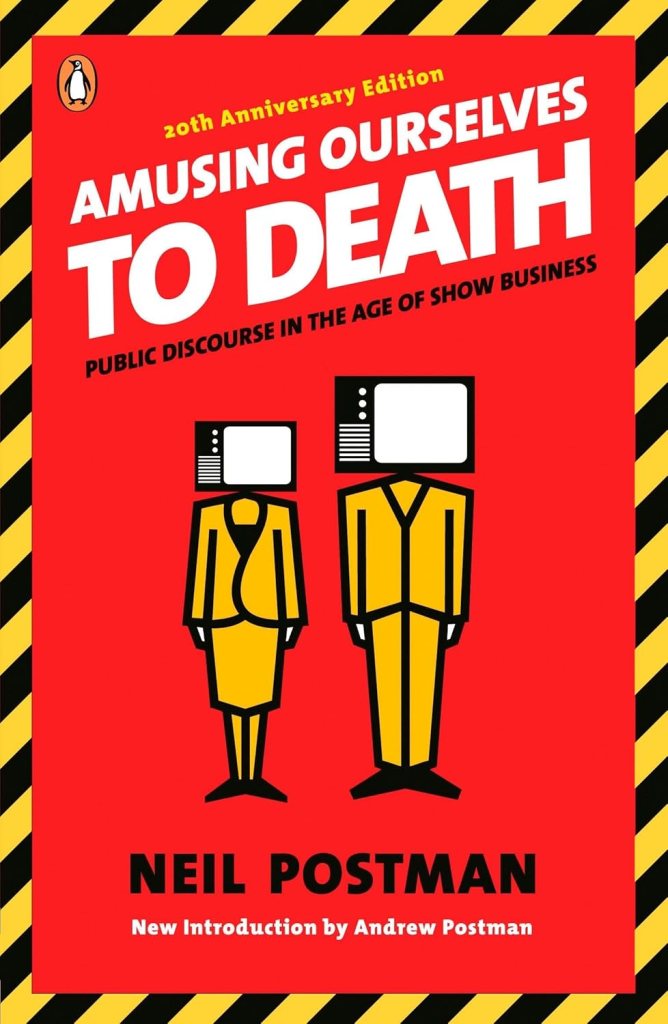
Amusing Ourselves to Death: Public Discourse in the Age of Show Business
by Neil Postman
Penguin (27 December 2005)
Amusing Ourselves to Death is Neil Postman’s 1985 text on media ecology, and the ways different mediums of communication shape human thought. Echoing Marshall McLuhan‘s theory on “the medium is the message,” it details Postman’s humanist concern that progress without moral grounding leads to the erosion of meaning, wisdom, and democratic processes. The key phrase is, “Television does not merely entertain us, it informs us by entertaining us.”
Postman argues that culture is dictated by the constraints of its dominant cultural medium. At the time of publication, it was television, and the spectacle of triviality that it brought. This meant compelling visuals, stories to “stay tuned” for, and style and theatrics over the substance of what we consume. In other words, news as entertainment. It’s all in the context of the United States of course, but seeing as we go out of its way to follow our drunk uncle’s lead in pretty much everything, it’s relevant to Australia too.
The text can be summarised with his famous comparison of George Orwell and Aldous Huxley’s novels depiction dystopian futures.
Orwell’s 1984 warned of oppression by an authoritarian force.
Huxley’s Brave New World warned of oppression by pleasure, distraction, and triviality.
Postman really leans into the latter, where the last thing one needs to fear is a juggernaut of censorship and control, but a culture glazed over by the most shallow, fabricated, and addictive media possible. No need for anything with substance or depth.
He then contrasts the “typographic mind” of the eighteenth and nineteenth centuries — shaped by printed books, leaflets, and pamphlets — with the “television mind” of the late twentieth century. He argues that print requires sustained attention, supports logical argument, and encouraging rational public debate. He sees early American culture as thriving under this print-based culture. Although, literacy rates and the standard of education during that time might have something to say here.
Then again, it’s hard to argue with his point that television, by contrast, is a visual, vapid, and decontextualised medium. Postman makes few or no exceptions when he says that basically everything on it is transformed into entertainment. News is mere spectacle, with fragmented stories, dramatic visuals, “stay tuned” and “now with the following,” and emotional impact taking precedence over factual depth. Political debates are reduced to mere performance; Bush vs. Gore in 2000 and Trump vs. Biden in 2020 reinforcing this. The televangelist culture of the eighties turned religion into a style of entertainment, with upbeat music, charismatic hosts, and emotional appeal, drastically altering the religious experience itself.
One “that’s interesting” moment, for me as a teacher. Postman goes hard on Sesame Street, a show that I always saw as fairly benign. His problem is that it creates the expectation that learning should always be fun, fast, and visually stimulating, undermining traditional schooling. On one level I get where he’s coming from, but on another level it’s something of an anachronism. Sure, students aren’t going to enjoy everything they do at school. But part of how kids learn is in how they’re engaged with a lesson. It’s the teacher’s job to things interesting, and, as far as we can help it, that means using textbooks as a last resort.
Amusing Ourselves to Death may have been written before the internet, but it’s easy to see why it endures. If anything, the book’s message feels more relevant than ever. It’s definitely prescient, with many readers seeing it as predicting social media’s attention economy, viral news and misinformation, politicians thriving on performance and charisma, emotionally-driven online discourse, and fragmented attention spans.
All delivered in a style that is clear, witty, and instantly accessible. It is a sweeping cultural critique that can appeal to academics and laypeople alike. Like so many similar authors, Postman offers next to nothing in the way of solutions; more diagnostics than a call for reform.
Fantastic text overall, and one I would recommend reading along with its follow-up, Technopoly, first published in 1992. And then, The Image by Daniel Boorstin, Empire of Illusion by Chris Hedges, and Trust Me, I’m Lying by Ryan Holiday.
 Lawrence Deveney