
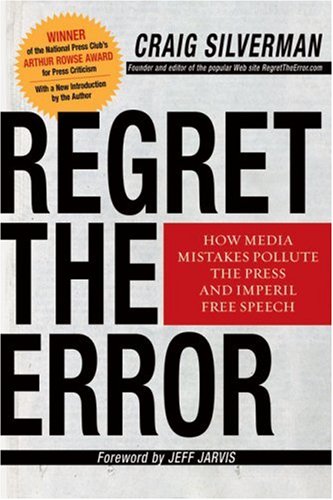
Regret the Error: How Media Mistakes Pollute the Press and Imperil Free Speech
Union Square Press (3 February 2009)
An influential book, and a good blog too. Regret the Error is about media accountability, journalistic mistakes, and why they matter. Known as an expert in fake news, Craig Silverman started his blog in 2004, collecting and commenting on media corrections — printed newspaper errata, clarifications, retractions and whathaveyou. His book of the same name was first published in 2007, not with the goal of shaming the press, but to push for higher standards in journalism.
His is a style of writing that manages to be both entertaining and serious, and I appreciate an author who can ride that line and do it well. Fact-checking and media inaccuracy make a lot of room for humour, depending on the severity. Some errors can be laughed at, like typos, misidentifications, and numerical blunders, which are pretty common and can be referenced through evidence and anecdote easily enough. Other errors are just downright scary, like deliberate misinformation and misreporting of stories, and all manner of ethical lapses.
Silverman categorises all these different errors. Numerical errors are referred to as “fuzzy numbers.” Publishing someone’s obituary while they’re still alive led to the coining of the term “obiticide.” Typos and misstatements that change meaning in surprising ways are “unidentified consequences.” And then the more serious failings, like plagiarism, fabrication, and so on.
Silverman argues that a news organisation’s credibility depends on how well they can admit and correct their mistakes. When done responsibly, corrections and retractions can build trust with readers, rather than destroy it. He calls for stronger mechanisms of accountability, not just in publishing corrections, but disclosing how errors occur and how they can be avoided in the future. Of course, the shift to online publishing has complicated things. Errors can be “scrubbed,” changed without acknowledgement of the fix or the error itself, and readers are none the wiser. He proposes “citizen journalism” as a means of holding the media accountable. The more the better, as they can apply pressure to identify and correct mistakes. Because when the media goes unchecked, misinformation is allowed to thrive, threatening discourse and free speech.
You have to remember, this was in the 2000s, when the whole idea of Web 2.0 was this feeling of optimism about decentralisation and transparency. If only things had worked out that way.
Regret the Error is seen as influential, but it’s also attracted some strong criticism. The text is full of great examples of media fuck-ups, but one issue people have is that the solutions proposed are outweighed by the volume of problems presented. That, and given that we’re in 2025, the text will likely be seen by many as dated. Again, that boundless Web 2.0 optimism that was felt. Things are different now. Social media, people scrolling through their phones instead of reading news on a desktop. Also, Silverman doesn’t give any insight into how citizen journalists and smaller news outlets can be so forceful in keeping the media in check and applying that pressure, given they probably wouldn’t have the resources. He suggests dedicated corrections editors and ombudsmen, but I don’t see how smaller outlets can put these things into practice, realistically.
Still, it’s an important text. If you’re a journalist, newsblogger, whatever, read it and check yourself before you wreck yourself (seriously). It’s useful as a jumping off point for discussions on how media institutions can correct themselves and maintain credibility, the ethics of journalism, and how the social media landscape changes all of this as it evolves at a breakneck speed.
For the layperson, it reinforces my understanding of how news is produced, where it can go wrong, and why corrections are so much more than just footnotes. Its combination of theory, history, and real-world examples make the text essential for students of history and media studies alike. For all its flaws, it provides some great value.
 Lawrence Deveney