
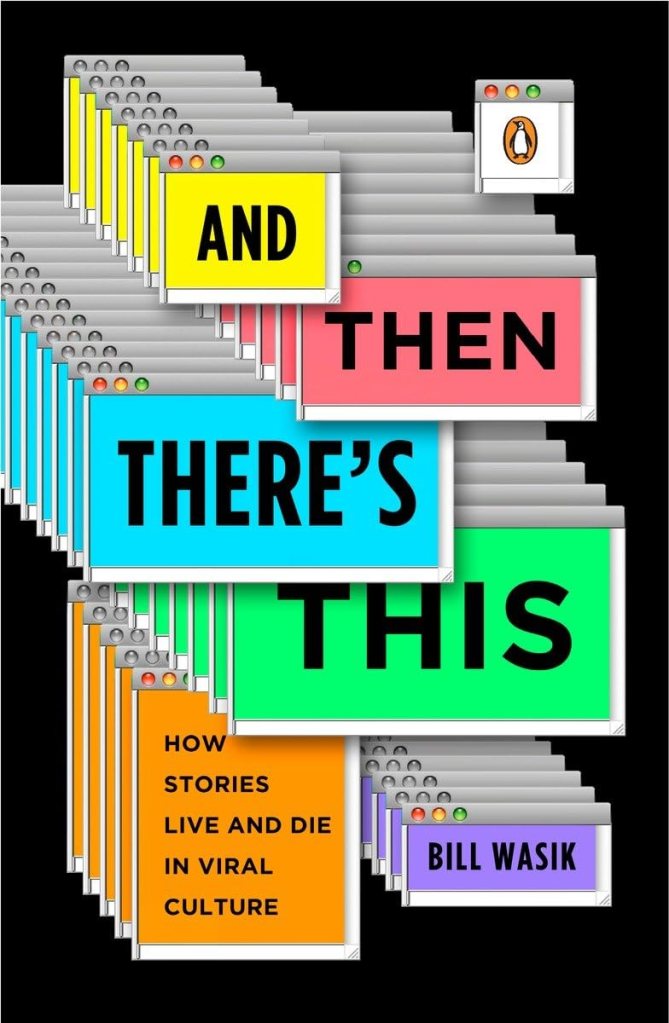
And Then There’s This: How Stories Live and Die in Viral Culture
by Bill Wasik
Penguin (31 August 2010)
If there was ever a book that could be deftly summarised in the subtitle, it would be And Then There’s This. It is exactly about “how stories live and die in viral culture.” In a hybrid of cultural commentary, journalism, memoir, and social experiment, Bill Wasik looks at the ways stories, memes, trends, and ideas have reshaped media, fame, and the ways we consume information.
Wasik’s position is that — whether they be about politics, music, pop culture, scandals and whathaveyou — stories can spread almost instantly in the internet age. They blow up, they get everyone’s attention, and they can fade just as quickly. Examples come from research and reported examples, as well as Wasik’s own experiments. “Buzz band” promotions, viral marketing, and even the first flash mobs are all explored, and Wasik gets into what grabs people’s attention, how things are shared, and the mechanisms of online hype.
From there, he looks at how these trends have altered not only the content we consume, but how we engage, the effects on attention span, how fame becomes more accessible but even more fleeting, how stories are churned out and digested so quickly… there’s a lot covered in the book’s two-hundred-plus pages.
It’s readable, engaging, and instantly accessible. Wasik doesn’t bog the reader down in jargon, and the examples of his own experiments are endearing in a way. His own observations are tangible, rather than simply abstract, making one feel like they have a front row seat to whatever it is Wasik is cooking up. That, and for anyone scratching the surface of media, internet culture, and marketing, the text is an excellent jumping-off point with a useful lens and vocabulary.
That being said, there were times I felt I was reading a book with an identity crisis. Between memoir and anecdote, and deeper reportage and sociological analysis, it did feel a bit fragmented. Wasik makes himself and his examples the focus in some parts, but I’d say if you’re going to do that, then just do it. Maybe have external examples to reinforce a point or something.
So, if you’re looking for a work of “big picture” conclusions about online media, the text falls short by that thin margin. That, and it might feel dated to modern readers, though one must always keep in mind the place and times that inform a text.
Still, And Then There’s This is worth a look for anyone with just everyday human curiosity about internet culture. The first-person accounts are great to read in themselves, and the text provides some useful insights into how flash mobs and memes became a part of today’s culture. And a lot of this is still relevant — the pace of online content, the thirst for novelty, and the tendency for sensationalised stories and memes to overwhelm anything resembling deeper and more substantive works. But if you’re looking for something more rigorous, this ain’t it.
 Lawrence Deveney