
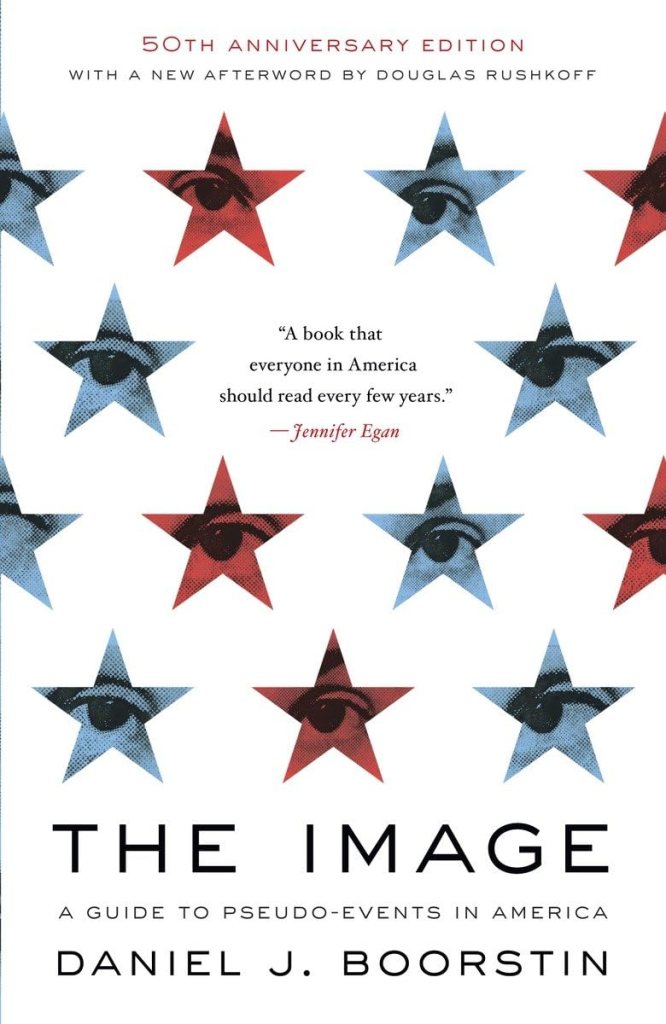
The Image: A Guide to Pseudo-Events in America
Vintage (1 September 1992)
One of the best books I’ve read on media, ever.
The Image examines how modern life became dominated by manufactured realities. Events, people, and experiences are created to be reported, promoted, and consumed. Author Daniel Boorstin argues that we increasingly live in a world shaped not by authentic experiences, but by images, media spectacles, and publicity-driven “events.” The core idea of the text being the “pseudo-event.”
Boorstin defines a pseudo-event as something that is planned in advance, created primarily to be reported by the media. It is ambiguous in its real-world impact, and designed to be repeatable and programmable, unlike organic, spontaneous events, pseudo-events exist to generate attention.
The best example is press conferences, which are held solely to create headlines. Others include staged political movements, celebrity publicity appearances, and award shows and media moments. The result is a culture where people begin to value how things appear over what they actually are. Image takes precedence over reputation, public relations over character, publicity over achievement, and so on. In other words, style over substance.
What really stayed with me is Boorstin’s distinction between heroes and celebrities. Heroes are known for their deeds; celebrities are simply known, “marketable human models” manufactured by the media. This distinction has become one of the most quotes insights in media studies.
And today? Only in such a climate do you get people like Paris Hilton, the Kardashians, Heidi Montag, or e-celebs like Nick Fuentes, Hasan Piker, Andrew and Tristan Tate… and the legions of social media influencers currently glutting the market. How do you think Donald Trump became President of the United States? The man’s political career is a pseudo-event.
Boorstin believed that modern media (television, photography, and advertising at the time of publication) had created a world of images that felt more real than reality itself. People stopped seeking meaning through direct experience, and started consuming mediated versions of life. Or put more simply, “illusions.” With these illusions, people have become addicted to “news” manufactured for easy consumption, travel that is more about comfort than discovery, politics shaped by appearances, and education driven by packaging rather than depth. Content exists just to fill space.
When I first read the text, I was a bit surprised. That feeling of, “Huh, I didn’t know that was a pseudo-event, but I can kind of see that now.” This was back in the late 2000s, and I’d taken television and early social media together. Almost twenty years later, I’m not some genius at identifying a pseudo-event on sight, but I approach the news knowing that so much of what’s out there exists — at least to some degree — to steal and monetise our attention.
The Image seems dated now, first published in 1961. That doesn’t matter, the central point of the text is so incisive that all the technological advances since have made it more relevant. I can’t imagine anyone reading it and not drawing parallels between the ideas presented and social media influencers, viral marketing, reality television, curated “authenticity” online, political image management, or just anything happening today. He wasn’t kidding when he talked about “the menace of unreality,” which is very Matrix-sounding, and a place where a lot of people on Twitter and Bluesky happen to live. One could easily interpret the text as an early warning about the attention economy and performative public life.
The Image is extremely forward-looking. It introduced concepts still used in media studies, has a clear moral and cultural framework, and has been influential in journalism, PR, and communication theory. The cultural shifts described in the text can shape how we understand truth, fame, politics, and our relationship with it all.
 Lawrence Deveney