
“The world breaks everyone, and afterward many are strong at the broken places. But those that will not break it kills.”
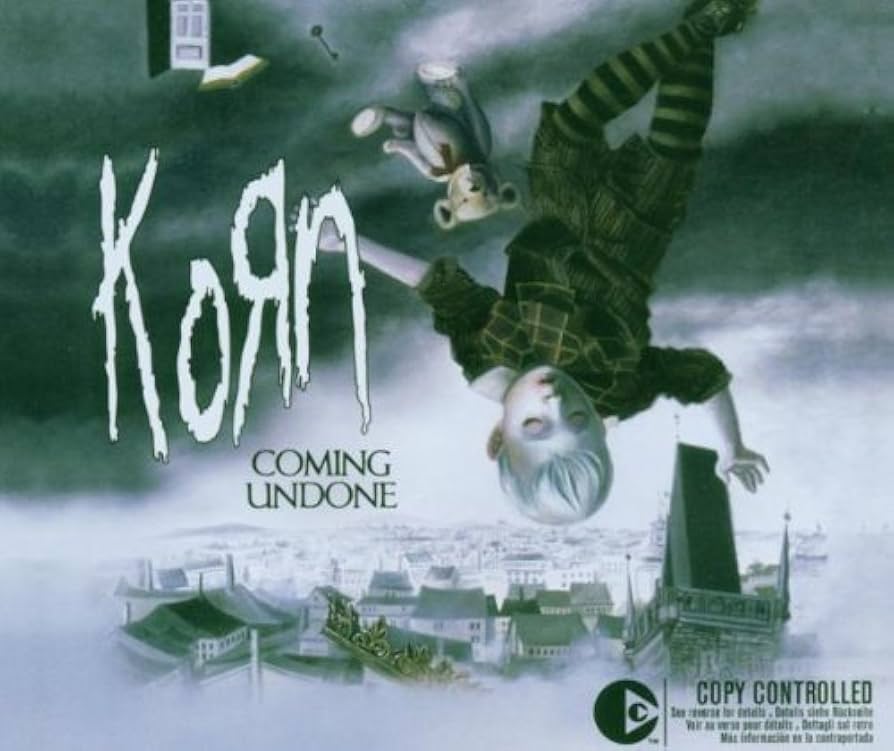
“Coming Undone” was the second single from Korn’s seventh album, See You on the Other Side. Released on 21 February 2006, it reached number four on the Billboard Mainstream Rock Songs chart, number fourteen on the Alternative Rock Songs chart, and number seventy-seven on the Hot 100 singles chart. It was charting here in Australia when the band was touring the country with Disturbed and 10 Years too, and it may be the track that defined the album’s legacy.
Directed by Little X, the music video is almost as memorable as that of its predecessor, “Twisted Transistor.” The performance footage shows the band physically… unravelling. It begins with them playing in a desert during the day, before the sky shatters to reveal the night. Then, the band start to come undone, like slinkies. By the end, they’re all gone.
Even when they unravel, the band keep on playing. Maybe I’m weird, but it reminded me of Animal from The Muppets, playing his drums even as they catch fire. As if to say, “What the hell, I’ve made it this far.”
Guitar nerds should note, guitarist James “Munky” Shaffer is playing an Ibanez K7 signature model, in a custom finish you couldn’t get in store — black with pearl binding, similar to the Universe model that was in production at the time. Very cool.
To this day, it’s one of the only songs from See You on the Other Side that is regularly played live, sometimes with a verse from Queen’s “We Will Rock You” thrown in. Which makes sense, since Queen’s classic was the first thing most listeners thought of when they heard Korn’s track; the beat is practically identical. It was included in the band’s MTV Unplugged set, with an additional string section, and unusual instruments like a saw. Yes, the band incorporated a range of unusual instruments to aid their performance, as they didn’t want the show to be just an acoustic approximation of the existing studio tracks.
It also continued Korn’s relationship with the hip-hop world, as it became part of a mashup with Dem Franchize Boyz — “Comin’ Undone wit It.” Blending Korn’s track with DFB’s “Lean wit It, Rock wit It,” the mashup was included on the CD/DVD compilation, Chopped, Screwed, Live & Unglued. Mash-ups are common now, but in 2006, the whole concept was fresh and exciting, and excellent when pulled off.
See You on the Other Side saw many changes for Korn, musically. But “Coming Undone” was the closest thing the album had to a proper, classic Korn track. Lyrically, it fits right in with the band’s material on rage, alienation, and anxiety. Inner turmoil, loss of control, and mentally breaking down.
The chorus lines:
“Wait, I’m coming undone
Irate, I’m coming undone
Too late, I’m coming undone
What looks so strong’s so delicate…”
Davis’s lyrics come from personal experience. Things that happen to him, seeing things that happen to other people. Early Korn releases took inspiration from his black sheep childhood and adolescence in Bakersfield, California. A blue collar town where you either kicked a football or got beaten up, there wasn’t much room for an introverted young male who wore makeup and listened to Duran Duran. Then came his experiences working at the Kern County Coroner’s Office, where everything — from the dead bodies to the grieving families — stayed with him, to put it mildly.
Any rocker would tell you that the perks of rock stardom outweigh the negatives, but the negatives are still difficult to deal with. Demands of recording and touring, promotions, people who hate you for your money and fame, people who only warm up to you for your money and fame, just generally feeling like a consumer product.
Or maybe it’s just living in a world of political division and dysfunction at just about every level. Compassion and respect are in short supply. Technological disruption dictates nearly everything around us, and tech oligarchs like Elon Musk, Mark Zuckerberg and Sam Altman are all in on AI data centres. The environmental impact and erasure of middle class jobs and careers are not only justified, but almost given a positive spin. It might seem cliche to say it, but the world is a cold place. It is indifferent to us and what we feel. It’s enough to make one… come undone.
What can one do? I can’t recommend any one solution, because how each person responds to their environment is different. Should go without saying, but anyway.
For me, philosophy helps. Or history, psychology, biography, or whatever. A book might not be a magic fix, but it can help put things into perspective. There is a precedent for everything, people have been through this before, and we can survive. That’s kind of what Marcus Aurelius’s Meditations was. To build that inner citadel, not so one could isolate themselves from the world, but to have the means of temporary retreat to refresh the mind and approach the problems of life from a position of strength. Nobody does this perfectly, but it is a process I like to subscribe to.
The Japanese art of Kintsugi — or, the art of repair — is growing increasingly popular in the West. Maybe it’s the aesthetic — broken plates, bowls, cups, and glasses are resealed with a special lacquer mixed with gold or silver. The idea is that those cracks and scars can actually be made to turn the object into something beautiful, even more striking than before.
I’m no Zen master, but I do appreciate what Kintsugi represents. The world can break us, but we can still grow. When things start to overwhelm me, I have my means of centring myself, of fixing those cracks and scars. I read, I go for walks, I talk to people who can give me a fresh perspective and isolate problems I can’t see. Sometimes nothing is solved, but I still feel like I have less to trouble my mind.
Davis turns to his art, his music. No matter what the haterz say, or the backstage politics. It calls to mind what Nassim Taleb wrote in Antifragile. The book unpacks uncertainty as a general concept, and ideas on how one can respond. The fragile breaks under uncertainty, the robust weathers it, while the antifragile thrives on it.
“If you take risks and face your fate with dignity, there is nothing you can do that makes you small,” Taleb says. “If you don’t take risks, there is nothing you can do that makes you grand. Nothing. And when you take risks, insults by half-men, small men, those who don’t risk anything, are similar to barks by non-human animals. You can’t feel insulted by a dog.”
Even multiplatinum selling nu-metal bands have to face their fate at some point. Losing bandmembers, drug and alcohol recovery, relationship problems of every kind. Like the antifragile, Davis learns and grows. His bandmates survive and thrive in their own ways. Whether it be through newfound religion and spirituality, in the case of some. Or just the pursuit of art, for Davis.
“Only after disaster can we be resurrected,” Tyler Durden says in Fight Club. “It’s only after you’ve lost everything that you’re free to do anything. Nothing is static, everything is evolving, everything is falling apart.”
This is far from being shallow, or chaos for the sake of chaos. One part of Fight Club is how modernity figures the human — consumer society, social expectations, status games, comfort. For Tyler, to come undone in such an environment would he the self crying for help, admitting that there is a problem. It would be a rejection of judgement, expectation, and all manner of keeping up with the Joneses bullshit that seems to affect even the most enlightened among us.
But then, the other part of Fight Club is not to get too caught up in revolutionary ideas, so there’s that to consider.
Friedrich Nietzsche wrote of a similar problem, that we live in a system of prescribed religious and moral frameworks, social roles, and herd mentality. He might have figured Tyler as an ubermensch of sorts, or Davis’s lyrics as a kind of liberation, being able to breathe again. His “Death of God” is a kind of coming undone as well. The question of how society can find meaning in a time when the morals of traditional, organised religion and institutions are no longer the dominant guiding force. Humbling and frightening for many, yes, but necessary if the individual is to break free and assert their will.
Tyler says you have to lose everything to be free. I would hope that it doesn’t have to get that far, that we can shed the validation-seeking self without some major upheaval. But that’s just me. And if it’s emotional stability without insight, then that is certainly not antifragile or part of evolution. You may need support, not some fictional archetype with cool one-liners, and I would hope that you have access to the help you need.
That, and none of these thinkers are “tough guys.” Well, maybe Taleb is a legit badass, but none of this should be taken as promoting some cliched macho posturing. To me, that’s the opposite of growth.
I kind of like what Maria Popova wrote on her blog, The Marginalian, recently.
“In the midst of a breakdown, we often wonder whether we have gone mad,” she says. “We have not. We’re behaving oddly, no doubt, but beneath the agitation we are on a hidden yet logical search for health. We haven’t become ill; we were ill already. Our crisis, if we can get through it, is an attempt to dislodge us from a toxic status quo and constitutes an insistent call to rebuild our lives on a more authentic and sincere basis. It belongs, in the most acute and panicked way, to the search for self-knowledge.”
Then again, you might have a different take entirely than any of the above. Philosophy teachers love to say there are no right answers. In that spirit, I say that these are all simply possibilities rather than recommendations.
They also could very well have nothing at all to do with what Davis was getting at when he penned those lyrics. But… these are the things I like to think about when I listen to “Coming Undone.” In general, listening to Korn makes me think about things. It’s more than just being pissed off at stuff, though that’s certainly valid with everything going on in the world. It’s a springboard for my thoughts about social structures, uncertainty, personal growth, identity, and belief and conviction in who I am and what I’m doing.
These are things I like to sit on, and while others will have different takes on Korn, I’d like to think any good music can give people something to think about.
Happy listening.
 Lawrence Deveney