
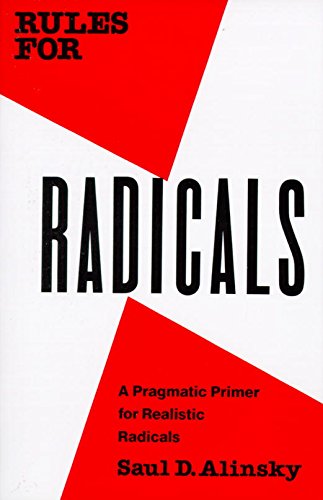
Rules for Radicals: A Pragmatic Primer for Realistic Radicals
Knopf US (26 March 1990)
Rules for Radicals is one of my all-time favourites books, and one that can be applied to today’s social and political climate in so many ways.
Saul D. Alinsky was a community organiser and political theorist, and a liaison for many civil rights, union, and student causes in the 1950s and 60s in the United States. Hillary Clinton and Barack Obama studied his works extensively, and Alinsky himself became something of a poster child among liberals in the American sense of the word. Rules for Radicals was first published in 1971, later in his career, as a how-to manual on his methods.
Key words being “pragmatism” and “realism,” the text instructs on how to implement radical agendas without the aid of radical tactics. The text has far less to do with ideology and more on strategy and tactics. Words and media are the means to disarm, as opposed to use of force and utopian rhetoric. To work with the system but shake things up from within, as opposed to simply being against it. He doesn’t preach the need for violent revolution, but strategic pressure from within. His tactics are blunt, and this has drawn some criticism, but it can also be seen as a strength, depending on how you see things.
I won’t list all the rules, but “Make your enemy live up to their own book of rules,” “Ridicule is man’s most potent weapon,” and “Pick the target, freeze it, personalise it, and polarise it” are timeless. But the common thread between them is pragmatism.
“As an organiser, I start from where the world is, as it is, not as I would like it to be,” Alinsky says. “That we accept the world as it is does not in any sense weaken our desire to change it into what we believe it should be — it is necessary to begin where the world is if we are going to change it to what we think it should be. That means working in the system.”
For all his emphasis on community organising, Alinsky was no fan of affiliations, even admitting in a 1972 Playboy interview that he never joined any one organisation, “not even the ones I’ve organised myself.” He could never accept any rigid dogma or ideology, as this leads to fanaticism, which in turn leads to all manner of crimes, from political persecution to genocide.
Ryan Holiday once described Rules for Radicals as being like The 48 Laws of Power “in a more idealistic, activist tone.” I think that’s a pretty apt descriptor. If 48 Laws is about playing the perfect courtier, and plotting and scheming your way to the top of some social hierarchy, then Rules for Radicals is a guide on how to organise collectively as a means of challenging those in power. Power isn’t so much what you have in a literal sense, but what your opponent thinks you have. Perception matters as much as material strength. Successful movements require strategy, discipline, and at times, provocation. The overlap between Robert Greene and Alinsky’s texts is a rabbit hole I could explore for days, but anyway.
Rules for Radicals was first published in a culture dominated by civil rights movements, the Vietnam war, and urban unrest in U.S. cities. A lot has changed, but some things have stayed the same. If anything, social media amplifies Alinsky’s tactics in all directions — pile-ons, memes, parody videos, coordinated calls for accountability, and just generally keeping the pressure on. Such tactics have helped movements like Black Lives Matter and #MeToo to thrive. Sure, it can devolve into mob behaviour (nobody wants another Gamergate), but it certainly produces results.
Pair your reading of the text with Reveille for Radicals, which lays the groundwork for Alinsky’s philosophy. Both are awesome and deserve to be read, now more than ever. Activists everywhere could certainly use his strategic guidance and insight, with a two-party system in shambles, and populist movements having no sense of the business of government at any level.
 Lawrence Deveney