
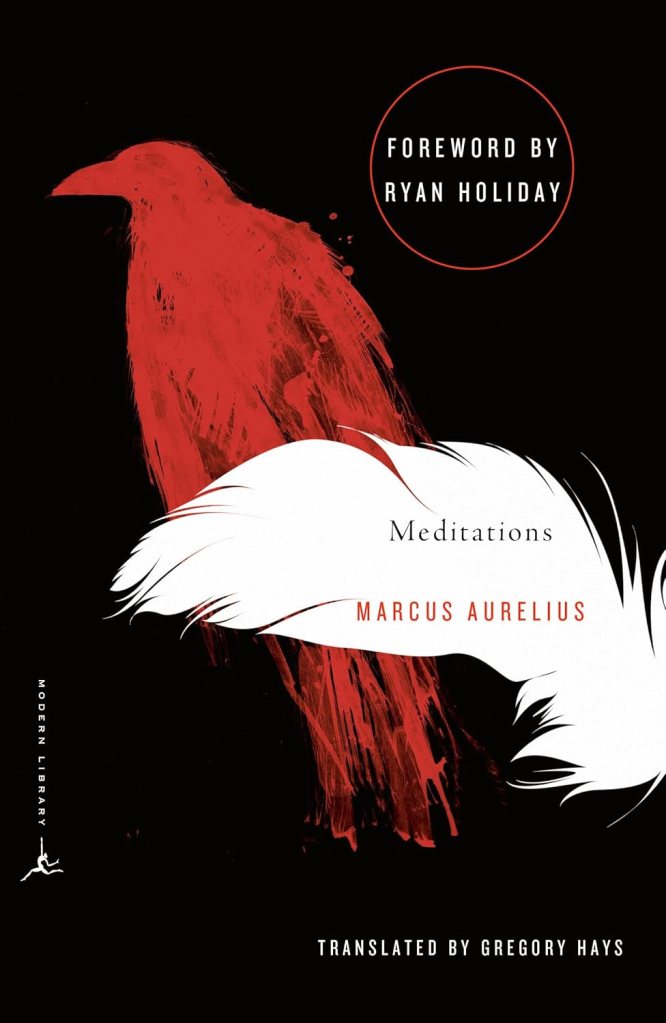
This is it. The book that has inspired people from all walks of life, from CEOs and world leaders to ordinary people alike. A favourite of Daily Stoic founder Ryan Holiday. The Meditations of Marcus Aurelius.
Originally written in Koine Greek and titled “Things Unto Himself,” the Meditations was the private journal of Marcus Aurelius, Roman emperor from 161-180 CE. It is divided into twelve books spanning different periods of his life, concerning finding one’s place in the world, and being at peace with it all. It’s unlikely that the text was ever intended for publication, it was simply a body of work that he could refer to whenever he needed to.
How many texts of this kind exist? You’d think being the most powerful man in the world would do things to your perspective. There’s always that association, that power necessarily corrupts, or at the very least have some negative impact on your worldview and sense of self. But the text reveals a man — trained in Stoic philosophy — who longed to be better. To be more just, more disciplined in the face of temptation, more courageous when trouble loomed, and above all, wiser. I know I can be more patient, empathetic, generous, humble, stronger. This is why so many cite it as the definitive self-help text. Every page has a quote you can put on your wall. One example:
“When you wake up in the morning, tell yourself: The people I deal with today will be meddling, ungrateful, arrogant, dishonest, jealous and surly. They are like this because they can’t tell good from evil. But I have seen the beauty of good, and the ugliness of evil and have recognised that the wrongdoer has a nature related to my own — not of the same blood or birth, but the same mind, and possessing a share of the divine. And so none of them can hurt me.”
It stays with me, and it’s just one of many.
It’s funny. My taste in music tends to lean towards aggressive rhythms with lyrics of frustration, alienation, and existential anxiety. Korn, Papa Roach, Limp Bizkit and all those bands — they don’t seem particularly Stoic or even philosophical in any way on the surface. And then on my shelf I have these books about ethics, self-discipline, humility, strength, and self-actualisation. Maybe I’m weird, but I think all of these things go together perfectly. Those songs of depression and anger, and then books on how to pick yourself up and go beyond. Two sides of a coin, really.
I would recommend Gregory Hays’ translation, if for no other reason than it being the most accessible. The others aren’t bad per se, but if you’re not a fan of texts loaded with “thou” and “shalt,” then Hays is the one you want. That said, it’s also worth checking out Robin Waterfield’s annotated edition, as his notes are golden. And if you’re a collector, the Daily Stoic store has a leather edition. Some might consider the latter equivalent to lighting money on fire, but I think it’s a fantastic edition that should withstand the test of time, complete with Ryan Holiday’s biography of Aurelius from Lives of the Stoics.
I mean, what more could you want? Meditations for the living room, bathroom, and bedroom.
Jokes aside… it’s been nearly two decades since I was introduced to the text. I bought my first copy in January of 2007, back when I used to lurk on the old Rudius Media forums. I miss that place sometimes, because it was a truly unique community, and I walked away from it with reading recommendations for years.
For the longest time, I read the Meditations with a sort of rugged individualism in mind. What can this text do for me? What can I do with this information? This was my way of thinking going in. It’s not like I was a Randian objectivist, but in my early twenties, my mind was young and egotistical. Selfish, even. Which is normal, but things have changed since then. The world has revealed itself to be increasingly uncertain, and as I’ve spent the last decade teaching, I’ve thought more and more about what I can do for others. There are expectations on how I conduct myself, and people who look to me to be an example, whether I think they do or should. That rugged individualism is something that was only afforded in a time of luxury and surplus. The question of what to do with a text’s information remains, but now it’s more in the context of How does this benefit people in the community? Holiday said that the text mentions the “common good” around eighty times. Maybe there’s something to that. Stoicism might not be a grassroots movement in itself, but there has to be more to it — and self-help in general — than a single-minded focus on me, me, me.
Some secondary reading: The Inner Citadel and Philosophy as a Way of Life by Pierre Hadot. The Obstacle Is the Way by Holiday is a bestseller for a reason. How to Think Like a Roman Emperor by Donald Robertson is great too. Marcus Aurelius can become an obsession, as he has with me. “How often do you think about the Roman Empire?” as the meme goes. Yeah well, of all the things people fixate on in this day and age, this particular Roman emperor is one of the better hills to die on.
Read him. Like, actually read him. Because an AI image of a buff Marcus Aurelius — promoting the personal brand and general fuckery of some manosphere influencer — is not going to cut it. Read, learn, then apply. It’s not something I do perfectly, but I try. I hope that anyone reading it can take something positive as well, however small.
 Lawrence Deveney