
“How much more harmful are the consequences of anger and grief than the circumstances that aroused them in us!”
-Marcus Aurelius
“Call Me When You’re Sober” was the lead single from Evanescence’s second album, The Open Door. Released in September of 2006, it was written by vocalist and pianist Amy Lee, and then-new songwriting partner and guitarist Terry Balsamo. From an outsider’s point of view, it doesn’t stray too far from the material found on the band’s debut, Fallen. They even brought producer Dave Fortman in a second time. However, longtime fans will note the songwriting partnership between Lee and Balsamo, and how this influenced the band’s direction.
This track is nothing if not direct, having to do with Lee’s relationship with Seether frontman Shaun Morgan, their break-up, and other things going on in her life. The line during the bridge, “You never call me when you’re sober,” is straight to the point. No clever hidden meanings here.
“I had no intention of hurting [Shaun], but when the song came out so bluntly instead of hiding behind metaphors, I had to keep it,” Lee clarified in an interview with Spin. “There were times when I was like, ‘Am I really gonna say this?’ My favourite line is when I sing, ‘I’ve made up your mind’ at the end, after singing ‘Make up your mind’ the whole song. It’s like, ‘I’ve had enough. I’m worth a lot more than this.’ But at the same time, I don’t hate Shaun. I hope he gets healthy and finds happiness.”
Fortunately, he did. After completing a stint in rehab, Morgan returned to the studio to record Seether’s next album, 2007’s Finding Beauty in Negative Spaces, and they’ve been doing great ever since. Good I say, because I like both bands, and I hope they continue to make awesome music for many years.
“Call Me When You’re Sober” is cathartic, and I’m sure a lot of fans can relate to what Lee is saying. It’s not a complicated track, musically or lyrically. It’s something that just feels bigger and bigger as it goes. Which is fitting. After a breakup, it’s easy to carry a lot of emotions. It would be so nice if there was a how-to on how to deal with it all, but no such thing exists. Something I do like, however, is this epigram from Publius Syrus, “Always shun that which makes you angry.” Ancient philosophers loved to talk about the good life, and so much of that had to do with what is in your control. Our emotions are what they are, but you could eliminate the unnecessary stimuli for anger and resentment. Or you could write a song and make it your album’s lead single. It worked for Evanescence, charting high across the world, reaching number five on the ARIA chart here in Australia.
The song feels more disciplined than what you heard on the first record, without straying too far from the band’s formla. That could be the Balsamo influence. He was more “schooled” than his predecessor, I think. Plus with his years with Jacksonville grunge-revivalist group Cold, he was simply more professional and experienced in the studio. Lee already ran through the gauntlet during the Fallen cycle, so there’s that as well. The rest of the band — guitarist John LeCompt, bassist Will Boyd, and drummer Rocky Gray — played out their parts as well, but Balsamo was de facto band leader for the instrumentation.
The music video was directed by Mark Webb and had a budget of USD $400,000. Inspired by the fairy tale, “Little Red Riding Hood,” the video is a modern take with a “more cool, superhero, rock and roll” protagonist (i.e. Lee herself). This version of Red was not afraid of the Big Bad Wolf, who was played by British actor Oliver Goodwill. MTV’s Corey Moss said it best when he described it as “an abstract take on somewhat literal lyrics,” because that’s exactly what the video is. The song itself is in-your-face and direct, while the visual is… a whole other thing. Awesome.
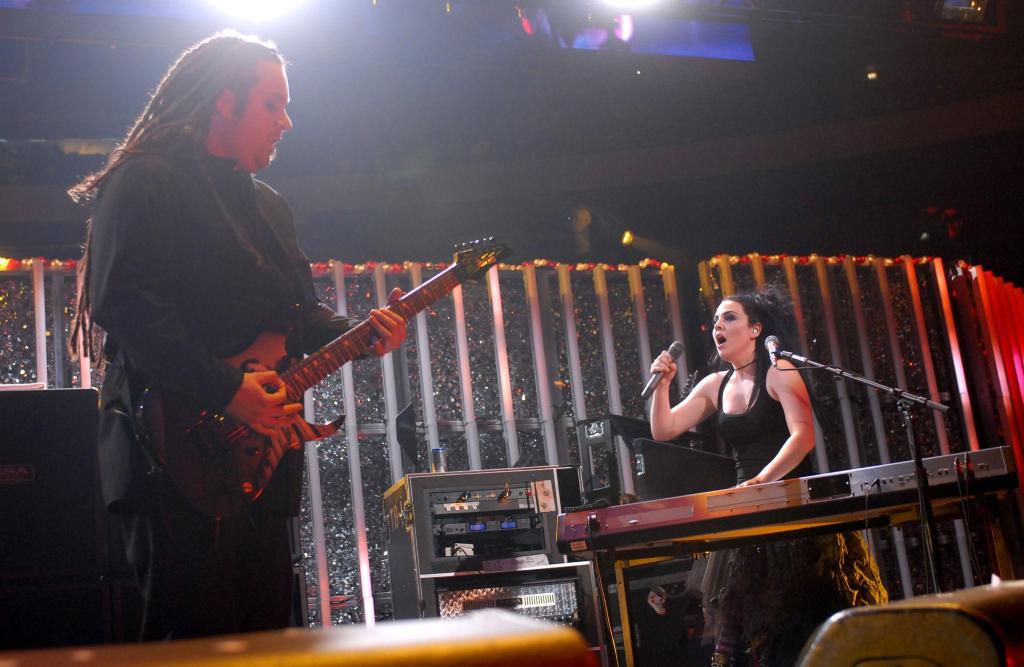
But my personal favourite thing about this song, since I’m a bit of a guitar nerd: Terry Balsamo’s Michael Myers Ibanez RG. Balsamo was endorsed by Ibanez at the time, appearing in their artist material for most of the 2000s. He was known for using a range of Prestige models live and in the studio — the RG2570EX being the most notable.
The Myers RG was either heavily modified or a custom job, possibly from Ibanez’s Los Angeles Custom Shop, with its humbucker/single coil pickup configuration and shark tooth inlays on the fretboard. And then, this cool Michael Myers graphic on the body. I imagine fans of the Halloween films would find this incredibly cool, seeing the iconic antagonist used to rock stages around the globe. This was his Drop D guitar. Another staple in his rig was Mesa Boogie Triple Rectifier amps, consistent with the band’s punchy, high-gain sound.
So with Lee’s polished presentation, and Balsamo’s high-gain wall of guitars and amps, you had a mainstream metal track with a very distinct sound. “Call Me When You’re Sober” wasn’t quite nu-metal or goth the way Fallen was; in fact it doesn’t easily fit into any niche. Maybe that’s why it’s aged so well. For all its lyrical angst, it ends up being surprisingly restrained and precise, as opposed to the unbridled bombast that defined some of the biggest acts in the 2000s heavy music scene.

