
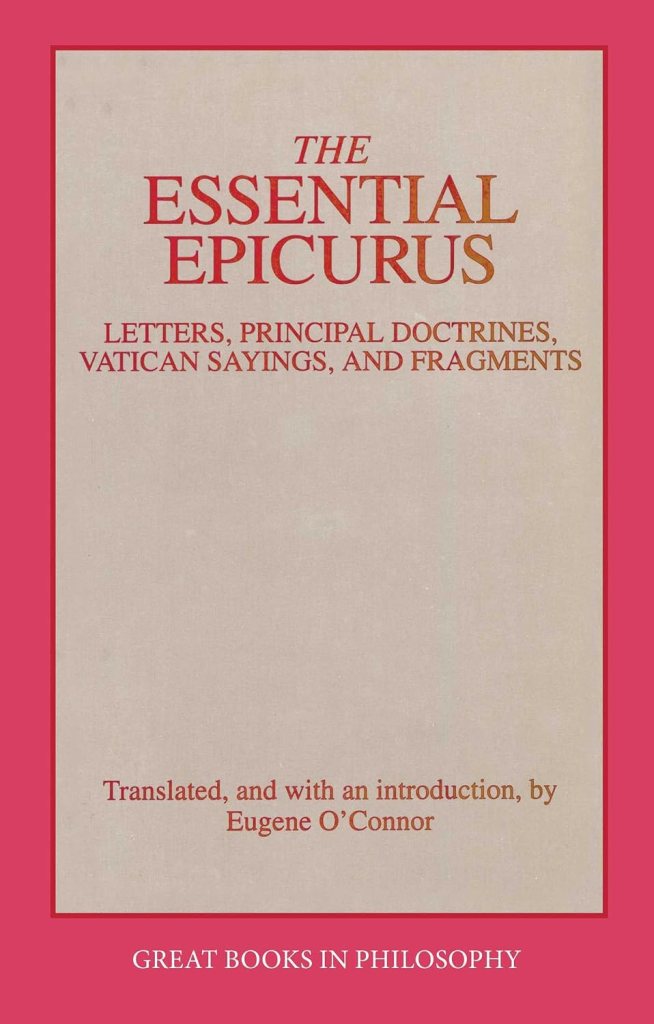
The Essential Epicurus: Letters, Principal Doctrines, Vatican Sayings, and Fragments
by Epicurus (trans. Eugene O’Connor)
Prometheus (1 May 1993)
What do people think of when they think “Epicurean”? If you’re Australian, you might think of the section of The Age newspaper that covers recipes, restaurant reviews, food guides. That’s what people tend to associate with Epicurus, but it’s far from a complete picture. Epicurus (341-280 BCE) was an ancient Greek philosopher, and his school teaches management of one’s desires, freedom from fear, and living with virtue. These things lead to lasting happiness, the highest good.
The Essential Epicurus is a nice, compact text, and a great way to get into the philosopher. It’s around one-hundred pages. Epicurus is not Stoic per se, but he’s drawn a lot of comparisons, mainly due to his attempt to answer the timeless question, “How should one live?” He arrives at some very different answers than Epictetus and others. Unfortunately, most of his writings have been lost, but what has survived has been compiled into volumes such as this. “The Principal Doctrines” and “Vatican Sayings” are considered the most important, because they give us the philosophy of Epicurus in somewhat aphoristic form.
Epicureanism became associated with indulgence and hedonism, which is silly, and all the more reason to actually read him. Shake off such misconceptions, and you will find that Epicurus was big on discipline and restraint. In traditional terms, the highest state for him would be aponia (freedom from bodily pain) and ataraxia (freedom from mental disturbance). He concludes that you don’t need much. Food, shelter and friends are essential. Things like sexual gratification, luxury foods and drink, status and entertainment are not evil in themselves, but they can be sources of anxiety and disturbance.
It’s like that line from Fight Club, “The things you own end up owning you, but do what you like.”
With that, Epicurus basically asks, what if the good life isn’t so much about acquiring more things, but eliminating unnecessary sources of suffering? His “Letter to Menoeceus” captures the essence of this perfectly, and his philosophy can be summarised as, 1. The gods are not to be feared; 2. Death is not to be feared; 3. Manage one’s desires; and 4. Friendship is essential. Pretty far from the hedonism he’s so frequently associated with.
Modern readers tend to skip Epicurus’s metaphysics, but you really shouldn’t, because so much of his philosophy is rooted in this material reality, which consists of atoms and the void. Or, that there is an objective reality we live in that exists independently of our wants and desires. Understand what reality is, and many of your fears will vanish.
Eugene O’Connor’s translation makes for a text that sits nicely alongside the many Penguin Classics editions of ancient philosophical works. Accessible and compact, one does not need hundreds upon hundreds of pages just to scratch the surface. Read a few pages, actually think about what is being said, and go about your day. Really, a one-hundred page introduction to the philosopher, to me, is preferable to a secondary interpretation that drags on seemingly forever.

