
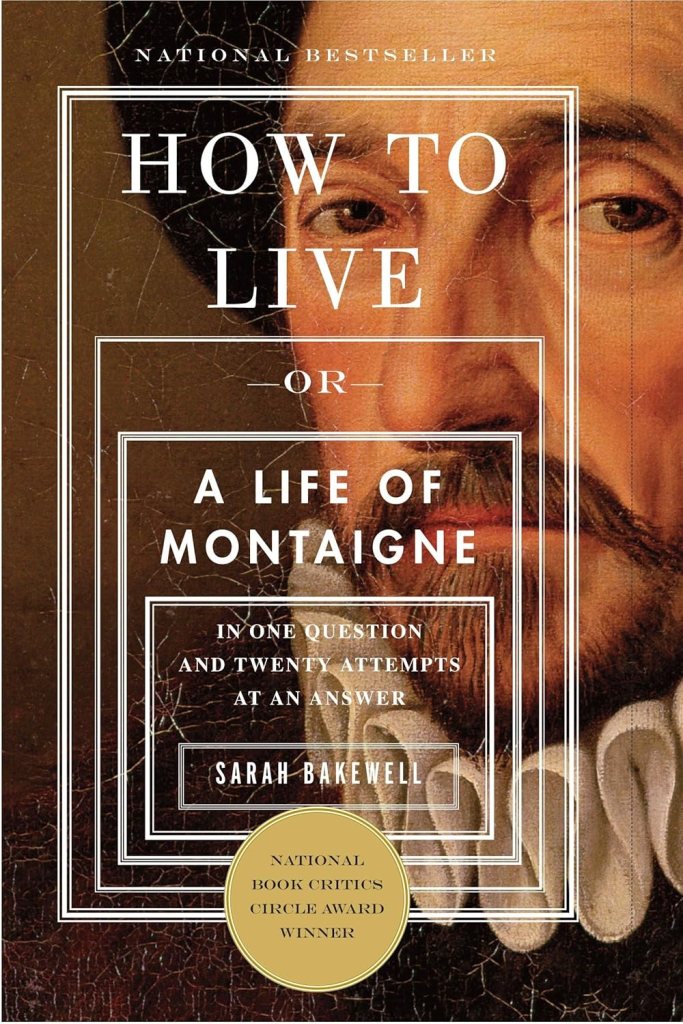
How to Live: Or, a Life of Montaigne in One Question and Twenty Attempts at an Answer
by Sarah Bakewell
Other Press (20 September 2011)
Michel de Montaigne is one of my favourite philosophers ever, and How to Live by Sarah Bakewell is one of my favourite biographies. It’s not just a conventional cradle-to-grave story of a great man. It doubles as a sort of philosophical guide on the perennial question of “how should a good person live,” or “what is the good life?” It’s an extended question on that, and each chapter serves as an “attempt” at answering.
Other biographies organise Montaigne’s life chronologically. Which is fine — Stefan Zweig’s Montaigne is a great read — but what sets Sarah Bakewell’s text apart from the rest is that each chapter has a theme, a different “attempt at an answer” that draws from Montaigne’s life and experiences. Themes like “Don’t worry about death,” “pay attention,” “question everything,” “be sociable,” “live temperately,” and so on. The best part is that they’re not presented as rigid doctrines. They are philosophical insights in the spirit of the man himself. As we like to say in philosophy classes, “there is no wrong answer.”
But then, you do get the life-and-times of Montaigne as well — his career as a magistrate, his withdrawal from public life, his role as Mayor of Bordeaux, the religious wars of sixteenth-century France — and each era is tied to the ideas he developed. He wrote about himself openly, and is often credited with inventing the modern essay. He embraced contradiction, uncertainty, and self-observation in a way that satisfied the faithful and sceptics alike. Better yet, he doesn’t feel like some stuffy old continental philosopher. It all feels very modern, as if he were tweeting today.
If you’re looking for a rigid, academic analysis of Montaigne’s life, you will not find that here. Bakewell treats the process like an ongoing conversation with Montaigne, which suits me just fine as a reader. Her voice is engaging, affectionate even. Totally wrong for philosophy, but that’s why I like it. And then, situating Montaigne among schools like Stoicism, Epicureanism, and Scepticism. But again, grounded and rooted in experience.
And Montaigne’s philosophy? I don’t want to be too simplistic, but I did find some recurring themes. Accepting what you can’t control, contentment with what you can, self-examination, moderation, tolerance, a healthy dose of scepticism, and everyday human curiosity. Another thing we tell students — be wary of any universal, totalising theory. The truth has a thousand shapes, after all.
How to Live has been very well-received. It won the National Book Critics Circle Award for Biography, and the Duff Cooper Prize. It’s often cited as an ideal modern introduction to Montaigne. And perhaps best of all, it’s a great text even if you haven’t read him. Definitely would recommend.
 Lawrence Deveney