
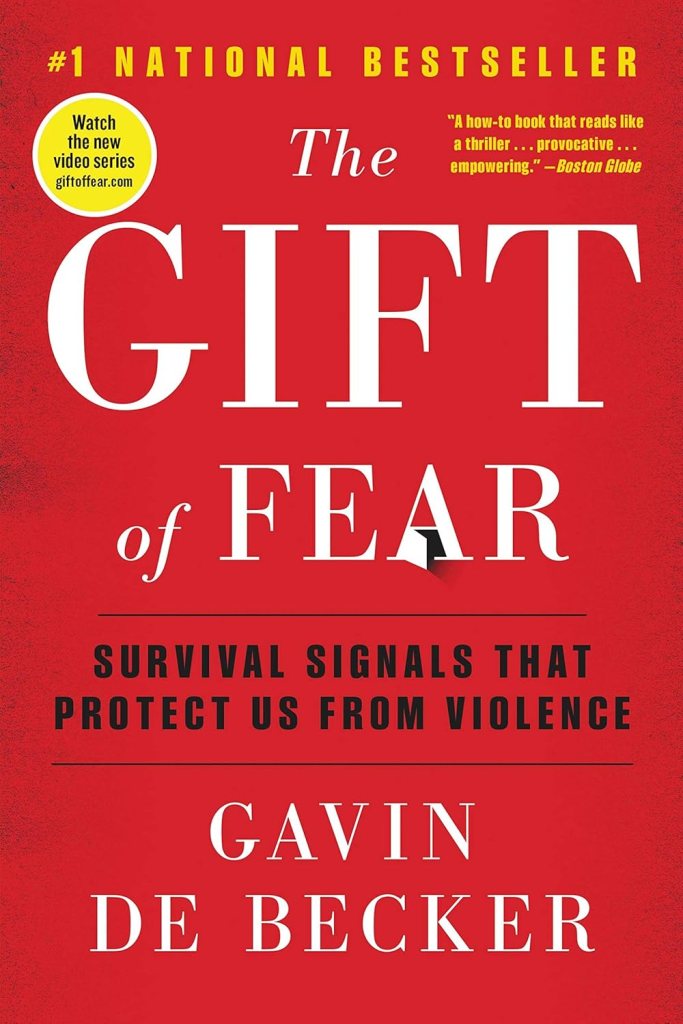
The Gift of Fear: Survival Signals That Protect Us from Violence
by Gavin de Becker
Little, Brown (30 March 2021)
Remember seeing this book on Walter White’s nightstand in Breaking Bad? Lawrence remembers.
The Gift of Fear is a bestseller on personal safety. Author and security specialist Gavin De Becker argues that one’s intuition — their sense of fear — is often a highly accurate warning system, and we should learn to utilise it, rather than try to overcome it. It’s more pop psychology than true crime, based on De Becker’s own work in providing security to governments, corporations, and public figures. It’s highly recommended in the contexts of personal safety, self-defence, and workplace dynamics.
De Becker distinguishes between true fear and anxiety. The former is a gut-level, psychological response to danger. The latter concerns itself with what might happen. True fear is based on pattern-recognition, picking up subtle cues before your brain can catch up. That is, if something feels off, it often is, even if you can’t explain why.
The text is mostly fine. Its value lies in its naming of some of the most common manipulation tactics that predators might use to influence people. “Forced teaming,” or acting like you and the other person are “in this together” is a major one. Use of charm and niceness as tools rather than common traits is another. Or not taking “no” for an answer, completely ignoring boundaries. These are just a few, but once you start to recognise these patterns, it’s like you can’t un-see them. De Becker goes deeper into the whole “no” thing. He argues that the word is a complete sentence. And yet… and yet… many people — especially women — are conditioned to say “yes,” to avoid appearing rude. This instinct can be dangerous, and a person’s refusal to take no for an answer should be considered a red flag.
Then there are behaviours that precede violence. Escalations in attempts at control, refusal to accept rejection, sudden bursts in intensity or entitlement, or boundary-pushing that gets worse over time. De Becker does not claim this to be a perfect system, but that there is merit to the idea of patterns existing and being recognised.
That’s the good. However, the text does have a few problems. One common criticism is that patterns can be overgeneralised, and readers might become overly suspicious when it isn’t due. Another is the emphasis on anecdotal evidence over empirical, which has left a bigger impression to some. And the text’s framing of gender and victimisation might strike the modern mind as a bit dated. As progressive as we’ve become, it is hard for us to shake that, the masculine-coded thing of “always bring an umbrella when it rains” in the context of social interactions. However, the text’s general advice of trusting your instincts — instead of ignoring them and saying “it’s probably nothing” — and enforcing boundaries is sound.
A more personal gripe: De Becker talks about how we subconsciously perceive threats to our safety, and that if we were more in tune with our feelings, then we could prevent such threats from happening. That’s interesting, but I wonder how much of it is just hindsight bias. I would prefer to just admit how vulnerable we really are, and that anything else is just a coping mechanism.
That being said, The Gift of Fear is at least worth a look. I think there is value in a text that reframes fear as useful information, rather than weakness, and I can see why it’s recommended.

