
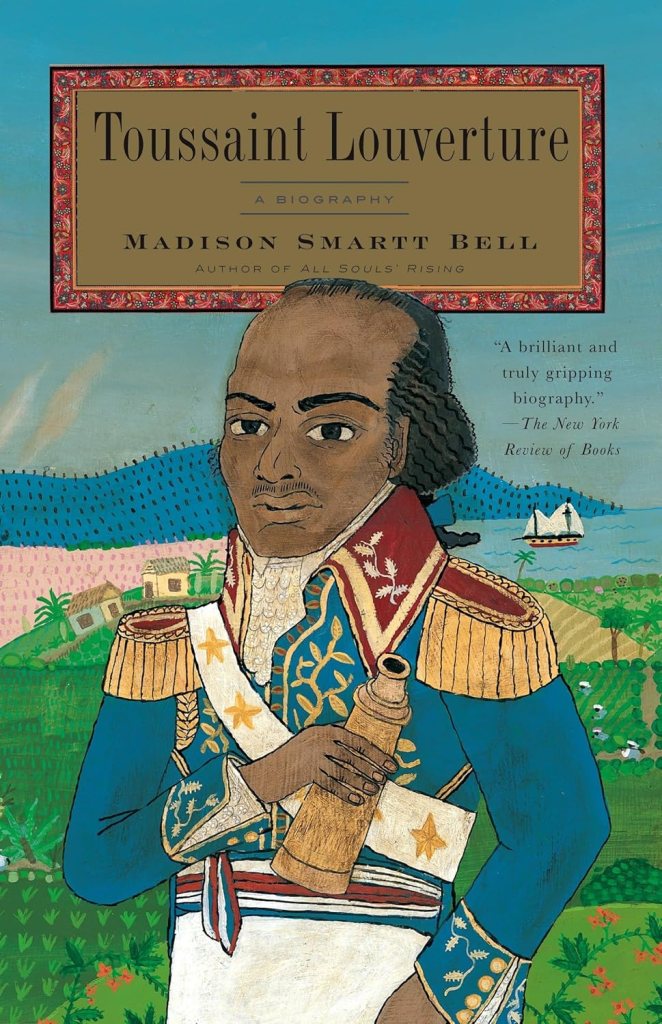
Biography of a former slave who challenged an emperor and led the Haitian Revolution. Relatively short, but dense, which might be due to Madison Smartt Bell‘s background as a novelist.
If you were being kind, you would say Louverture was a divisive figure. For some, he’s a heroic liberator and revolutionary. To others, he’s seen as a ruthless, opportunistic dictator. Bell doesn’t really lean into either one, but presents the man as a paradoxical figure. He was pragmatic, and harsh, but also someone who seemed genuinely committed to ending slavery and stabilising the colony that was Haiti. He was likely freed before the revolution, and even owned slaves at one point. It wasn’t like he just jumped into the 1791 revolution as a pure ideologue. So, his story isn’t as cut-and-dry as some might expect.
Plus, to write a biography of Louverture would have presented one pretty big hurdle — the fact that there is so little in the way of primary sources on him, especially his early life. Bell managed to form a complete text with just fragmentary records and letters, often with conflicting accounts. The reader has to speculate when information is missing. Still, the text is upfront about this. Bell had already written a historical fiction trilogy on the Haitian Revolution, so maybe it’s fitting that Louverture would end up as an unreliable protagonist. You couldn’t get away with that in an academic history book, but for a work of narrative nonfiction, it’s fine.
But it’s not like the text is short on actual history. Bell goes deep into the political and economic reality of Haiti leading up to and during the revolution. The colony of Saint-Domingue was the richest and also the most brutal slave colony in the Americas, and there were multiple European colonial powers to contend with. Britain, France, Spain, not to mention internal factions. It was like a classic case of prisoner’s dilemma where no choice seemed “good.” Louverture maintained plantation production, and while there was payment for workers, it was all very tightly controlled. And it wasn’t like he didn’t value freedom. He did, but these ideals had to be matched with the belief that emotional discipline was necessary. It meant survival. So yes, he may have seemed ruthless to some, but given what was happening at the time, any attempt at state-building meant extreme pressure.
It might not be a comprehensive work, but Bell’s Toussaint Louverture is a quick, accessible text that tells a compelling story. It might feel uneven, but it was his first major English-language biography in decades, and it’s nice to see one written by an author so deeply immersed in this historical period. And it is a compelling narrative. Neither hero nor villain, Louverture is a complex figure in every sense of the word. And who knows, it could be a jumping-off point to other works on the subject.
 Lawrence Deveney