
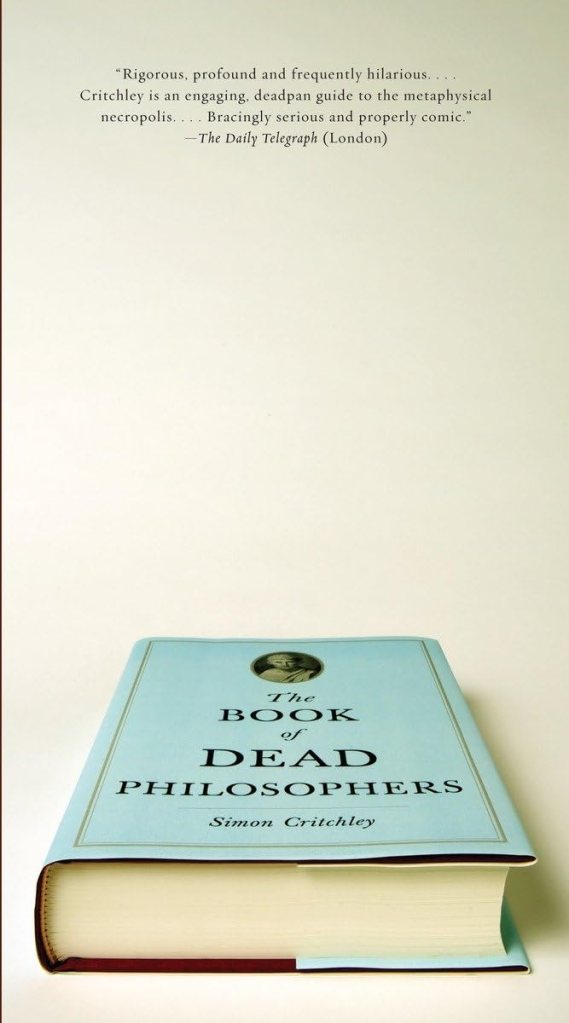
I wish we had this book when I studied philosophy during my VCE and undergrad years. The ones assigned — aside from all the photocopied extracts of Plato and Nietzsche — I’d honestly forgotten until I was drafting this post. Sophie’s World by Jostein Gaarder and The Philosophy Gym by Stephen Law weren’t exactly what I’d call stellar. And yet they are considered by curriculum people as “important.” Yeah.
For many, The Book of Dead Philosophers might seem like an unusual choice for an introduction. I would make the case that it works perfectly. Rather than neatly organise philosophers by ideas, schools, or eras, Simon Critchley organises them by… how they died. And it contains entries on nearly two-hundred philosophers, from the pre-Socratics to Michel Foucault and Jacques Derrida.
It’s no gimmick — Critchley uses this to explore a claim that might just be as old as philosophy itself. It’s a claim often associated with Socrates, Cicero, and Michel de Montaigne. And that is, to philosophise is to learn how to die. Questions about mortality, finitude, what is the good life, and what constitutes a good death have dominated philosophy for centuries.
Some of these stories are absurd, others tragic. Causes of death vary wildly, from self-imposed starvation, succumbing to illnesses, suicide, political violence, old age, or from laughing too hard at one’s own jokes. Critchley had fun with this, and one can’t help thinking he delighted in the details (to be fair, I would too). But he manages to connect everything back to the philosophers’ ideas. All of this makes for a concise history of philosophy. Each entry is just a few pages long, so there’s no sense that you’re wading through a textbook. That’s what makes a book like this, I think — being entertaining while also being informative.
I wouldn’t want anyone to think of the text as being morbid for morbidity’s sake. Critchley’s message is life-affirming, that one can live more deliberately and honestly by confronting their mortality. “In learning how to die, we learn how to live,” as he says. And I think that’s why the text has endured. Scholarly, sometimes melancholy, but funny and uplifting all at once. Everyone (I’m assuming) has that friend who seems to know infinity stories about this or that obscure topic. Sometimes you’ll get a good laugh, or nod your head and think “that’s interesting,” or both. The Book of Dead Philosophers is that friend, in paper format. Every bizarre death in Western philosophical history, in this case.
 Lawrence Deveney