
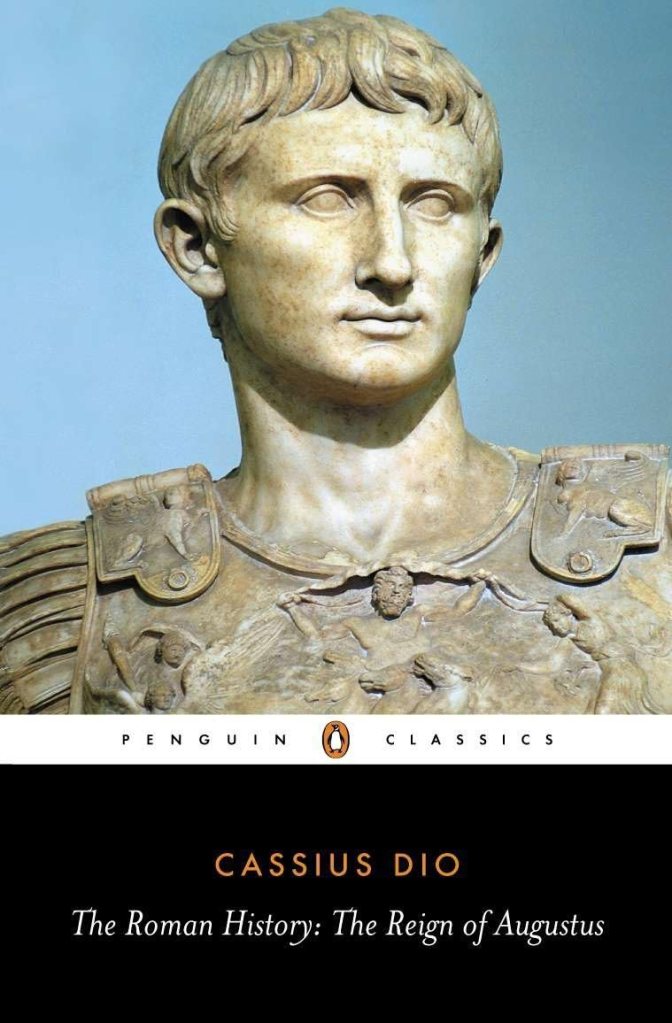
The Roman History: The Reign of Augustus
by Cassius Dio (translated by Ian Scott-Kilvert)
Penguin (1 June 1987)
Another one for those who like to think about the Roman Empire. The Roman History by Cassius Dio is an excellent intersection of history and philosophy, and one of the most important surviving accounts of how the Roman Republic became… the Roman Empire.
Dio (155-235 AD) was a Roman senator of Greek origin. He served under several emperors, eventually becoming consul (twice). He was not simply a disinterested observer (and let’s face it, that is an awful lot of academic historians), but someone who spent decades inside the Roman political system, understanding it thoroughly. At some point around the third century AD, he wrote an eighty-book history of Rome, covering nearly a thousand years. From the founding of Rome, to his present day. This put Dio in a unique position, understanding both the ideals of the old Republic, and the pragmatic realities of imperial government.
What was his interest in Augustus? Born Octavian, Augustus was arguably the most consequential figure in Roman history. After his great-uncle Julius Caesar was assassinated, Augustus found himself heir to his will and political cause. He defeated Mark Antony and Cleopatra, and became Rome’s sole ruler while insisting he had restored the Republic. This represented a paradox, and became an endless source of fascination for Dio.
How do you end a republic while claiming to preserve it?
How can you make one-man rule palatable to those who hate the monarchy?
How do you secure a republic without appearing tyrannical?
These are not idle questions, and they occupy much of Dio’s account.
The most famous part of the text is the dialogue between Gaius Maecenas and Marcus Vispanius Agrippa. Whether this dialogue actually happened is up for debate, and most historians think that Dio composed it himself (fun fact: Plato exaggerated or otherwise made up a good chunk of Socrates’s dialogues). Agrippa argues for the restoration of the Republic. Maecenas argue for monarchy. It helps to treat these dialogues less as a historical transcript, and more like a reflection on political theory. Dio used them as a springboard to address a variety of questions. Is liberty worth the instability it can bring? Is efficiency more important than maintaining the constitution? Can a benevolent dictator produce better outcomes than a dysfunctional republic?
It reads a lot like today’s political debates, really. The end of democracy, the rise of the far-right, fascism, communism, social democracy, etc. Peter Thiel often makes headlines for having an opinion about something. He’s the kind of Silicon Valley-Aspergers type of thinker who has never had much faith in the democratic process, believing that a strongman can guide a nation in the right direction. Is he onto something, or is he completely batshit insane? Only time can tell.
How reliable is Dio as narrator? As a senator, he had access to senatorial traditions and official records. He had a thorough understanding of Roman institutions, and could provide careful explanations of what motivated political figures. Most importantly, to me at least, he had a longterm perspective that is simply not available to contemporary writers. That being said, he wrote two centuries after Augustus, and as mentioned above, he would often shape dialogues to express ideas rather than record exact words. And I don’t know if this is really a criticism per se, but Dio’s own experience under specific emperors would have coloured his interpretations of earlier events. Something to keep in mind at least.
That being said, he was in a unique position as far as writers go. Riding the line between history and philosophy, he doesn’t merely recount events one, two, and three. He asks enduring questions about power, ethics, and governance, though they can be simplified to this:
When a political system is failing, is it better to preserve its ideals, or replace it with something more stable?
What you do with that question is up to you.
You don’t need an encyclopaedic knowledge of Ancient Rome to enjoy the text, though I would say a beginner’s understanding of Julius Caesar, Mark Antony, and Augustus can help. And if you enjoy Dio’s works, then I would also recommend Selected Political Speeches by Cicero, The Twelve Caesars by Suetonius, Annals by Tacitus, and even Augustus’s own Res Gestae Divi Augusti.
Or if you don’t particularly feel like reading, check out HBO’s Rome. Heavily dramatised of course, but it captures the rise of Augustus (Mark Pirkis in season one, Simon Woods in season two) very well. Not a towering “great man of history” like his uncle, but a quiet, bookish young man. He’s a figure who wins by patience, administration, smart choice of alliances, and extraordinary political instinct. Seemingly harmless and unassuming, it makes his rise even more brutal and awesome. Shame on HBO for cancelling the show after only two seasons.

