
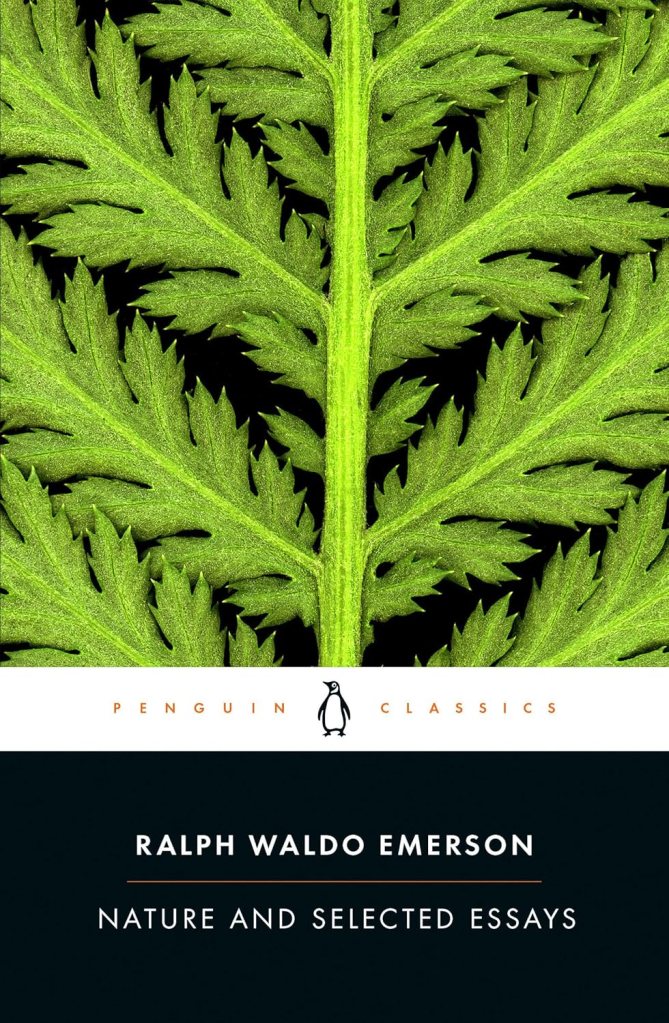
If you enjoy reading the essays of Seneca and Montaigne, then Ralph Waldo Emerson works nicely as a next step. He complements them while setting his works apart in a uniquely American way. I am referring to an emphasis on drive and ambition, in a healthy sense, rather than the modern “hustle and grind” sense.
“Nature” is the drawcard, obviously. But this collection also includes other famous essays such as “Self-Reliance,” “Spiritual Laws,” “Friendship,” and “Politics.” I have the Penguin Classics edition, and while other editions vary in terms of content, they all have more or less the same greatest hits.
The text begins with “Nature” for a good reason. For Emerson, people in the modern world became detached from reality, by relying too much on inherited institutional knowledge, traditions, or some other forms of second-hand knowledge. He argues that one should engage with the world directly. It’s in the opening statement, “Why should we not enjoy an original relation to the universe?” There is a tendency to think of nature as scenery, but for Emerson, it is so much more. Nature is a teacher, a spiritual guide, a source of truth, a mirror of the human soul. Walking through the forest is a spiritual exercise, a way of meditating on one’s philosophy.
“Self-Reliance” is what most people think of when they think of Emerson. Trusting your own experience, not because you’re infallible, but because genuine understanding comes from thinking for oneself. His famous line, “Trust thyself,” and relentless critiques of conformity, really hit the spot for a lot of people.
If you’re looking for a philosopher who writes in a logical, structured way, Emerson probably isn’t it. He tends to write in bursts, and his writing is basically a series of aphorisms threaded together. A single paragraph can be all over the place, in the best way possible. First it’s about the stars, then politics, then friendships, then… whatever. There is a harmony to it all, but it’s more intuitive than propositional.
Books of essays have always been my thing, and Nature and Selected Essays is a natural fit, up there with the likes of Seneca’s Letters from a Stoic, Montaigne’s Essays, Simon Critchley’s The Book of Dead Philosophers, Nassim Taleb’s The Black Swan, and various biographies and works of nonfiction. The only thing I would prepare for is his form, rather than just his ideas. Seneca is methodical, Montaigne is conversational, Taleb is… well, Taleb for the most part. Emerson would rather just give his two cents than prove a theory. Like he mastered all the rules of the classics, and then proceeded to toss them all out the window and go from there. Almost like a motivational speaker, which is also a very American thing.
Happy reading.

