
“We can easily forgive a child who is afraid of the dark; the real tragedy of life is when men are afraid of the light.”
-Michel de Montaigne
Breaking Benjamin’s third album, Phobia, elevated the band from a promising grunge-revivalist combo to one of hard rock’s biggest acts. Released on 8 August 2006, it cemented the band’s identity with more polished production, heavier guitars, a darker atmosphere, and soaring choruses that made hit singles like “The Diary of Jane” and “Breath.”
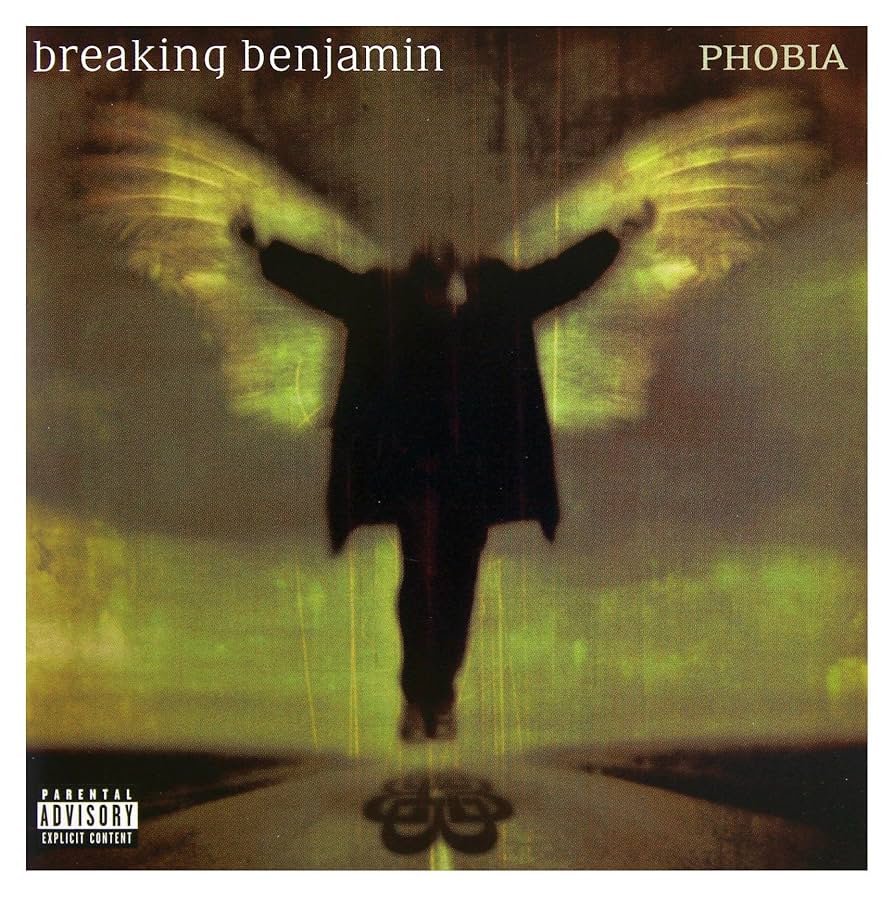
The title is a cool-sounding name, but it goes a lot deeper than just that. Frontman Benjamin Burnley has talked at length about his various fears — particularly of flying — and the album has a strong sense of fear and anxiety throughout. The opening, “Intro,” is made up of airport noise, and a flight attendant issuing standard safety procedure announcements. The “Outro” is similar, making the album one long journey through this. The cover art, depicting a man suspended above a runway, only reinforces the whole concept.
Musically, the album is defined by a sense of restraint and precision. Thick, downtuned guitars and layered vocal harmonies are fine and all, but they also added a sense of confidence in alternating between subdued verses, and choruses that seemed to aim for the stratosphere. Their 2002 debut, Saturate, was a solid debut. Its only weakness was a lack of anthemic tracks later releases would have. Their sophomore effort, 2004’s We Are Not Alone, managed to expand the band’s fanbase with the success of singles like “So Cold” and “Sooner or Later.” They might not have tried to do anything special with Phobia, but the album just managed to blow up. Maybe they’d just fine-tuned their sound by that point, and Burnley approached his lyrics and overall strong structures with greater confidence and intensity.
“The Diary of Jane” is the band’s signature track. Instantly recognisable instrumentation, and lyrics lamenting the Jane Does of the world being filed away as statistics in reports. “Breath” makes for a nice, heavy radio single, and it stayed at the top of the rock charts for several weeks. “Until the End” made for a nice crossover hit, melodic enough to appeal to fans of all kinds of genres.
But as always, it would be silly to focus on just the singles. The album’s deeper cuts get even more interesting. “Dance with the Devil” quickly became a fan favourite, with a dark, brooding atmosphere that builds and builds into one of Burnley’s strongest vocal performances. “Unknown Soldier” boasts a hitherto unforeseen combo of military imagery and a reflective tone. A nice contrast from the straightforward, fist-pumping patriotism that defined the Bush era. “Evil Angel” is another showcase of the band’s melodic instincts juxtaposed with crushing, heavy guitars.
Ever read The Gift of Fear? That book on Walter White’s nightstand in Breaking Bad? Author Gavin de Becker differentiates between natural, healthy fears, and what’ could be called’s basically unexamined anxiety. The difference between signal and obsession. “The Diary of Jane” explores this kind of contrast. A lot of gothic literature explores this as well — horror and terror. The former is physical, tangible; the latter psychological, abstract.
It’s like that famous quote from Seneca, “We suffer more in imagination than in reality.” Not to downplay actual suffering, but when anticipation and dread start to take the wheel. “Fear leads to anger, anger leads to hate, hate leads to suffering,” as a certain green sci-fi puppet once said. Philosophy would have one separate what’s in one’s control, and what isn’t. But then, maybe that’s the whole point of Phobia as a body of work. I would surmise that Burnley is someone who acknowledges his fear, used it as a source of expression, and has poured it into his music for the listener.
You have to give credit to producer David Bendeth for the album’s sound. He’s known for his hard-hitting drum sounds (one famous example being Paramore’s “Misery Business“), but he worked wonders with the guitars and bass tones on Phobia. I’m a picky listener, and I’m never impressed at a heavy record where guitars are competing for space, and/or sound muddy. On this album, every instrument has its lane. The guitars are tuned low (Drop A#) without getting all muddy. At the time, Burnley played baritone guitars custom-made by PRS. He has since moved onto ESP, and in 2017 they released a signature model, the BB600 Baritone. Aaron Fink played Ernie Ball Music Man and Washburn guitars during his time in the band. They recorded with a mix of Marshall and Soldano amps, with more midrange than your average nu-metal act, if I remember right (I’m not much into any of those brands and models, but they might work for you). The drums sound huge, thankfully without that annoying multiple-kick sound that blots out everything else. It’s a style of production that has aged very well.
That’s the production and instrumentation; back to the lyrical subject matter, or rather Burnley’s fears. Loss, betrayal, being forgotten, and broader themes of depression and emotional dependency. Burnley really laid everything out on this album, but with enough ambiguity in his lyrical designs to allow the listener to figure their own experience into it. Probably why the album has endured this long.
Breaking Benjamin were already playing a set of theatre and club dates, including some shows supporting Staind. In late 2006, the band opened for Godsmack on their IV tour. Both ideal crowds for Burnley and co. A few scheduling conflicts led to Breaking Benjamin headlining their own shows, while “The Diary of Jane” took off and became the hit we know today.
2007 saw an even busier schedule. The band’s performance at Stabler Arena in Bethlehem, Pennsylvania was used for their DVD, The Homecoming, which was released with reissues of Phobia. That footage was also used for the “Breath” music video. They also co-headlined a tour with Three Days Grace, with Puddle of Mudd and Red supporting at various points. Seether and Skillet would also serve as support later in the year. That whole era was like a who’s who of post-grunge, all those straight-ahead rock bands that came of age after the Seattle movement came to a halt. If you’re into that scene, then I imagine 2007 would have been a pretty exciting time.
Phobia was Breaking Benjamin’s highest-charting album, selling 131,000 copies in the United States on its first week (that was until 2015’s Dark Before Dawn). I think it’s one of those commercially successful albums that well and truly deserves the hype, a body of work where frontman and band are at their strongest. I’d really have to stop and think about any negatives. Repetitive? Maybe, but I tend to think of it as consistent. It’s music without pretence. It doesn’t go out of its way to be progressive, or in any way fashionable. It’s just good hard rock music, tightly written and executed. I cannot think of even one filler track, so I’d recommend the entire album start to finish. It just has that right combination of polish, heaviness, and emotion. It represents everything the band do well, and as such, remains one of the standout hard rock albums of the 2000s.

