
“Empty your mind. Be formless, shapeless, like water. You put water into a cup, it becomes the cup. You put water into a bottle, it becomes the bottle. You put it in a teapot, it becomes the teapot. Now water can flow or it can crash. Be water, my friend.”
-Bruce Lee
Bands have eras, classic line-ups that stay with the fans long after changes are made. You have Korn’s classic line-up with the original five members. The original nine members of Slipknot. Foo Fighters when Taylor Hawkins manned the drum kit. And with Papa Roach, you had four major label albums with frontman Jacoby Shaddix, guitarist Jerry Horton, bassist Tobin Esperance, and founding drummer Dave Buckner.
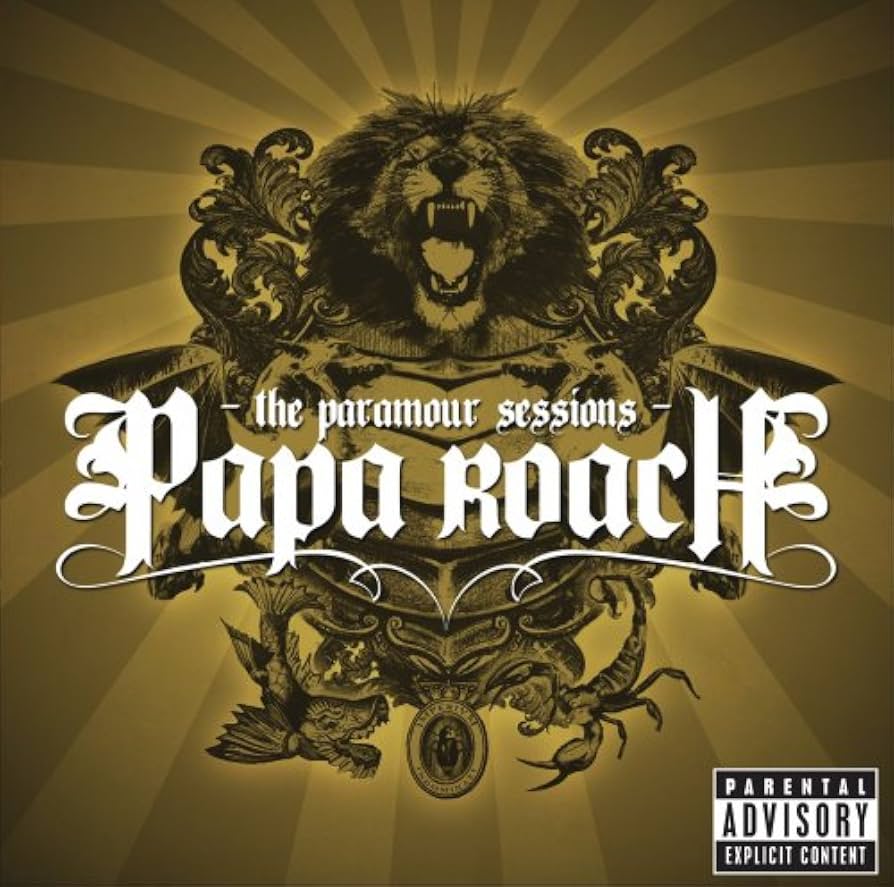
Released in September of 2006, The Paramour Sessions would see this classic line-up come to its end.
Papa Roach have long been remembered as one of nu-metal’s biggest acts, but they always managed to evolve over time. They had one of the strongest major label debuts with 2000’s Infest. Propelled by the success of hit singles like “Last Resort,” “Broken Home,” “Between Angels and Insects,” and “Dead Cell,” it remains their greatest commercial success. They came out the gate with such a fully-formed sound that they could have coasted off it for years. But they didn’t. 2002’s Lovehatetragedy was far less rap-oriented, but didn’t stray too far from the overall song structure and style, as seen with modest radio hits “She Loves Me Not” and “Time and Time Again.” It remains my personal favourite, and a severely underrated album. In 2004, the band signalled that they were going even further in a straight-ahead rock direction when they released Getting Away with Murder. The title track alone was a great sample, but “Scars” and “Take Me” were big radio hits as well.
The Paramour Sessions, in my view, was an attempt at fine-tuning who the band were at this point — transcending the dead nu-metal scene to cement themselves as a timeless rock act. I say “fine-tuning” because it wasn’t quite as streamlined as future records. Howard Benson handled production duties.
The first thing that really stands out about this album, in terms of its history, is the fact that it was mostly recorded in the Paramour Mansion, in Los Angeles. It was a bit of an experiment, and something the band had wanted to do for years, as they had watched some of their favourite bands do it. Aerosmith recorded Toys in the Attic in such a setting, and the Red Hot Chili Peppers famously recorded Blood Sugar Sex Magik in the Houdini Mansion. These albums were hugely influential on Papa Roach, so why not explore this method as a way to give back to the culture?
“We went to discover who we were as musicians,” Esperance said in an interview with Blabbermouth. “We found that we ended up with something completely different. We were set out to write this sleazy board to the floor rock and roll record and there are some songs that adhere to that ethic and idea, but when we got into the jam sessions nobody was watching us nobody was listening so everything goes.”
“It was a great experience,” Shaddix said to V13. “There were mornings we woke up and we didn’t start jamming until 3 pm, we’d just kick around, I’d go meditate or read a book you know, or just cook some food and chill by the pool. And then you know, 2 or 3 pm comes around, we start jamming and we’re jamming until 10 pm at night and then the festivities began. It was just like living a dream up there, I wouldn’t trade that experience for any amount of money or anything in the world.”
So, it wasn’t one of those recording situations where the guys arrived at the studio at ten, recorded their parts, and then went home again. No, this was a combination of living, rehearsals, recording, creative retreat, and some rockstar partying just for good measure. Even though the production is extremely polished in a Howard Benson kind of way, it’s actually one of the more organic, spontaneous rock records of the 2000s. Song ideas would come in a variety of ways, without any strict formula in place.
“There were jam sessions where we just wrote songs and then either I’d come with a vocal melody or some lyrics from the outside and go ok cool let’s work on this,” Shaddix said. “Or Tobin would come with a drum loop or a keyboard synth line and then we’d build a song from that. So the songs manifested in all different ways and I think that’s what gives each song a different life and a different vibe and you know a different soundscape.”
Listen for yourself. “…To Be Loved” is the album opener and lead single. Pure octane, it is nothing if not arena-driven hard rock and is proud to be so. “The World Around You” follows a similar tendency, without sounding quite as huge. “Roses on My Grave” sits comfortably between goth and alternative territory. “No More Secrets” is where the band get heavier and more aggressive. So there was a lot of variation in the album’s tracks, but somehow it all worked. They made for a cohesive body of work, which is impressive to say the least.
“Forever” was the album’s second single, and the closest the band ever came to a massive power ballad. It peaked at number two on the Billboard Modern Rock Tracks chart, where it stayed for six weeks. It also reached number fifty-five on the Hot 100 singles chart, the second-highest the band had ever charted there. There was also a contest on YouTube, where fans would create their own videos for the song. One of these, directed by Meiert Avis, was shot in May of 2007 and became the official music video.
Two further singles were released later in 2007: In July, there was “Time Is Running Out,” a fairly straightforward rock number that was a downloadable track for Rock Band, and “Reckless” by the year’s end, the requisite under-the-radar final single that has an almost punk-like aggression to it.
The sessions made for a huge amount of material. While the album’s standard track listing is thirteen tracks, Shaddix said they wrote around thirty overall. Buckner would later claim that it was closer to fifty. Whatever the number, the band generated a lot of material. Shaddix attributes this to the band being more prepared going into the tracking process than they had been previously. Loose creative process, deliberate recording process. Nice.
And the mansion setting worked. It wasn’t just this thing of “Oh, this band recorded that album in a mansion way back when. Let’s rent one out so we can have one too!” No, the Paramour Mansion was actually more conducive to the band’s songwriting and recording than one might think. Tracks the came before moving in didn’t make the cut. And of course, there’s the “haunted mansion” aspect that seems to go with every album recorded IN A MANSION. Although, I’m never sure whether they really feel that or if they’re just having a laugh.
Of course, you had the stellar production of Benson, who is famous in the industry for taking song ideas and turning them into chart-topping material. Additional percussion came courtesy of Lenny Castro, and Jamie Muhoberac played piano on “My Heart Is a Fist” and “What Do You Do?” All of this made for a pretty solid album. While other bands from the nu-metal heap were struggling to find a new identity in the mid-2000s, Papa Roach seemed to be managing perfectly well.
“Accept the fact that nothing is certain and no law is fixed,” Robert Greene says in The 48 Laws of Power. “The best way to protect yourself is to be as fluid and formless as water; never bet on stability and lasting order. Everything changes.”
Bruce Lee’s famous “Be like water” quote is probably the source of Greene’s law here, emphasising flexibility and open-mindedness in the face of adversity or change. To be water is to adapt to any shape, and not be dragged down by the challenges of life. In some cases, going with the flow can be a good thing.
The same can be said about flexibility in any modern work environment. Learn the rules, master them, then throw all that shit out the window and adapt to the chaotic flow of circumstance. People are generally drawn to the perceived safety of routines. This may be true for many people, but plans can hit a snag when unexpected pressures arise. The same is true of being in a band. Staying open to new ideas and styles can help one remain a dynamic, effective performer.
As a listener, I didn’t think The Paramour Sessions was the best thing Papa Roach had ever done, and I kind of wanted another Infest. Same with every other band from that scene at that point in time. But I appreciate what the band were doing here, and I’m glad they didn’t repeat their past glories. They were faced with changing musical trends, and probably didn’t want to become a parody of themselves. Same with Slipknot, Disturbed, and other heavy acts pivoting to more straight-ahead rock. Fair enough.
The album was released on 12 September 2006, and it was around this time that the band set about touring. The earliest run was the No Sleep Till Halloween tour, an eleven-date trek that saw Papa Roach hit the road with HIM, Lostprophets, and Kill Hannah. Then they headlined the 2006 Zippo Hot tour, making for sixty-six dates on the road that year. From making an album in a Los Angeles mansion to going on tour. Like the album itself, a real mix.
Infest may have been the definitive Papa Roach album, but The Paramour Sessions makes for one of their more unique bodies of work. It also signalled the end of an era, since it would be the last album to feature Buckner on drums. In April of 2007, the band announced that he would be stepping away from touring due to “personal matters.” Shaddix later confirmed that the drummer had entered rehab for treatment for substance abuse. Tony Palermo of Unwritten Law was brought in initially as a touring replacement. This arrangement was originally meant to be temporary, with the band intending to bring Buckner back into the fold. For whatever reason, this never happened, and Palermo worked so well that he was made a full-time member of the band.
This was not a decision the band made lightly. Shaddix described it as “one of the hardest things we have ever had to do,” and he would emphasise that he and Buckner remained friends and talked regularly. However, Buckner did not seem to feel the same way. After his departure, the drummer sued the band, alleging that he had not been paid his share of the band’s earnings, even threatening to “dissolve Papa Roach.” So, his departure wasn’t exactly as Rosy as Shaddix either wanted to believe or made out to the public.
But this would not be the end for band and ex-drummer. When Papa Roach performed at the 2013 Aftershock Festival, Buckner joined them for their performance of “Last Resort,” their biggest hit. They also appeared together on an episode of Family Feud. But it’s important to note that he wasn’t just “the drummer on Infest.” He formed Papa Roach with Shaddix in 1993, while the two were still in high school. He was there from day one and performed on their most successful albums until his departure in 2007, so it’s critical to acknowledge the guy as the backbone of one of nu-metal’s key acts. Considering his departure and what happened after, it’s actually a nice way to close the book on that whole saga. He’s doing well as a stay-at-home husband, while the band continue to record and tour. The history of rock and roll is littered with examples of bands and musicians who either couldn’t or wouldn’t reconcile after splitting, and it’s a pretty big deal that Papa Roach and Buckner could take the stage again the way they did.
So, yeah. End of an era, but probably the best ending one could hope for after such a split.
 Lawrence Deveney