
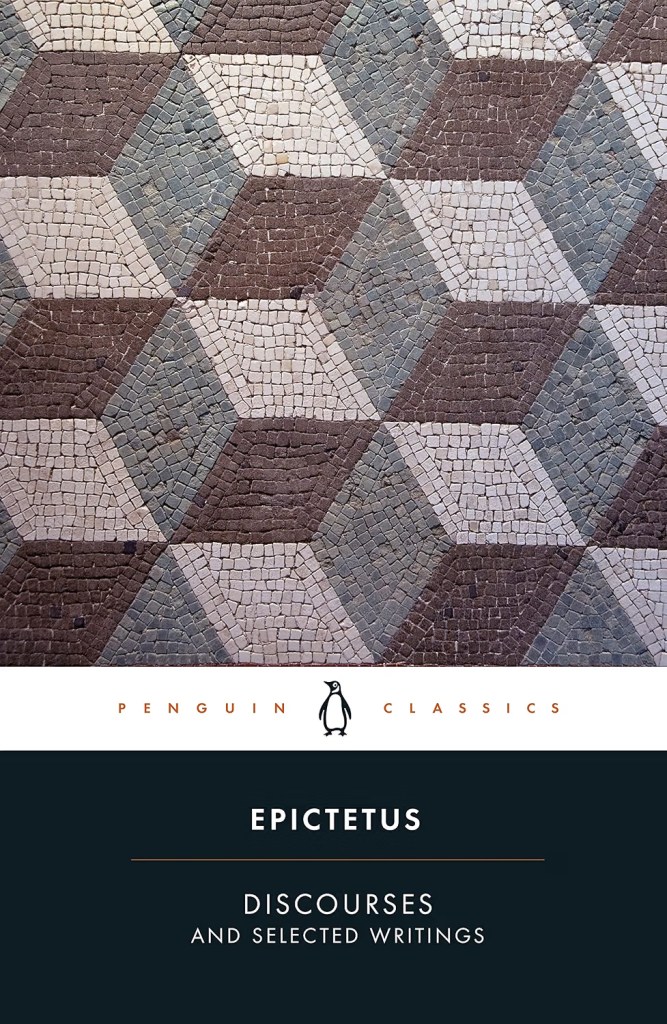
Discourses and Selected Writings
by Epictetus (trans. Robert Dobbin)
Penguin (29 September 2008)
A primer on the principles of happiness, freedom, and living in accordance with nature, the Discourses of Epictetus is seen as a foundational text on Stoicism, cited by people from all walks of life.
There is a saying, the right book at the right time is a powerful thing. For a young Ryan Holiday, that book was the Discourses. Holiday was nineteen, and studying at the University of California’s Riverside campus before dropping out. He had been invited to a summit of college journalists being hosted by Dr. Drew (Loveline, Celebrity Rehab). Holiday asked Dr. Drew if he had any book recommendations, and the doctor recommended Epictetus. From there, a modern Stoicism movement was born. And after all these years, Holiday still quotes Epictetus frequently. Accuse him of shilling books and courses all you want, but he is committed.
I love that story almost as much as the text itself. The appeal of Epictetus — and Stoicism in general — is that it’s not some dense, inaccessible academic work with no practical application (remember the anon who did his PhD on Husserl). It’s the words of a teacher written down by his most famous student, the historian Arrian (whose Campaigns of Alexander is excellent). I started on Stoicism with the Meditations of Marcus Aurelius, after reading Holiday’s posts on the long-defunct Rudius Media forums. It’s the journal of a Roman emperor. Then it was Letters from a Stoic, a collection of moral letters from Seneca to Lucilius Junior. The Discourses of Epictetus came later, and it takes the form of a collection of conversations between a teacher and his students. Three philosophers, three texts, and three vastly differing methods of delivery.
The text is an adult dose. Of all the famous Stoics, he is the most rigid and dogmatic. He’s the teacher, you’re the student, and you’d best listen to what he says. When his students didn’t understand him, he would come down on them like a ton of bricks. So, he’s not easy to get through.
But then, this is a guy who knew a thing or two about handling adversity. Born into slavery in Hierapolis, Phrygia (now modern-day Turkiye), he served a prominent freedman at the court of Nero. After gaining his freedom, he moved to Nicopolis on the Adriatic coast of Greece. This was where he opened his school. Arrian transcribed his lectures, which we enjoy (or endure) today. Still, he lived the rest of his life with a limp. But he chose to see this as only one physical impairment, having no bearing on his philosophy. Philosophy, for him, was simply or “first job” in life, “to divide and distinguish things into two categories: externals I cannot control, but the choices I make with regard to them I do control.”
Just when you’ve written him off as a stuffy old lecturer, he drops a banger like that, and that’s why there is value and inspiration to be found in his works. Plus he can actually be pretty funny at times. I mean at one point he says, “I must die. But must I die bawling?” Maybe that’s closer to what he was like, rather than the stern lecturer known to the public. But, who really knows?
The influence of Epictetus cannot be understated. Not only did he inspire Marcus Aurelius, but also James Bond Stockdale, Frederick the Great, Thomas Wentworth Higginson, Toussaint Louverture, Theodore Roosevelt, Dr. Drew (may as well throw him in too), and others.
“I like to say that Epictetus is your favourite philosopher’s favourite philosopher,” Holiday says. “Like the way we sometimes talk about ‘your favourite rapper’s favourite rapper’ or ‘your favourite comedian’s favourite comedian’ — someone who isn’t necessarily the biggest name, but who is revered by those in the know.”
I like that. Epictetus is to many of history’s greatest what Mr. Bungle was to Korn. Thanks Ryan, I’m going to quote that to my students and pretend I came up with it.
I have the Dobbin translation, which is the standard Penguin edition pretty much everyone reads. It’s a nice little volume, containing two additional texts: Epictetus’s Fragments (surviving pieces of his teaching), and the Enchiridion (Manual, a condensed handbook of Stoicism. If you’re only going through a few sections of the Discourses, the first chapter is the most famous, but I would also recommend “On Progress” as being particularly valuable. Other than that, read it all cover-to-cover, and learn from the man behind the famous quotes rather than just the quotes on your social media feed. Happy reading.
 Lawrence Deveney