
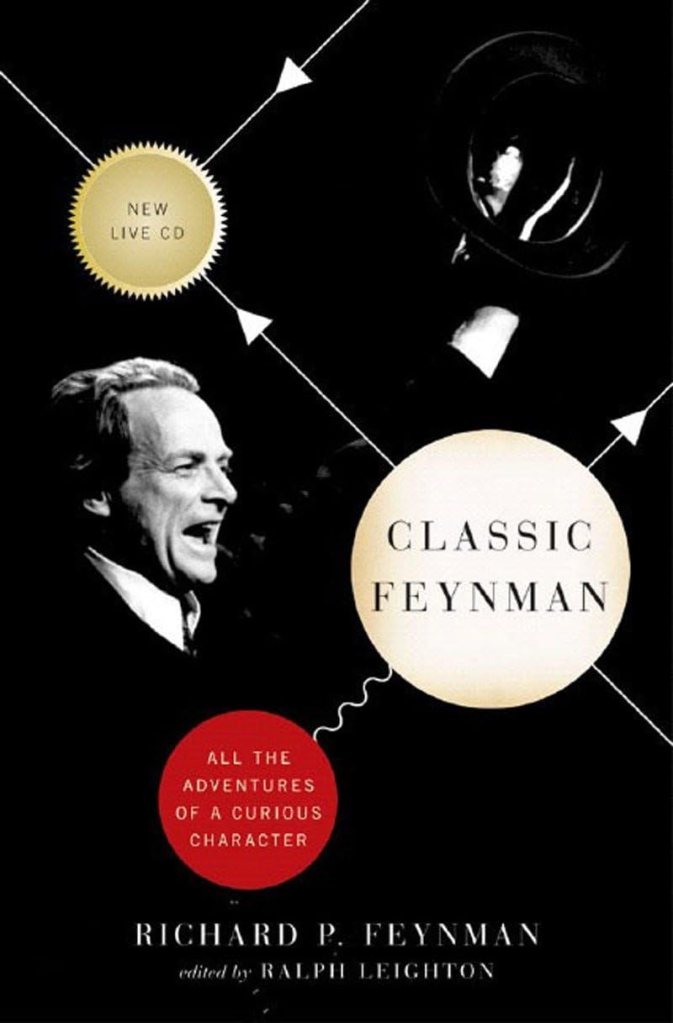
Classic Feynman: All the Adventures of a Curious Character
W. W. Norton & Company (22 November 2005)
Classic Feynman is a single volume containing legendary quantum physicist Richard P. Feynman’s autobiographical works, Surely You’re Joking, Mr. Feynman!, What Do You Care What Other People Think?, and his famous lecture, The Pleasure of Finding Things Out.
Feynman is the kind of public intellectual the world needs right now. His curiosity, independent thinking, simple communication, disregard for social status, and his commitment to intellectual honesty really hit close to home. His guiding maxim, “The first principle is that you must not fool yourself — and you are the easiest person to fool,” is one I will quote until the sun comes up. I know I find it easy to believe things I want to be true. Nobody can fool me as easily as… well, me.
The Feynman Learning Technique is a four-step active learning method that replaces passive memorisation with deep, intuitive comprehension. If only for writing alone, it’s a model I have found invaluable for breaking down complex topics. 1. Pick a topic you want to understand; 2. Explain it to yourself/someone else as if you/they were a child; 3. Identify gaps in your own understanding where you rely on jargon; 4. Review and simplify the source material until the explanation is seamless.
This is the standard I try to follow — write what I know and what I’m comfortable with. Plus, if an author cannot explain their concept simply, then they do they really understand their subject? Unfortunately, I have found this to be the case with far too many books. When I’ve read a book or attended a lecture where the writing is obtuse, or the author/speaker cannot easily explain what they claim to be an expert on, then you have a problem. They’re doing it professionally, so they should be called out on it.
The idea of the “celebrity scientist” is common now, and I can’t help but think that Feynman is needed today more than ever. He was the type of figure who could explain scientific phenomena in a way that might clear up doubt, anxiety, misconceptions, and misinformation in the general public. What a public intellectual should do, something lacking with the likes of Bill Nye or Neil deGrasse Tyson, figures who pander to the cameras for the attention of the IFLScience crowd who fawn over them as serious thinkers.
Tyson in particular seems to just use his intellect to tell people that they should be angry. He’s an astrophysicist by day, and then at night he’s everyone’s drunk uncle on Twitter. In 2016, he proposed forming a new country, “Rationalia,” where “all policy shall be made based on the weight of scientific evidence.” It’s a forced meme, and a myopic, elitist form of government that completely rules out representation, human principles, and checks and balances. He acts like intellect is the be-all and end-all of human thought, when it isn’t. You need both heart and mind in this world, something his terminally online fanbase has yet to grasp.
Then he’ll look at a Hollywood blockbuster and go “This is why [insert blank] can’t happen scientifically.” First of all, no shit. It’s a movie. Secondly, it can. When Star Wars: The Force Awakens came out in 2015, he thought he’d be clever by taking shots at that little soccer ball droid, BB8. The official Star Wars Twitter account responded, very gently explaining that it wasn’t CGI, but an actual robot they built on-set.
The 2010s was a zenith for the likes of Tyson, though now he’s behaving himself a bit. Back to Feynman.
This volume is fantastic. Really, all his works are an example of how books can be entertaining and informative all at the same time. As well as having a brilliant mind, Feynman is an excellent storyteller. His unpretentious style keeps me engaged, and is such a welcome contrast to all the pretentious posturing that characterises the celebrity scientists of the social media age. Would definitely recommend.

