
“When we are no longer able to change a situation, we are challenged to change ourselves.”
-Viktor Frankl
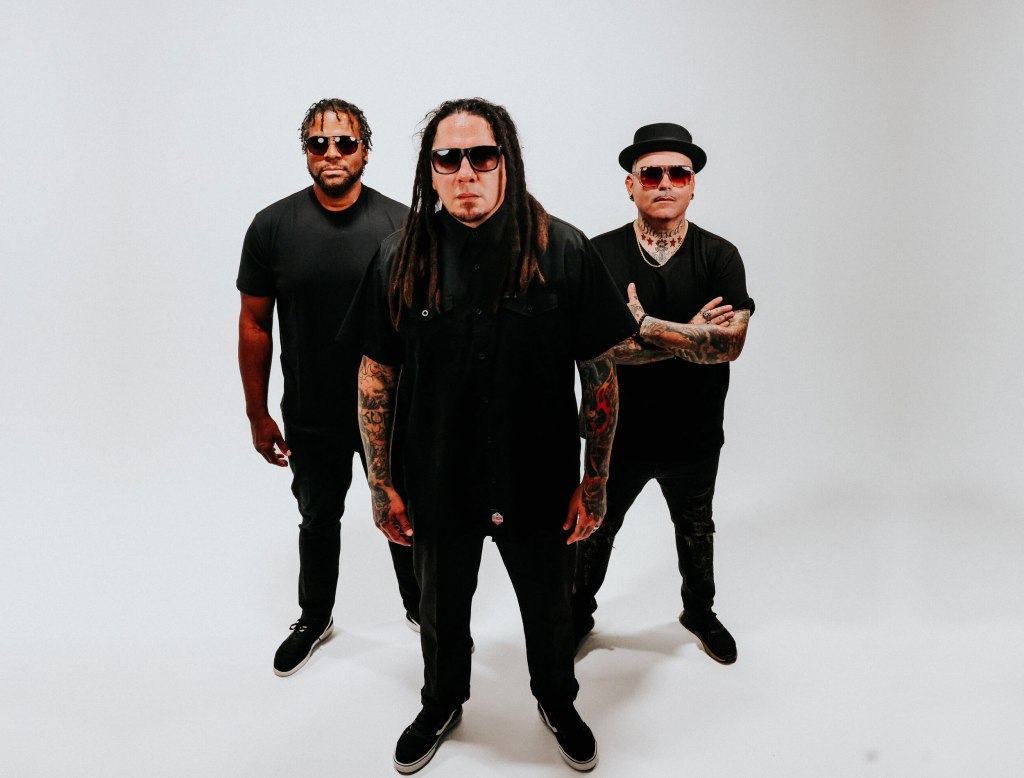
The idea of a Christian nu-metal band always struck me as being a bit contradictory and incongruous, but P.O.D. have made it work somehow. Boasting a rap-rock formula comparable to Limp Bizkit, Linkin Park, and Hed PE, the band spice things up with faith, reggae, and hardcore influences. Their story is one of underground persistence, mainstream success, and survival. I want to look at how they became one of the scene’s most enduring acts.
Formed in 1992 in San Diego, California by vocalist Sonny Sandoval and his cousin, drummer Wuv Bernardo, the band’s lineup was completed with the addition of bassist Traa Daniels and guitarist Marcos Curiel. They set about gigging where and whenever possible — skate parks, house parties, local clubs.
One thing that sets P.O.D. — short for Payable on Death — apart from the nu-metal heap is their Christian faith. Sandoval’s story is probably the most documented, so I’ll focus on him. He came to Christianity through personal tragedy. He grew up in a turbulent family environment in San Diego. Although he was raised as a Catholic, he didn’t have much of a relationship with the faith for some time. Two things happened that changed things for Sandoval. First, his uncle (Bernardo’s father) was involved in drug-dealing until saw the light. Secondly, and perhaps most significantly, his mother was diagnosed with leukaemia, when he was around eighteen years of age. Seeing his mother’s faith, the peace and conviction she maintained while dying, had a huge impact.
Sandoval converted, and after his mother died, he turned away from drugs and self-destruction, wanting to do something more meaningful with his life.
“What doesn’t kill me makes me stronger,” Nietzsche says in Twilight of the Idols. Sandoval’s mother’s illness became this pivotal moment in his spiritual development. I would add that suffering doesn’t automatically make people stronger, what matters is what they do with that experience. Marcus Aurelius wrote in his Meditations, “The impediment to action advances action.” Personal tragedy made part of the foundation on which P.O.D. was built. Hence the adage, “What stands in the way becomes the way.”
And here’s a fun fact: Sandoval never planned on being a professional musician. Bernardo simply invited him to join a band, and Sandoval figured it would be a great way to voice his newfound faith.
“We always keep it open for interpretation, because I never want to sound religious or preachy,” Sandoval explained of his faith, and how he figures it in his music. “It’s kind of like a painting: Twenty people can look at a piece of art and have twenty different interpretations. I believe it’s supposed to speak to your soul. So the same thing with our music.”
They formed their sound very early on, but a lack of commercial interest forced them to release music through Rescue Records, a label formed by Bernardo’s uncle. They release two studio albums on Rescue — Snuff the Punk (1994) and Brown (1996). These early albums have a more overt hardcore influence, and are definitely more preachy, but they did establish the band’s unique hybrid sound.
P.O.D. earned a dedicated local following, particularly in Christian circles, but they still wanted to take their career further. Essential Records offered the band a USD $100,000 recording contract, but they declined. “God has a bigger plan for P.O.D.,” Sandoval said. In 1998, they crossed paths with Atlantic Records A&R guy John Rubeli. Rubeli listened to their demo, and while he didn’t quite get it at first, he signed the band after seeing them play the Roxy on Los Angeles’s famous Sunset Strip.
P.O.D.’s major label debut, The Fundamental Elements of Southtown, was released on 24 August 1999. It peaked at number fifty-one on the Billboard 200 albums chart. Enough fans — referred to unofficially as the “Warriors” — amassed to propel the singles “Southtown” and “Rock the Party (Off the Hook)” into heavy rotation on MTV2. Right in the middle of the rap-rock boom. Korn ruled all over the place, Limp Bizkit were selling millions, and emerging acts like Kid Rock, the Bloodhound Gang, and Disturbed were making waves. It was in this environment that P.O.D. carved their own path.
The band had been working tirelessly for six years, and now they were finally getting somewhere. It wasn’t all smooth sailing from this point, however. Christian retailers took issue with the album’s cover artwork, a painting by Jean Bastarache depicting (possibly) a God-like figure as the centrepiece, while angels tear down the wallpaper. All around, gritty visual elements depict the culture and environment of Southtown, i.e. San Diego. Some objected to the visual details, calling them “Pagan,” and an alternative censored version was released. P.O.D. were too saved for the sinners, but the saved didn’t want them around. Go figure.
Despite this, the album was a success, being certified platinum by the RIAA in November of 2000. The band were quickly establishing themselves as key players in the burgeoning nu-metal scene. They joined Korn on their European leg of the Sick & Twisted tour, before joining the Kings of the Game tour with Hed PE, Linkin Park, and Project 86. The song “School of Hard Knocks” was featured on the Little Nicky soundtrack, while “Southtown” and “Rock the Party (Off the Hook)” also appeared in the film.
The band’s fourth album, Satellite, was released on 11 September 2001. They’d been preparing for a career-defining day, and the album’s release ended up coinciding with an event that fundamentally changed American popular culture, politics, and public consciousness — the terrorist attacks on the World Trade Center. The album release concert for that day was cancelled. Representatives from Atlantic, who had travelled to New York from LA, were now stranded, unable to return home. Sandoval and his bandmates spent time with their families, contacting friends and relatives on the East Coast.
“Everything just stopped,” Sandoval said. “Our record didn’t matter at that point. It was just about being there for each other, and being there for the world if we needed to be.”
Still, in this environment, Satellite was well-received, debuting at number six on the Billboard chart with 133,000 copies sold. The lead single “Alive” was a hit, and has remained one of their most enduring tracks. The chorus is instantly recognisable.
“I, I feel so alive
For the very first time
I can’t deny you
I, I feel so alive
For the very first time
And I think I can fly…”
Sandoval wrote the lyrics for this song while he and his wife were driving on the 405 freeway. He was in the passenger seat, and he would look over at his baby daughter. That moment where one sees themselves in their child, that connection. Just moments of unadulterated joy.
“You always hear people say, ‘He looks just like you,’ and ‘She looks just like you’,” Sandoval explained. “And like forever I never saw that. And everybody’s like, ‘Oh, she’s the spitting image, she looks exactly like you.’ And I just didn’t see it, because it’s just my little baby. And for some reason with the traffic light shining in, I look at her and for the first time I see myself in her. I can finally see it now. And it was like, wow. That was just the moment. That’s almost completely what the song’s about. For the very first time I see myself in my daughter. It was a beautiful moment.”
Seneca said, “It’s not that we have a short time to live, it’s that we waste a lot of it.” Time spent with your baby is the furthest thing from time wasted, and “Alive” captures this perfectly. And gratitude for all things — relationships, opportunities, or simply being able to breathe. Simple things we tend to take for granted.
Many nu-metal/rap rock bands of the day would sing, scream, growl and rap about their tortured souls, but “Alive” was this nice little ray of sunshine in the middle of all that. The song was already a hit, released before September, but after the attacks, its message about appreciating life started to resonate with people on a whole other level.
The second single was “Youth of the Nation,” which became a different kind of anthem, reaching out to a generation impacted by mass shootings. The band were recording Satellite earlier that year, and one day in March, they were on their way to the studio but were held up in traffic. The reason was a mass shooting at Santana High School, where a fifteen-year-old student had killed two people and wounded thirteen. This inspired the track, which may just be as recognisable as “Alive.”
Two further singles were released from Satellite. “Boom” was accompanied by a video depicting the band in a table tennis competition with Swedish Christian metallers Blindside. The video for “Satellite” contained live footage, as well as a separate performance filmed in the woods. The album is also notable for its guest artists, including Eek-a-Mouse on “Ridiculous,” Christian Lindskog of Blindside on “Anything Right,” and H.R. of Bad Brains on “Without Jah, Nothin’.” In addition to being excellent tracks, they should also give the listener an idea of the band’s broad range of influences. And though it wasn’t released as a single, “Portrait” was nominated for a Grammy.
The band spent all of 2002 touring for Satellite, even playing on the main stage at that year’s Ozzfest, alongside Ozzy Osbourne, System of a Down, Rob Zombie, Drowning Pool, Adema, and Black Label Society. Satellite was ultimately certified triple-platinum, for sales of over three-million in the States. While other acts in the nu-metal genre were starting to flounder, slowly being jettisoned by radio and music television, P.O.D. and Linkin Park were the two artists I remember that still managed to hold their own and get a lot of airtime during that year. Chalk it up to creating a sound that’s uniquely your own.
By early 2003, it seemed like anything was possible for P.O.D. However, on 19 February, the band announced that guitarist Curiel had left. He was replaced with Jason Truby, formerly of Living Sacrifice. Fans got a taste of this revamped line-up when the band contributed “Sleeping Awake” to the soundtrack for The Matrix Reloaded. The video tied in with the film perfectly, depicting the band in the film’s simulation and “real world.”
Released on 4 November 2003, Payable on Death introduced a somewhat darker, more straightforward rock sound, as exemplified on singles like “Will You,” and “Change the World.” This was in part due to Truby’s style and influence on the group. Like Limp Bizkit’s Results May Vary, P.O.D.’s self-titled isn’t the fan favourite, but it’s one that some of us hold onto, and appreciate for what it is. One thing that interests me is that while the band may have snipped the rap element from their hybrid formula, the reggae influence remained. Deep cuts like “Wildfire,” “Execute the Sounds,” and “Freedom Fighters” integrate that element seamlessly. It made for a more considered alternative metal sound that was nothing like the floundering nu-metal scene. In that light, this album has its value.
Testify saw Truby more integrated into the band, and the band returning to their more hip-hop-oriented roots, as seen in the tracks “Goodbye for Now,” “Lights Out,” and “Roots in Stereo.” I can’t say I loved it as much as the self-titled album, but I think it’s a very solid body of work that deserves some recognition. Although, its legacy may have more to do with a then-unknown Katy Perry’s guest appearance on the lead single than the album itself.
[Aside: I have written more about both of these albums here and here.]
At the end of 2006, the band finished their deal with Atlantic, releasing the compilation Greatest Hits: The Atlantic Years. Truby departed shortly after, and Curiel made his return. The reunited classic line-up recorded their seventh studio album, When Angels & Serpents Dance. It wasn’t the hit previous albums had been. Mainstream success was now behind P.O.D. While they retained their core fanbase, some wondered what was next for them.
The band went on a hiatus, before returning in 2012 with the release of their eighth studio album, Murdered Love. Howard Benson was once again brought in to handle production duties, making for a product that had much more fanfare than its predecessor. The lead single, “Lost in Forever (Scream),” was a success, and currently sits on ten million views on YouTube. “Higher” and “Beautiful” pushed the album through the following year, and with the modern nu-metal revival, P.O.D. have not only survived the ups and downs of the mainstream, but have taken pride of place as a timeless act.
Since then, P.O.D. have released three more albums — The Awakening (2015), a concept album of sorts; Circles (2018), which marked a return to some of their earlier musical characteristics; and Veritas (2024), which features some pretty awesome collaborations, including Lamb of God frontman Randy Blythe on “Drop,” Tatiana Shmayluk of Jinjer on “Afraid to Die,” and Cove Reber of Dead American on “This Is My Life.” The band have continued to record and tour, with Sandoval, Daniels, and Curiel forming the core lineup. Bernardo has been on hiatus since 2021, citing burnout from years of touring.
“If the conditions don’t suit you, leave,” Epictetus said. If you’re in a band for so many years, then nobody can blame you for feeling tired or just wanting to go somewhere else. Former Suicide Silence drummer Alex Lopez filled in from 2022 to 2024, and Zachary Christopher has been manning the kit full-time since.
The key to P.O.D.’s longevity is easily understood in principle, though difficult for a band to achieve in practice: a unique identity that transcends any musical trends or scenes. Yes, their mainstream breakthrough happened during the nu-metal boom of the early 2000s, but they also had characteristics that were uniquely theirs. They never set out to write music that was self-consciously aggressive, fashionable, or commercially viable. They just did what came naturally.
For a non-religious person, the band’s spiritual edge has always been something that sets them apart. That came through in lyrics of hope, redemption, perseverance, gratitude. But at the same time, these things are also part of the human condition, independent of what one believes. To me, “Alive” is simply about gratitude. “Youth of the Nation” examines violence and the consequences of neglect. Nothing preachy about them. I love that I can share in the enjoyment of these songs without sharing the band’s theology.
It also helps that P.O.D. spent years cultivating not only their sound, but also their core fanbase, who deserve a mention. Slipknot have their “Maggots,” Kiss have their “Army.” P.O.D. refer to their fans as the “Warriors.” No corporate branding, not a gimmick from the record label, it was something Sandoval came up with onstage. During the band’s early days, he would wear tribal face paint when performing onstage. Between songs, he would tell the audience, “It takes a warrior to grow up these days in the world.”
Whatever the audience’s beliefs, it resonated as being about conviction and standing up for yourself. And the word stuck. The fanbase began identifying as the Warriors, and this became the official unofficial name for the P.O.D. community. It became a grassroots movement of sorts, functioning as a street team making promotional artwork, putting up posters, handing out flyers, and so on. It was them who rallied to propel singles like “Alive” into heavy radio and TV rotation. Mainstream listeners would enjoy Satellite and move onto the next current thing, but the Warriors are the ones who have always stuck around, regardless of album sales. They identify with the band’s message in a different way. Me personally, I feel like I sit firmly in the middle. Not a Warrior per se, but when the band release a new album, I make the time to sit down and listen.
There’s also the band’s broader appeal. From an outsider’s point of view, one might think of a Christian band as some goofy dudes singing kumbaya songs or whatever. Not the case. They can throw down with the best, and have appeared at festivals and on tours with artists who are very NOT religious. Ozzfest, punk venues, skateparks and house parties in the earliest days. Wherever they go, they seem to fit in just fine.
Plenty of bands sell records and get streaming numbers. Few get respect and longevity. P.O.D. have managed to enjoy both, and they deserve every bit of their success.

