
“No man ever steps in the same river twice, for it’s not the same river and he’s not the same man.”
-Heraclitus
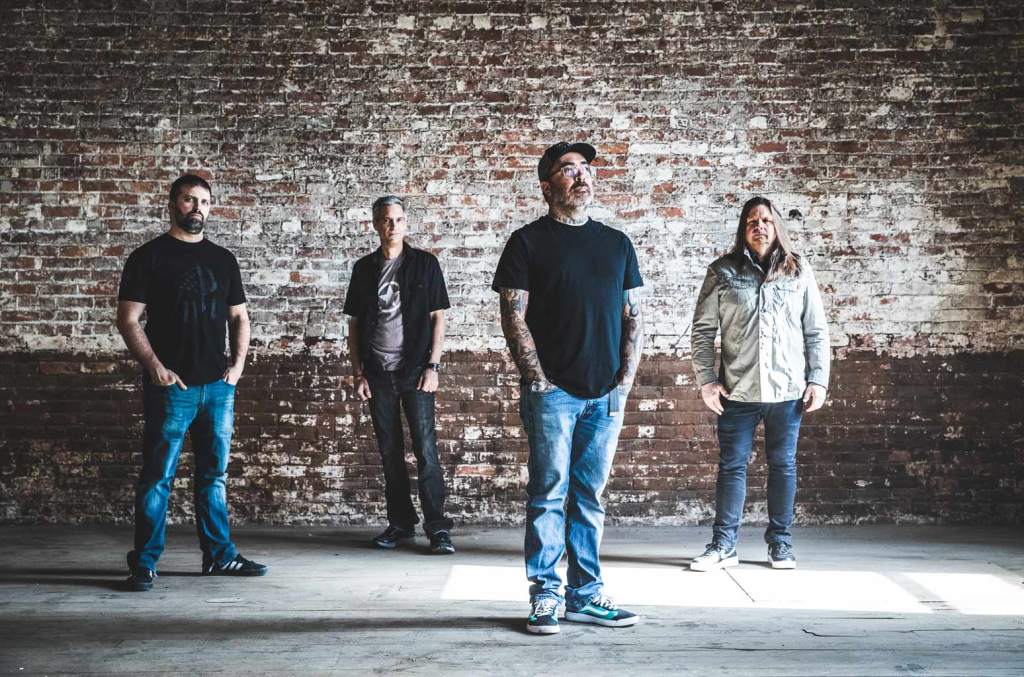
The term “nu-metal” has been applied to so many different-sounding bands that the meaning kind of gets lost. And yet, one of the key players of the genre is Staind. Known for their acoustic ballads, downtuned riffs, melodic choruses, and emotional lyrics with a greater emphasis on introspection than their supposed peers.
Formed in Springfield, Massachusetts in 1995, Staind’s classic line-up was comprised of vocalist and guitarist Aaron Lewis, guitarist Mike Mushok, bassist Johnny April, and drummer Jon Wysocki. They set about playing local clubs, and in addition to their own material, they performed covers of songs by Korn, Rage Against the Machine Tool, Pearl Jam, Alice in Chains, and other influences. Extensive touring of the Northeast region earned the band a dedicated local following, and they released an independent album, Tormented, in 1996.
Tormented is notable for a number reasons. I don’t know if you could really call it a demo, but it is a snapshot of a band in a pre-fame era, and something rawer and darker than anything they’d done since. The lyrics are nothing if not angst-ridden, based on Lewis’ life growing up. It contains an original version of “Mudshovel,” which was later rerecorded for their major label release, 1999’s Dysfunction. “Four Walls” is noticeably softer, while “Come Again,” “Break,” and “Tolerate” were early live favourites.
The album was self-financed by the band and distributed locally and at gigs, promoted via word-of-mouth and through their website. It has since become an important artefact for dedicated fans, and a part of the genre’s mythology, like Fred Durst’s baseball cap.
Speaking of the Limp Bizkit frontman, Durst’s first encounter with Staind is nice little piece of nu-metal lore. In October of 1997, the band found themselves in a support slot for Limp Bizkit in Hartford, Connecticut, thanks to a connection in the form of Lewis, cousin. Durst, a rather pious fellow at the time, saw the cover artwork for Tormented — depicting a bloody Barbie doll on a crucifix with nails hanging from a plastic frame, a buried person with a rosary protruding from their nose, and a knife impaling a Bible — and freaked out. Believing Staind to be Theistic Satanists, Durst attempted to have them removed from the bill. Mushok tried to reason with him, explaining that the cover was meant to portray the mind of someone going through a dark time.
“That artwork depicted where I was at in my life,” Lewis said in a 2001 interview with Rolling Stone. “I had lost faith in everything, from religion to love to life.”
Staind’s music frequently deals with emotional pain, regret, and the desire to move forward. And while there’s rarely any sort of nice, neat resolution in the lyrics, listeners have identified with Lewis’s words. Lived experience given an outlet, that’s the appeal. Anyway, Durst cooled off, and Staind were not booted from the concert. Hearing the band, the Limp Bizkit frontman immediately reversed his position. In fact, he was so impressed by the band’s performance, that he signed them to Flip/Elektra in February of 1998, and helped them record Dysfunction.
A more commercially viable offering than Tormented, Dysfunction was produced by Durst and Terry Date. It exposed the band to a wider audience and establish their sound that we know today. Heavy, but with more emphasis on melody this time. “Mudshovel” underwent a little reconstruction. The song was a hit on rock radio, as were “Just Go” and “Home.” And of course, the album’s deep cuts. “Suffocate,” “Spleen,” “A Flat,” “Crawl,” and “Raw” are all excellent, and gave us a mainstream debut with a fully-formed sound.
Dysfunction was released on 13 April 1999. It peaked at number seventy-four on the Billboard 200 albums chart, but the band quickly grew in popularity, and it was certified double-platinum in the States. The Durst connection got them on some pretty big tours that year, most notably the Family Values Tour 1999. A travelling music festival founded by unofficial Bizkit mentors Korn, that year’s instalment featured Limp Bizkit as headliners. Filter, Primus, Method Man & Redman, the Crystal Method, and others opened at various points. Korn even made a few surprise appearances, as they had just wrapped up their fourth album, Issues.
It was during Family Values that Lewis debuted “Outside.” Lewis had been working on this song for a while, hadn’t finished writing the verses, but had the chorus down. Durst loved what he’d heard so much that he encouraged Lewis to perform what he had live. The decision was supposedly made ten minutes before Staind even took the stage. No pressure at all! But Lewis did it, giving the world the now-famous version in Biloxi, Mississippi. Lewis played acoustic guitar and sang, improvising most of the lyrics, while Durst contributed backing vocals. The crowd went nuts for it, and it was included on the tour’s accompanying CD/DVD release. Think about it: the song that propelled the band to superstar status was almost entirely an improvised performance.
The lyrics capture a particular feeling, that of being surrounded by people but feeling completely alone. Trying to fit in, trying your best, but never finding your place. The chorus begins:
“But I’m on the outside, I’m looking in…”
Never quite fitting in, and the frustration and disappointment that follows. Then there’s the moment you realise that the people you’re trying to fit in with are not what they seem. The chorus continues:
“I can see through you, see your true colours,
‘Cause inside you’re ugly, you’re ugly like me,
I can see through you, see to the real you…”
It’s an experience many people know, and it’s why the song resonated with so many.
“You have power over your mind — not outside events. Realise this, and you will find strength,” Marcus Aurelius wrote in the Meditations. With Staind, this unfinished song suddenly became a phenomenon beyond expectations. That the crowds would react the way they did was not something they ever imagined, but now here they were. This new band that were opening for Limp Bizkit were suddenly one of the hottest acts in the world.
But Staind were not done with the road just yet. They began 2000 by joining Korn for their Sick & Twisted tour, which also featured animated shorts from Spike and Mike’s Sick & Twisted Festival of Animation. Lewis and co. opened for the Bakersfield boys on the tour’s first American leg. For fans, it was cool to see these worlds collide. Korn helped Limp Bizkit get off the ground, and Limp Bizkit did the same for Staind. It was only a matter of time before Korn and Staind crossed paths.
After that, they joined MTV’s Return of the Rock tour, before heading to the studio to record their third album.
Produced by Josh Abraham, Break the Cycle is an incredible body of work. This was the one that propelled Staind to superstar status, and remains a fan favourite to this day.
The live acoustic rendition of “Outside” had made for a nice little bridge between albums, but now the band had the opportunity to record a far more ambitious version of the ballad. It wasn’t just this one song either; the album saw Lewis give the acoustic guitar a solid workout, which really set Staind apart from the herd. Ever display the slightest aptitude for something at work — mathematics, perhaps — that you become the office’s designated guru in that thing? Well, Lewis made such an impression strumming his acoustic that it seemed like every kid in baggy jeans was screaming “more!”
The band hadn’t thrown out the heavy side of things completely. But whatever the heaviness of each track, the album feels completely coherent, every song blending perfectly. The studio version of “Outside” and lead single “It’s Been Awhile” propelled the album’s success, as did subsequent singles “Fade,” “For You,” and “Epiphany.” Deeper cuts like “Pressure,” “Can’t Believe,” “Suffer,” and “Waste” were equally worthy.
Break the Cycle was released on 8 May 2001, debuting at number one on the Billboard chart, selling around 717,600 copies in its first week. The album was a multiplatinum success, selling nearly five-million copies in the US alone, and established Lewis as one of the most prominent voices in mainstream rock. It topped the charts in the UK, Canada, and New Zealand, and was certified platinum in several markets. “It’s Been Awhile” spent a total of sixteen and fourteen weeks on top of the Billboard Modern and Mainstream rock charts respectively, which was… nothing short of phenomenal.
It was also during this era that Staind did their MTV Unplugged set. Filmed in Times Square, New York, with Cold guitarist Terry Balsamo lending a hand, it’s a great performance. The transition to all-acoustic was so seamless; to me, it’s one of the best Unplugged sets ever. I mean, look at the people in the audience, singing along with the lyrics, completely transfixed by Lewis’s words. It’s amazing to watch.
Staind saw out the year by joining the Family Values Tour 2001. This was the only instalment not to feature founders Korn at all, as they were working on their fifth album, Untouchables. Stone Temple Pilots headlined, with Linkin Park, Static-X, Deadsy, and Spike 1000 also serving as openers. Lewis appeared to be the star of the accompanying CD. “Fade” and “It’s Been Awhile” are featured, as was Lewis’s solo rendition of Pearl Jam’s “Black,” and his assisting Stone Temple Pilots on “Creep,” and Linkin Park on “One Step Closer.”
Break the Cycle was Staind’s bestselling album, so by the time they were done touring for it, they had enough clout to take their time writing new music. Josh Abraham returned as producer for their fourth album, and the band spent a week developing songs at his house. Staind would go even further into melodic and acoustic-driven territory. So-called nu-metal was on the way out by that point, plus Lewis and his wife having a child probably changed his direction a little.
Released on 20 May 2003, 14 Shades of Grey marked the band’s second number one debut on the Billboard chart, with 221,000 copies sold. “Price to Play” and “So Far Away” were rock radio hits, with the latter reaching number six on the Mainstream Rock Tracks chart. “How About You” also saw some success, while the fourth and final single, “Zoe Jane,” was about Lewis’ daughter, and the bittersweet feelings seeing her before returning to the studio. “Yesterday” recalls the band’s heavier roots. “Layne” pays tribute to one of the band’s idols, Alice in Chains frontman Layne Staley, who died in 2002 of an overdose after years of living in self-imposed exile.
Continuing the evolution of 14 Shades of Grey, Chapter V was the band’s third number one debut on the Billboard chart, with first week sales of 185,000 copies. This one was a bit more varied, with David Bottrill (Tool, Godsmack) taking the production reigns. Some tracks still have that heavier side to them, while others convey messages of hope and uncertainty. “Right Here” was the album’s biggest hit, followed by “Falling,” “Everything Changes,” and “King of All Excuses.” As usual, the album’s deep cuts did not disappoint. “Paper Jesus” took aim at music industry executives who value money and output over expression, while “Reply” served as an open letter response years of fan mail received by the band.
On 14 November 2006, band released the compilation, The Singles: 1996-2006. In addition to the band’s hit singles, it contained live tracks performed at the Hiro Ballroom in New York, as well as a rerecorded version of “Come Again” from Tormented.
If you’ll permit me the use of my nerd glasses, I’d like to focus on Mushok’s use of baritone guitars. He uses baritones almost exclusively, and plays in many different tunings. In the early days of Staind, he played Ibanez. In 2003, they released his signature model, the MMM1. Based on the SZ series body shape, it featured a twenty-eight inch scale, neck-through construction, Ibanez Super 58 Custom pickups, and a Gibraltar Custom bridge specifically introduced for this model. To this day, there’s no other Ibanez model like it.
At some point after the Chapter V cycle, Mushok switched to Paul Reed Smith (PRS) guitars. They developed his second signature, the SE Mike Mushok Baritone. It’s been his main instrument ever since it was released in 2008. It features a 27.7-inch scale and twenty-two frets, ebony fretboard, and a fixed string-through bridge. Originally, it was only available in a silverburst finish, but later it came in brown burst, and a smaller number in vintage cherry. This model was discontinued in 2014, but it was well-received by professionals and the general public alike. He also had a couple of seven-strings custom made in 2011, since he needed the extra space for soloing. There are other models in his rig, but his baritones and sevens get played the most.
For amplification, Mushok uses a Marshall JMP-1 preamp with an EL34 100/100 power amplifier in his live rig. He combines those with a Diezel VH4, through which he runs his effects. Chorus, flanger, phaser, and delay effects have always come from a multi-effects unit, most notably the Lexicon MPX G2.
The band took a bit of a break, and on 19 August 2008, they released The Illusion of Progress. Johnny K (Disturbed) was brought in to produce the album, which was more bluesy than anything they’d done previously. The album peaked at number three on the Billboard chart, ending their number one run. “Believe” was the lead single, followed by “All I Want,” “The Way I Am,” and “This Is It,” the last of which was featured on the soundtrack for Transformers: Revenge of the Fallen.
On 13 September 2011, they released their self-titled album. The lead single, “Not Again,” dropped in July of 2011 and did nicely on the charts. The official video was released in August. “Eyes Wide Open,” “Now,” and “Something to Remind You” also got some decent airtime. “Failing,” “Throw It All Away,” and “Paper Wings” rounded out the selection of deep cuts. “The Bottom” featured on the soundtrack for Transformers: Dark of the Moon (noticing a pattern here). The album’s sessions were a labour for the band, mostly due to Lewis wanting to focus on his solo career. Wysocki and Lewis butted heads all throughout, leading to the drummer’s departure in May of 2011.
The album debuted at number five on the Billboard chart. Evanescence drummer Will Hunt filled in for Wysocki very briefly, before the band recruited Sal Giancarelli as a full-time member. Meanwhile, Wysocki joined Chicago alt-metal outfit Soil. Staind toured throughout 2011 and into early 2012, before announcing that they were going on hiatus.
Maybe they just needed a break from each other. During this time, Lewis concentrated on his solo career, which has gone in a traditional, politically conservative direction. And not “conservative” in the sense of market regulations, trade policy, law and order, or property ownership (a la Edmund Burke). Rather, Lewis has gone the populist route, sporting a #MAGA cap and speaking out against COVID mandates.
His prerogative, sure, but it’s rubbed a lot of people the wrong way. It’s the world we live in, people tend to be all-or-nothing when it comes to their political stances.
“If you want to improve, be content to be thought foolish and stupid,” Epictetus once said. Lewis’s statements and political stances have drawn a lot of criticism, a good chunk of it coming from his own fans. Whether Lewis agrees with this is a different matter. What should he do? Does the artist organise his identity around the approval of an audience? Right or wrong, allowing the crowd to dictate your choices is a form of dependence. Popularity isn’t the same as having integrity, et cetera.
Meanwhile, Mushok joined Saint Asonia. An alt-metal supergroup of sorts, with former Three Days Grace vocalist Adam Gontier, Eye Empire bassist Corey Lowery, and Finger Eleven drummer Richie Beddoe. He also became a member of Newstead’s touring line-up, so he’s definitely kept himself busy.
In September of 2019, it was announced that Staind would reunite to play some shows. Some festival appearances were planned for 2020, but COVID completely derailed that. The band announced the Evening with Staind tour in April 2022, and in 2023, they released their eighth studio album, Confessions of the Fallen. Their first in twelve years, the band added in some programming and synthesisers, but nothing too drastic. Just something in the background to keep things fresh. It was still Staind in every sense of the word. Dark, heavy, and introspective. “Lowest in Me” was the lead single.
In May of 2024, it was announced that founding drummer Wysocki had died at the age of fifty-three from “issues with his liver that required him to be under the care of medical professionals.” That sucked, big time. It doesn’t feel good to see some of your favourite musicians departing this realm, but I suppose it’s inevitable.
The band have continued to tour since, and will release their ninth studio album, The Space Between the Darkness and the Light, on 5 March 2027. The single “Ghosts” was released this October, and is currently sitting on a healthy 1.4 million views on YouTube. And just a week ago, as the artwork and track list were revealed, the angst-driven “Watch Me Break” was released as the second single.
Whatever you think of them, Staind are an interesting case study in the history of nu-metal and alternative rock. They emerged from the same scene as Korn and Limp Bizkit, but their identity became increasingly centred on the acoustic ballad. Retaining some core elements of their sound, they’ve managed to evolved and shake things up. What the future holds for them remains to be seen, but they have an amazing ability to create chart-topping rock hits.

