
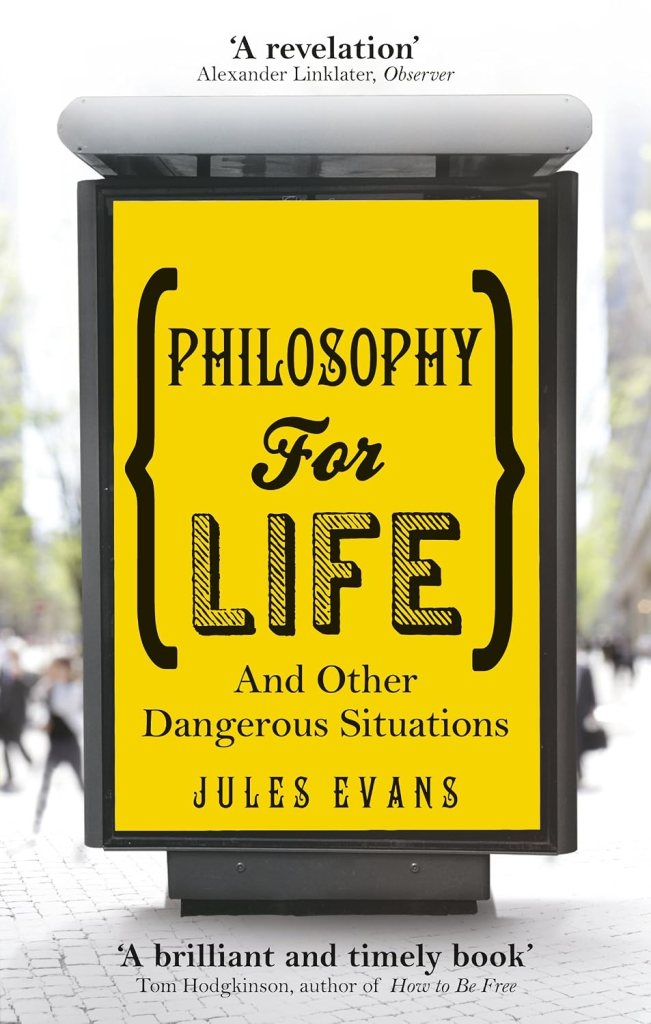
Philosophy for Life and Other Dangerous Situations is another book for those getting into the Stoicism 2.0 movement. Its thesis is simple: Ancient philosophy was never intended to be an academic subject, but a toolkit for living. Author Jules Evans examines what happens when we take this idea seriously in the modern world.
Evans didn’t find philosophy because he was bored. He was going through an actual crisis, and found that cognitive behavioural therapy (CBT) helped him immensely. He noticed that some of the techniques used had a lot in common with ancient Stoicism. He started investigating, and the whole thing became a rabbit hole, giving us this book. Interviews with Albert Ellis and Aaron Beck revealed that ancient philosophy really was influential on CBT, and this fascinated Evans. And this text poses the question, what if ancient philosophers were teachers at some modern school of life?
So the text is unique, but I still can’t help but compare it to some of my favourites. Ryan Holiday’s books (The Obstacle Is the Way, Ego Is the Enemy, The Daily Stoic) combine historical example with storytelling and Stoic interpretation to provide a simplified contemporary application for the everyperson. Donald Robertson (How to Think Like a Roman Emperor) directly integrates Stoicism with CBT. Evans’s scope is wider, and his focus is more exploratory than anything. His book is structured like a series of conferences where philosophers are teaching courses. Socrates, Epictetus, Musonius Rufus, Seneca, Epicurus, Heraclitus, Diogenes, Plato, Plutarch, Aristotle, and the Sceptics make up the faculty.
If only it were like this in real life. One of my biggest gripes with philosophy as a discipline is that it doesn’t teach philosophy as much as it teaches you about philosophers. Maybe it was just the lecturers and tutors I had, but it definitely seemed that way to me (those who taught Critical Thinking and Logic being exceptions). Yes, it’s very entertaining to hear about the time Wittgenstein went ballistic and confronted so-and-so with a fireplace poker for some perceived slight, but that’s not why we take out those HECS loans. We want to learn how to read the texts. We want to dig deep and explore the big ideas. And there’s always that one dickhead in every tutorial who thinks he’s hilarious by bringing up that Monty Python philosopher song, and… I’m getting distracted again. Evans has the right idea. He asks how real modern people are attempting to use philosophical ideas, and that’s what sets his work apart from the more conventional history-of-philosophy books out there.
That Evans isn’t a Stoic evangelist is a breath of fresh air. You could say Epictetus is the MVP of the text, and Evans is fascinated by the influence of Stoicism on CBT, but they’re not the only ones. Epicureanism, Cynicism, Scepticism, Aristotelianism, and the Socratic method may disagree with one another, but together they make for an ancient philosophical toolkit so you can avoid a single doctrine. Good, I say, AncientWisdom™ shouldn’t be reduced to a homogenous substance. That the book came out in 2012 — right before Stoicism 2.0 blew up — is great too.
Philosophy for Life and Other Dangerous Situations is definitely worth reading. If you’ve come to philosophy via Stoicism 2.0 and want to see what else there is, it’s a great addition to your collection. It doesn’t tell you which school to believe, but simply drives home the point that philosophy is something to be practised.

