
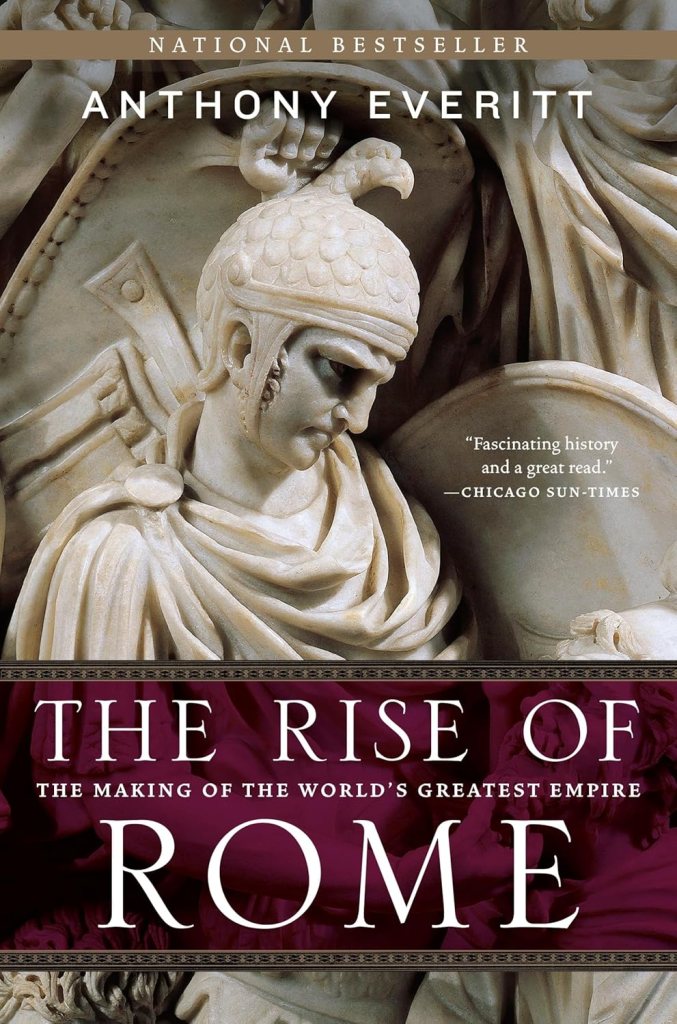
The Rise of Rome: The Making of the World’s Greatest Empire
by Anthony Everitt
Random House (12 November 2013)
Not to be confused with Livy’s text, Anthony Everitt’s The Rise of Rome is a great book on how Rome became Rome. A modern account, ideal for those might want to bypass the countless biographies of Caesar and Augustus.
Spanning a little over five-hundred pages, Everitt starts with the foundation of Rome, through the Republic, and ultimately to Caesar’s victory and Augustus’s transformation from the Republic into the imperial government. It’s definitely a worthwhile subject. Exactly how does a relatively obscure city-state become the dominant power of the Mediterranean? It wasn’t just that they had a good army (though that helps). Other factors included political institutions, military organisation, Roman citizenship, class conflict, colonisation, infrastructure and engineering, political culture, individual ambition, and the enormous wealth generated by conquest. I’m probably missing a few things, but those are the main ones.
Part of the text’s appeal is its conventional chronological history, which is nice and neat. Its history of Roman power transformation is where things really get interesting. The chronology is fascinating, almost like a political drama. Beginning with mythology — Aeneas, Romulus and Remus, the kings — then moving into the better-documented Republic. Everitt gives us an enormous sweep, and though the title is the “Rise of Rome,” the text has just as much to do with the Republic undermining the political conditions that made its success possible. That’s what makes it so interesting.
Rome as a military machine is awesome; I could read about it for days. For those with an interest in philosophy, the text’s dark turn on success becoming the problem makes it even more fascinating. It would be so easy to look at Rome as going from nothing to something, or weak to strong to strongest. Everitt looks at the virtues that allowed the Republic to succeed, and then the changing environment in which such virtues operated. Civic duty, military service, discipline, reason, compromise, honour, etc. The conquest of the Mediterranean may have brought untold wealth and massive states, but what happens when institutions are no longer powerful enough to contain the individuals they’ve created? Those virtues are corroded, and reason and compromise are replaced by violence and civil war.
The Rise of Rome shows how deeply connected philosophy can be to ancient politics, a refreshing change of pace from books on the might of military institutions, as awesome as those texts may be. I would also recommend other works by Everitt, including Augustus, Cicero, and Hadrian and the Triumph of Rome. Great reading for those who like to think about the Roman Empire.

